Sovi.AI - AI Math Tutor

Scan to solve math questions

QUESTION IMAGE

question 9 of 10 what types of body language are helpful when saying no…

Question

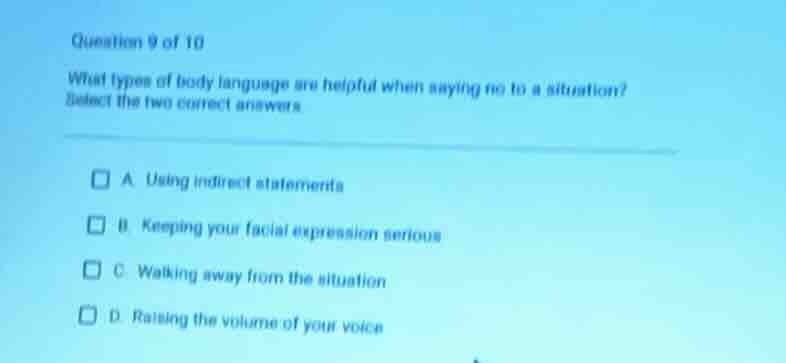
question 9 of 10

what types of body language are helpful when saying no to a situation? select the two correct answers.

a. using indirect statements
b. keeping your facial expression serious
c. walking away from the situation
d. raising the volume of your voice

Explanation:

Response

<pre_analysis>
{
"quality": "clear",
"question_count": 1,
"skills_matched": [
"direct_cot",
"multiple_choice_formatter",
"explain_then_answer",
"tutor"
],
"needs_drawing": false,
"concepts_used": [
"Conflict Resolution Steps"
],
"new_concepts": [
"Refusal Skills",
"Assertive Communication"
],
"current_concepts": [
"Conflict Resolution Steps",
"Refusal Skills",
"Assertive Communication"
]
}
</pre_analysis>

<reasoning>

Analyze the question requirements

The question asks to identify two types of body language or non-verbal actions that are helpful when saying "no" to a situation (refusal skills).

Evaluate Option A

"Using indirect statements" is a verbal communication style, not body language. Furthermore, indirect statements weaken a refusal.

Evaluate Option B

"Keeping your facial expression serious" is a non-verbal cue. A serious expression reinforces the verbal message "no" and shows determination, which is a key part of Conflict Resolution Steps and assertive refusal.

Evaluate Option C

"Walking away from the situation" is a physical action/body language that clearly communicates a firm refusal and removes one from pressure.

Evaluate Option D

"Raising the volume of your voice" is a verbal/vocal tone adjustment, not body language, and can escalate conflict rather than resolve it calmly.
</reasoning>

<answer>
<mcq-option>A. Using indirect statements</mcq-option>
<mcq-correct>B. Keeping your facial expression serious</mcq-correct>
<mcq-correct>C. Walking away from the situation</mcq-correct>
<mcq-option>D. Raising the volume of your voice</mcq-option>
</answer>

<post_analysis>
{
"subject": "Social Science",
"question_type": "Multiple Choice",
"knowledge_point": [
"Social Science",
"Psychology",
"Assertive Communication and Refusal Skills"
]
}
</post_analysis>

Answer:

<pre_analysis>
{
"quality": "clear",
"question_count": 1,
"skills_matched": [
"direct_cot",
"multiple_choice_formatter",
"explain_then_answer",
"tutor"
],
"needs_drawing": false,
"concepts_used": [
"Conflict Resolution Steps"
],
"new_concepts": [
"Refusal Skills",
"Assertive Communication"
],
"current_concepts": [
"Conflict Resolution Steps",
"Refusal Skills",
"Assertive Communication"
]
}
</pre_analysis>

<reasoning>

Analyze the question requirements

The question asks to identify two types of body language or non-verbal actions that are helpful when saying "no" to a situation (refusal skills).

Evaluate Option A

"Using indirect statements" is a verbal communication style, not body language. Furthermore, indirect statements weaken a refusal.

Evaluate Option B

"Keeping your facial expression serious" is a non-verbal cue. A serious expression reinforces the verbal message "no" and shows determination, which is a key part of Conflict Resolution Steps and assertive refusal.

Evaluate Option C

"Walking away from the situation" is a physical action/body language that clearly communicates a firm refusal and removes one from pressure.

Evaluate Option D

"Raising the volume of your voice" is a verbal/vocal tone adjustment, not body language, and can escalate conflict rather than resolve it calmly.
</reasoning>

<answer>
<mcq-option>A. Using indirect statements</mcq-option>
<mcq-correct>B. Keeping your facial expression serious</mcq-correct>
<mcq-correct>C. Walking away from the situation</mcq-correct>
<mcq-option>D. Raising the volume of your voice</mcq-option>
</answer>

<post_analysis>
{
"subject": "Social Science",
"question_type": "Multiple Choice",
"knowledge_point": [
"Social Science",
"Psychology",
"Assertive Communication and Refusal Skills"
]
}
</post_analysis>