QUESTION IMAGE
Question
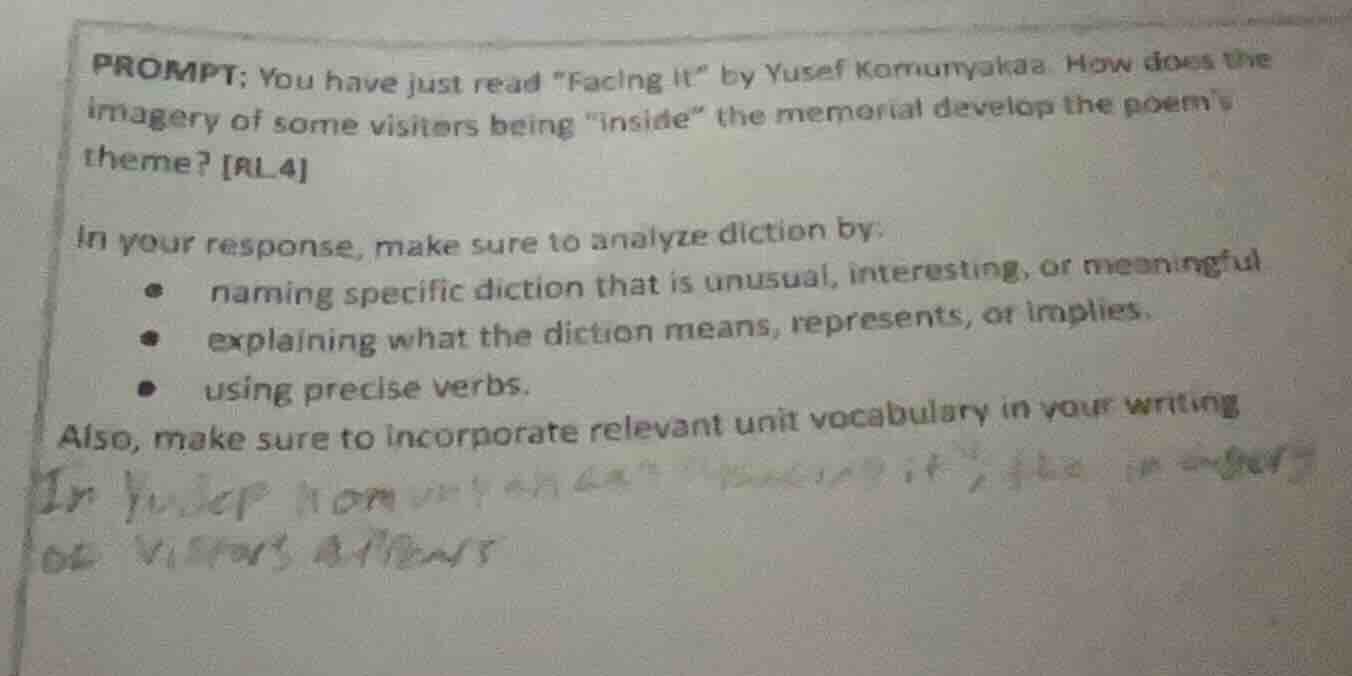
prompt: you have just read \facing it\ by yusef komunyakaa. how does the imagery of some visitors being \inside\ the memorial develop the poems theme? rl.4
in your response, make sure to analyze diction by:
- naming specific diction that is unusual, interesting, or meaningful
- explaining what the diction means, represents, or implies.
- using precise verbs.
also, make sure to incorporate relevant unit vocabulary in your writing.
Analyze the prompt and imagery
Using the Poetic Imagery and Textual Evidence knowledge points, we examine the prompt's focus on "inside" the memorial in Yusef Komunyakaa's "Facing It." The poem describes the reflective black granite of the Vietnam Veterans Memorial, where the speaker sees visitors' reflections appearing to merge with the names etched into the stone, creating a haunting visual boundary between the living and the dead.
Analyze the diction of "inside"
Using the Diction Analysis knowledge point, the word "inside" acts as a spatial preposition that becomes a psychological metaphor. It blurs the physical line between the external world of the living and the internal, permanent world of the deceased soldiers, suggesting that the survivors and visitors are trapped or deeply integrated with the memory of the fallen.
Connect imagery to theme development
Using the Theme Development knowledge point, the imagery of being "inside" the wall develops the theme of the inescapable, lingering trauma of war. The living do not merely look at history; they are absorbed by it, illustrating how grief and memory permanently alter the survivor's reality.
Draft the analytical response
We synthesize these points into a cohesive paragraph that names specific diction, explains its symbolic meaning, uses precise verbs (e.g., submerges, blurs, entangles), and directly addresses the prompt's requirements.

Snap & solve any problem in the app
Get step-by-step solutions on Sovi AI
Photo-based solutions with guided steps
Explore more problems and detailed explanations
In Yusef Komunyakaa’s "Facing It," the haunting imagery of visitors appearing "inside" the black granite of the Vietnam Veterans Memorial develops the poem's theme that the trauma of war permanently entangles the living with the dead. By utilizing the spatial preposition "inside," Komunyakaa employs a diction choice that transcends physical description to create a psychological threshold. This word choice implies a literal and emotional submergence; the visitors do not merely view the names on the wall, but are visually swallowed by the reflective surface, blurring the boundary between past loss and present existence. Precise verbs like shimmering and vanishing capture this optical illusion, representing how grief absorbs the survivors. Ultimately, this imagery reveals that for those affected by war, memory is not a distant monument to be observed, but an active, inescapable environment that they must inhabit.