QUESTION IMAGE
Question
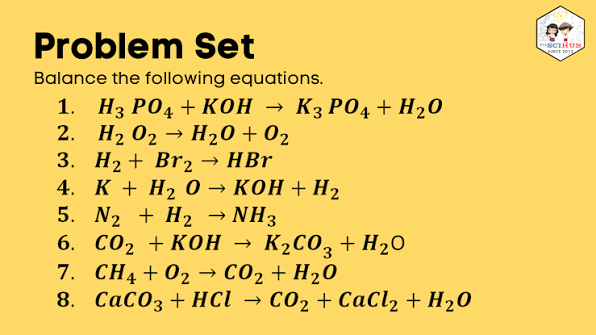
problem set
balance the following equations.
- \\(h_3po_4 + koh \
ightarrow k_3po_4 + h_2o\\)
- \\(h_2o_2 \
ightarrow h_2o + o_2\\)
- \\(h_2 + br_2 \
ightarrow hbr\\)
- \\(k + h_2o \
ightarrow koh + h_2\\)
- \\(n_2 + h_2 \
ightarrow nh_3\\)
- \\(co_2 + koh \
ightarrow k_2co_3 + h_2o\\)
- \\(ch_4 + o_2 \
ightarrow co_2 + h_2o\\)
- \\(caco_3 + hcl \
ightarrow co_2 + cacl_2 + h_2o\\)
🆕 New Concept Discovered: Balancing Chemical Equations
Equalizing atoms on both sides of a reaction
To balance a chemical equation, we must ensure that the number of atoms of each element is the same on both the reactant side (left) and the product side (right). We do this by placing whole-number coefficients in front of the chemical formulas.
---
Step 1: Balance Equation 1
Reaction:
- Identify the metal first: There are \(3\) potassium (\(\text{K}\)) atoms on the right, so we place a coefficient of \(3\) in front of \(\text{KOH}\) on the left:
- Balance the phosphate group (\(\text{PO}_4^{3-}\)): There is \(1\) on each side, so it is balanced.
- Balance hydrogen (\(\text{H}\)) and oxygen (\(\text{O}\)):
- Left side has \(3 \text{ (from } \text{H}_3\text{PO}_4) + 3 \text{ (from } 3\text{KOH}) = 6\) hydrogen atoms.
- To get \(6\) hydrogen atoms on the right, we place a coefficient of \(3\) in front of \(\text{H}_2\text{O}\):
- Check oxygen atoms: Left side has \(4 + 3 = 7\); right side has \(4 + 3 = 7\). The equation is balanced.
---
Step 2: Balance Equation 2
Reaction:
- Count the atoms: Left side has \(2\text{ H}, 2\text{ O}\). Right side has \(2\text{ H}, 3\text{ O}\).
- Balance oxygen: To make the number of oxygen atoms even on the right, place a \(2\) in front of \(\text{H}_2\text{O}\):
- Balance hydrogen: Now there are \(4\) hydrogens on the right. Place a \(2\) in front of \(\text{H}_2\text{O}_2\) on the left:
- Check: Left side has \(4\text{ H}, 4\text{ O}\); right side has \(4\text{ H}, 4\text{ O}\). The equation is balanced.
---
Step 3: Balance Equation 3
Reaction:
- Count the atoms: Left side has \(2\text{ H}\) and \(2\text{ Br}\). Right side has \(1\text{ H}\) and \(1\text{ Br}\).
- Balance: Place a coefficient of \(2\) in front of \(\text{HBr}\):
- Check: Both sides now have \(2\text{ H}\) and \(2\text{ Br}\). The equation is balanced.
---
Step 4: Balance Equation 4
Reaction:
- Count the atoms: Left side has \(1\text{ K}, 2\text{ H}, 1\text{ O}\). Right side has \(1\text{ K}, 3\text{ H}, 1\text{ O}\).
- Balance hydrogen: To make the odd number of hydrogens on the right even, place a \(2\) in front of \(\text{KOH}\):
- Balance potassium and oxygen:
- Now we have \(2\text{ K}\) on the right, so place a \(2\) in front of \(\text{K}\) on the left.
- We have \(4\text{ H}\) and \(2\text{ O}\) on the right, so place a \(2\) in front of \(\text{H}_2\text{O}\) on the left:
- Check: Both sides have \(2\text{ K}, 4\text{ H}, 2\text{ O}\). The equation is balanced.
---
Step 5: Balance Equation 5
Reaction:
- Balance nitrogen (\(\text{N}\)):…

Snap & solve any problem in the app
Get step-by-step solutions on Sovi AI
Photo-based solutions with guided steps
Explore more problems and detailed explanations
- \( \text{H}_3\text{PO}_4 + 3\text{KOH}
ightarrow \text{K}_3\text{PO}_4 + 3\text{H}_2\text{O} \)
- \( 2\text{H}_2\text{O}_2
ightarrow 2\text{H}_2\text{O} + \text{O}_2 \)
- \( \text{H}_2 + \text{Br}_2
ightarrow 2\text{HBr} \)
- \( 2\text{K} + 2\text{H}_2\text{O}
ightarrow 2\text{KOH} + \text{H}_2 \)
- \( \text{N}_2 + 3\text{H}_2
ightarrow 2\text{NH}_3 \)
- \( \text{CO}_2 + 2\text{KOH}
ightarrow \text{K}_2\text{CO}_3 + \text{H}_2\text{O} \)
- \( \text{CH}_4 + 2\text{O}_2
ightarrow \text{CO}_2 + 2\text{H}_2\text{O} \)
- \( \text{CaCO}_3 + 2\text{HCl}
ightarrow \text{CO}_2 + \text{CaCl}_2 + \text{H}_2\text{O} \)