QUESTION IMAGE
Question
part c
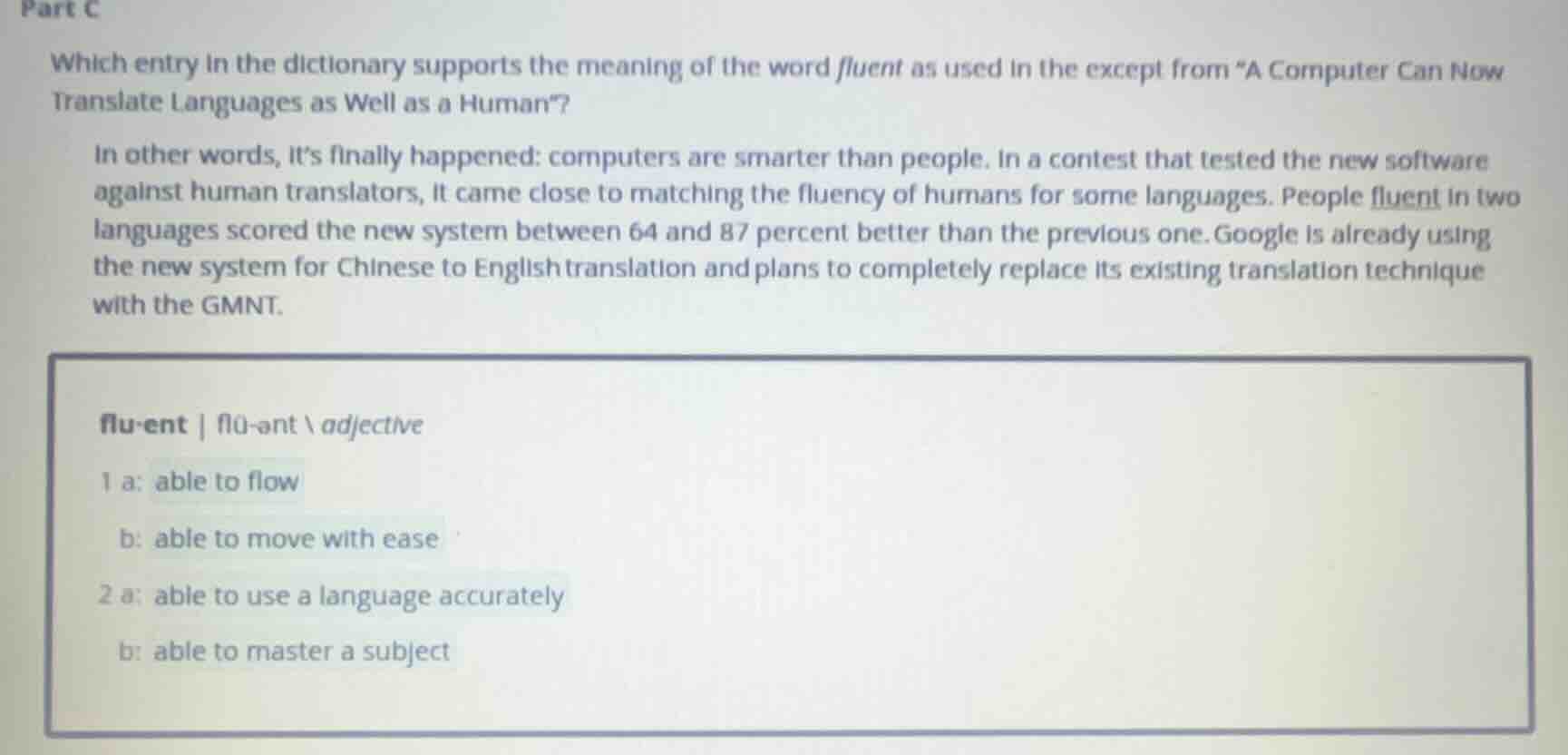
which entry in the dictionary supports the meaning of the word fluent as used in the excerpt from \a computer can now translate languages as well as a human\?
in other words, its finally happened: computers are smarter than people. in a contest that tested the new software against human translators, it came close to matching the fluency of humans for some languages. people fluent in two languages scored the new system between 64 and 87 percent better than the previous one. google is already using the new system for chinese to english translation and plans to completely replace its existing translation technique with the gmnt.
flu-ent | \flü-\partial nt \\ adjective
1 a: able to flow
b: able to move with ease
2 a: able to use a language accurately
b: able to master a subject
Analyze the context
Using the Vocabulary in Context knowledge point, we examine how "fluent" is used in the excerpt: "People fluent in two languages scored the new system...". The surrounding text discusses translation, human translators, and languages.
Evaluate dictionary definitions
Using the Context Clues knowledge point, we compare the context of language translation with the provided dictionary entries:
- 1 a: "able to flow" (relates to liquids or movement)
- 1 b: "able to move with ease" (relates to physical motion)
- 2 a: "able to use a language accurately" (directly matches the context of speaking/translating languages)
- 2 b: "able to master a subject" (too broad)
Select the correct entry
Definition 2 a specifically defines "fluent" in relation to language proficiency, which matches the excerpt's use.

Snap & solve any problem in the app
Get step-by-step solutions on Sovi AI
Photo-based solutions with guided steps
Explore more problems and detailed explanations
- 1 a
- 1 b
- 2 a (Correct answer)
- 2 b