QUESTION IMAGE
Question
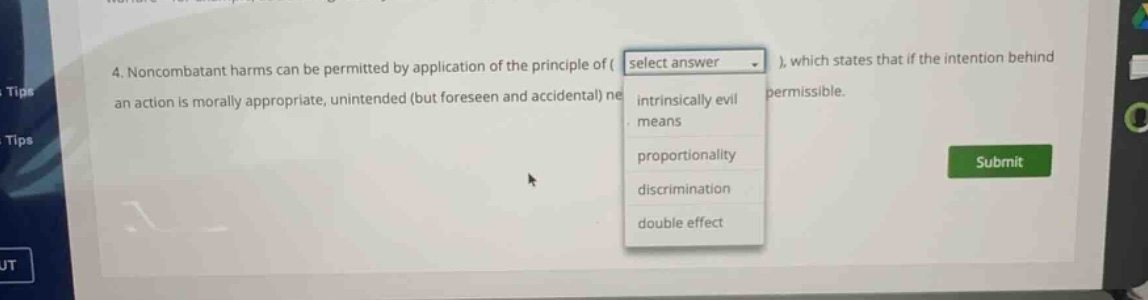
- noncombatant harms can be permitted by application of the principle of ( select answer ), which states that if the intention behind an action is morally appropriate, unintended (but foreseen and accidental) negative consequences are permissible.
options:
- intrinsically evil means
- proportionality
- discrimination
- double effect
<pre_analysis>
{
"quality": "clear",
"question_count": 1,
"skills_matched": [
"direct_cot",
"multiple_choice_formatter",
"explain_then_answer",
"quick"
],
"needs_drawing": false,
"concepts_used": [
"Principle of double effect"
],
"new_concepts": [],
"current_concepts": [
"Principle of double effect",
"Jus in bello principles"
]
}
</pre_analysis>
<reasoning>
Identify the core philosophical principle
The question describes a moral framework where noncombatant harms are permitted if the primary intention behind an action is morally appropriate, and the resulting negative side effects (such as civilian casualties) are unintended, even if they are foreseen and accidental.
Match the definition to the options
- "intrinsically evil means" (mala in se) refers to actions that are inherently wrong, which cannot be justified by good intentions.
- "proportionality" requires that the anticipated civilian harm must not be excessive in relation to the concrete and direct military advantage anticipated.
- "discrimination" requires distinguishing between combatants and noncombatants.
- "double effect" (the principle of double effect) specifically states that an action with both good and bad effects is permissible if the bad effect is unintended, foreseen only as a side effect, and the intended primary action is morally good or neutral.
</reasoning>
<answer>
<mcq-option>intrinsically evil means</mcq-option>
<mcq-option>proportionality</mcq-option>
<mcq-option>discrimination</mcq-option>
<mcq-correct>double effect</mcq-correct>
</answer>
<post_analysis>
{
"subject": "Social Science",
"question_type": "Multiple Choice",
"knowledge_point": [
"Social Science",
"Philosophy of Law",
"Principle of double effect"
]
}
</post_analysis>
Snap & solve any problem in the app
Get step-by-step solutions on Sovi AI
Photo-based solutions with guided steps
Explore more problems and detailed explanations
<pre_analysis>
{
"quality": "clear",
"question_count": 1,
"skills_matched": [
"direct_cot",
"multiple_choice_formatter",
"explain_then_answer",
"quick"
],
"needs_drawing": false,
"concepts_used": [
"Principle of double effect"
],
"new_concepts": [],
"current_concepts": [
"Principle of double effect",
"Jus in bello principles"
]
}
</pre_analysis>
<reasoning>
Identify the core philosophical principle
The question describes a moral framework where noncombatant harms are permitted if the primary intention behind an action is morally appropriate, and the resulting negative side effects (such as civilian casualties) are unintended, even if they are foreseen and accidental.
Match the definition to the options
- "intrinsically evil means" (mala in se) refers to actions that are inherently wrong, which cannot be justified by good intentions.
- "proportionality" requires that the anticipated civilian harm must not be excessive in relation to the concrete and direct military advantage anticipated.
- "discrimination" requires distinguishing between combatants and noncombatants.
- "double effect" (the principle of double effect) specifically states that an action with both good and bad effects is permissible if the bad effect is unintended, foreseen only as a side effect, and the intended primary action is morally good or neutral.
</reasoning>
<answer>
<mcq-option>intrinsically evil means</mcq-option>
<mcq-option>proportionality</mcq-option>
<mcq-option>discrimination</mcq-option>
<mcq-correct>double effect</mcq-correct>
</answer>
<post_analysis>
{
"subject": "Social Science",
"question_type": "Multiple Choice",
"knowledge_point": [
"Social Science",
"Philosophy of Law",
"Principle of double effect"
]
}
</post_analysis>