QUESTION IMAGE
Question
multiple choice question
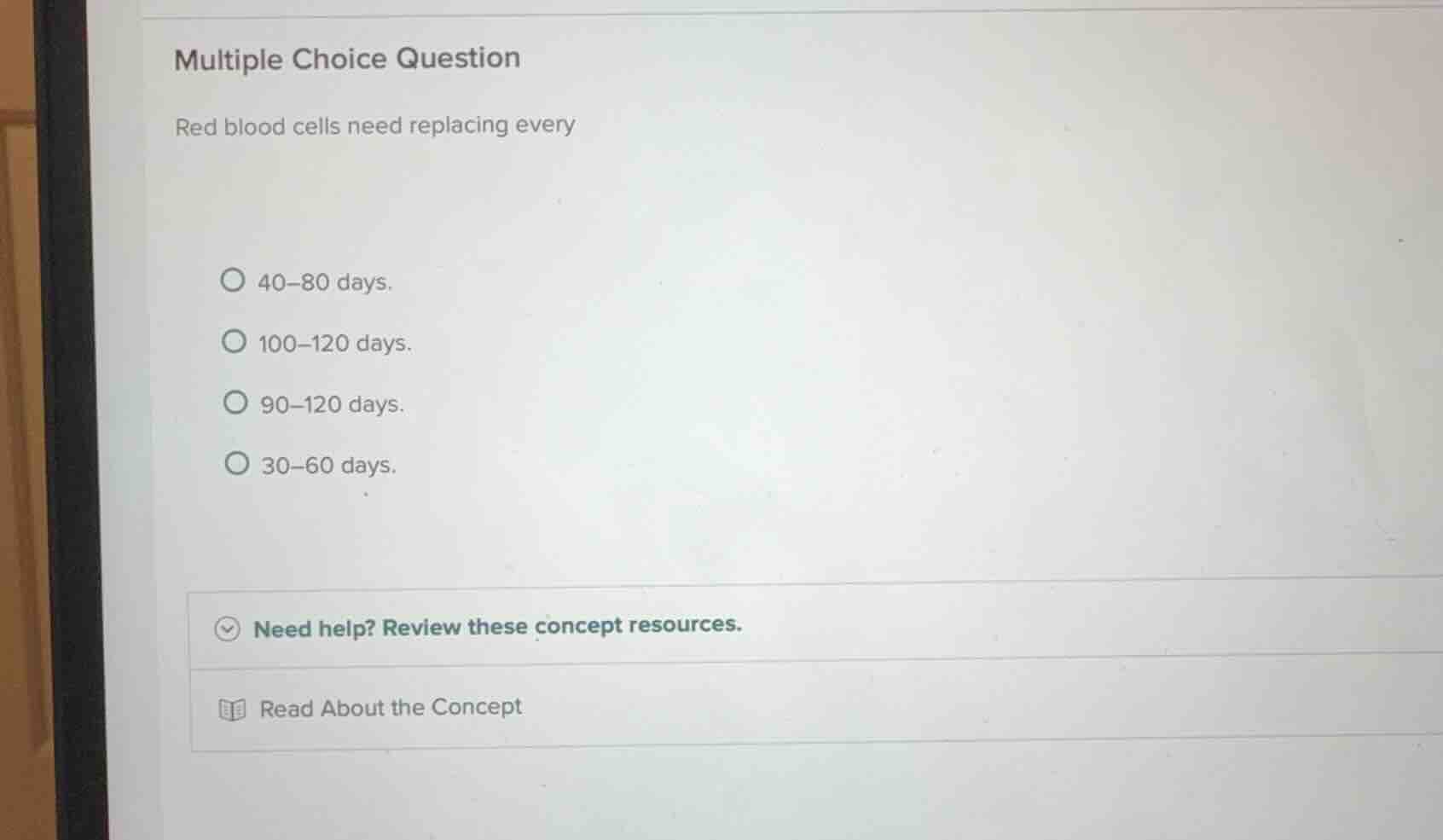
red blood cells need replacing every
40-80 days.
100-120 days.
90-120 days.
30-60 days.
<pre_analysis>
{
"quality": "clear",
"question_count": 1,
"skills_matched": [
"direct_cot",
"multiple_choice_formatter",
"explain_then_answer",
"tutor"
],
"needs_drawing": false,
"concepts_used": [],
"new_concepts": [
"Erythrocyte Lifespan",
"Red Blood Cell Replacement"
],
"current_concepts": [
"Erythrocyte Lifespan",
"Red Blood Cell Replacement",
"Cardiovascular Terminology"
]
}
</pre_analysis>
<reasoning>
Identify the biological lifespan of erythrocytes
Red blood cells (erythrocytes) are specialized cells that transport oxygen throughout the body. Because they lack a nucleus and other organelles, they cannot repair themselves or divide. Consequently, they have a finite lifespan in circulation.
Determine the standard replacement range
In healthy human adults, the average lifespan of a red blood cell is approximately 120 days. Therefore, these cells need to be replaced continuously, with the entire population turning over roughly every 90 to 120 days.
Evaluate the given options
- 40–80 days: Too short for normal red blood cell survival.
- 100–120 days: While 120 days is the upper limit, the standard clinical range for replacement is typically broader.
- 90–120 days: This range accurately captures the typical physiological lifespan and replacement cycle of erythrocytes.
- 30–60 days: Incorrectly short.
</reasoning>
<answer>
<mcq-option>40–80 days.</mcq-option>
<mcq-option>100–120 days.</mcq-option>
<mcq-correct>90–120 days.</mcq-correct>
<mcq-option>30–60 days.</mcq-option>
</answer>
<post_analysis>
{
"subject": "Natural Science",
"question_type": "Multiple Choice",
"knowledge_point": [
"Natural Science",
"Biology",
"Erythrocyte Lifespan"
]
}
</post_analysis>
Snap & solve any problem in the app
Get step-by-step solutions on Sovi AI
Photo-based solutions with guided steps
Explore more problems and detailed explanations
<pre_analysis>
{
"quality": "clear",
"question_count": 1,
"skills_matched": [
"direct_cot",
"multiple_choice_formatter",
"explain_then_answer",
"tutor"
],
"needs_drawing": false,
"concepts_used": [],
"new_concepts": [
"Erythrocyte Lifespan",
"Red Blood Cell Replacement"
],
"current_concepts": [
"Erythrocyte Lifespan",
"Red Blood Cell Replacement",
"Cardiovascular Terminology"
]
}
</pre_analysis>
<reasoning>
Identify the biological lifespan of erythrocytes
Red blood cells (erythrocytes) are specialized cells that transport oxygen throughout the body. Because they lack a nucleus and other organelles, they cannot repair themselves or divide. Consequently, they have a finite lifespan in circulation.
Determine the standard replacement range
In healthy human adults, the average lifespan of a red blood cell is approximately 120 days. Therefore, these cells need to be replaced continuously, with the entire population turning over roughly every 90 to 120 days.
Evaluate the given options
- 40–80 days: Too short for normal red blood cell survival.
- 100–120 days: While 120 days is the upper limit, the standard clinical range for replacement is typically broader.
- 90–120 days: This range accurately captures the typical physiological lifespan and replacement cycle of erythrocytes.
- 30–60 days: Incorrectly short.
</reasoning>
<answer>
<mcq-option>40–80 days.</mcq-option>
<mcq-option>100–120 days.</mcq-option>
<mcq-correct>90–120 days.</mcq-correct>
<mcq-option>30–60 days.</mcq-option>
</answer>
<post_analysis>
{
"subject": "Natural Science",
"question_type": "Multiple Choice",
"knowledge_point": [
"Natural Science",
"Biology",
"Erythrocyte Lifespan"
]
}
</post_analysis>