QUESTION IMAGE
Question
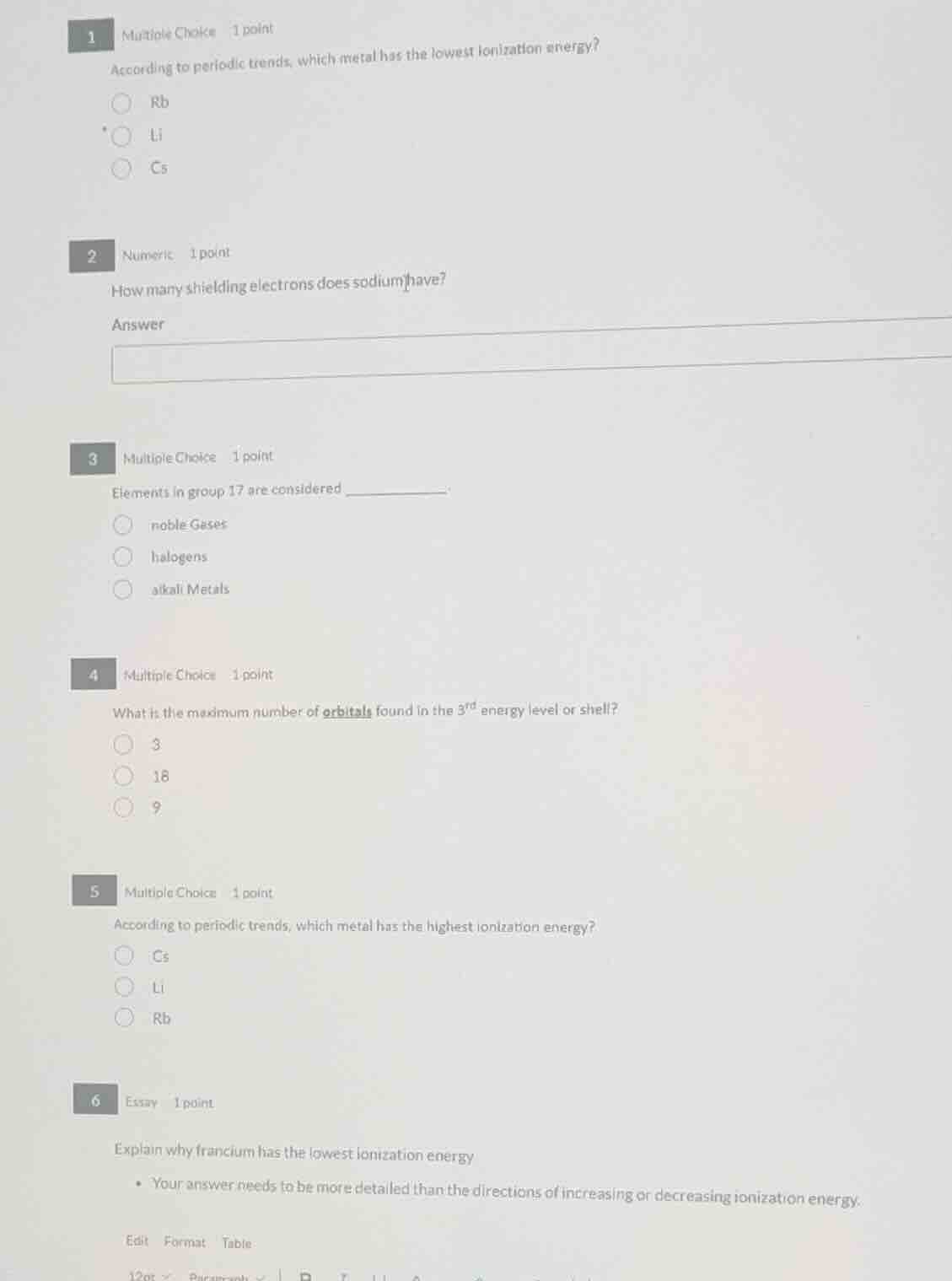
1 multiple choice 1 point
according to periodic trends, which metal has the lowest ionization energy?
rb
li
cs
2 numeric 1 point
how many shielding electrons does sodium have?
answer
3 multiple choice 1 point
elements in group 17 are considered ______.
noble gases
halogens
alkali metals
4 multiple choice 1 point
what is the maximum number of orbitals found in the 3^{rd} energy level or shell?
3
18
9
5 multiple choice 1 point
according to periodic trends, which metal has the highest ionization energy?
cs
li
rb
6 essay 1 point
explain why francium has the lowest ionization energy
- your answer needs to be more detailed than the directions of increasing or decreasing ionization energy.
Analyze ionization energy trends for Question 1
Ionization energy decreases down a group because atomic radius increases, making outer electrons easier to remove. Among the alkali metals listed (\(\text{Li}\), \(\text{Rb}\), \(\text{Cs}\)), cesium (\(\text{Cs}\)) is furthest down Group 1. Thus, \(\text{Cs}\) has the lowest ionization energy.
Calculate shielding electrons for Question 2
Sodium (\(\text{Na}\)) has an atomic number of 11, with electron configuration \(1s^2 2s^2 2p^6 3s^1\). The valence shell is \(n=3\) containing 1 electron. The inner core shells (\(n=1\) and \(n=2\)) contain \(2 + 8 = 10\) shielding electrons.
Identify Group 17 elements for Question 3
Elements in Group 17 of the periodic table (fluorine, chlorine, bromine, iodine, astatine) are known as the halogens.
Determine maximum orbitals for Question 4
The maximum number of orbitals in any energy level \(n\) is given by the formula \(n^2\). For the \(3^{\text{rd}}\) energy level (\(n=3\)), the number of orbitals is \(3^2 = 9\) (one \(3s\), three \(3p\), and five \(3d\) orbitals).
Analyze ionization energy trends for Question 5
Ionization energy increases up a group. Among the alkali metals listed (\(\text{Cs}\), \(\text{Li}\), \(\text{Rb}\)), lithium (\(\text{Li}\)) is the highest up in Group 1. Thus, \(\text{Li}\) has the highest ionization energy.
Explain francium's low ionization energy for Question 6
Francium (\(\text{Fr}\)) has the largest atomic radius in Group 1, meaning its valence electron is furthest from the nucleus. Additionally, it has the highest number of shielding inner-shell electrons, which greatly reduces the effective nuclear charge felt by the valence electron, making it extremely easy to remove.

Snap & solve any problem in the app
Get step-by-step solutions on Sovi AI
Photo-based solutions with guided steps
Explore more problems and detailed explanations
Question 1
- (A) Rb
- (B) Li
- (C) Cs (Correct answer)
Question 2
10
Question 3
- (A) noble gases
- (B) halogens (Correct answer)
- (C) alkali metals
Question 4
- (A) 3
- (B) 18
- (C) 9 (Correct answer)
Question 5
- (A) Cs
- (B) Li (Correct answer)
- (C) Rb
Question 6
Francium has the lowest ionization energy because it has the largest atomic radius and the greatest number of shielding electron shells in its group. This combination maximizes the distance between the positive nucleus and the single valence electron while minimizing the effective nuclear charge holding that electron, making it exceptionally easy to remove.