QUESTION IMAGE
Question
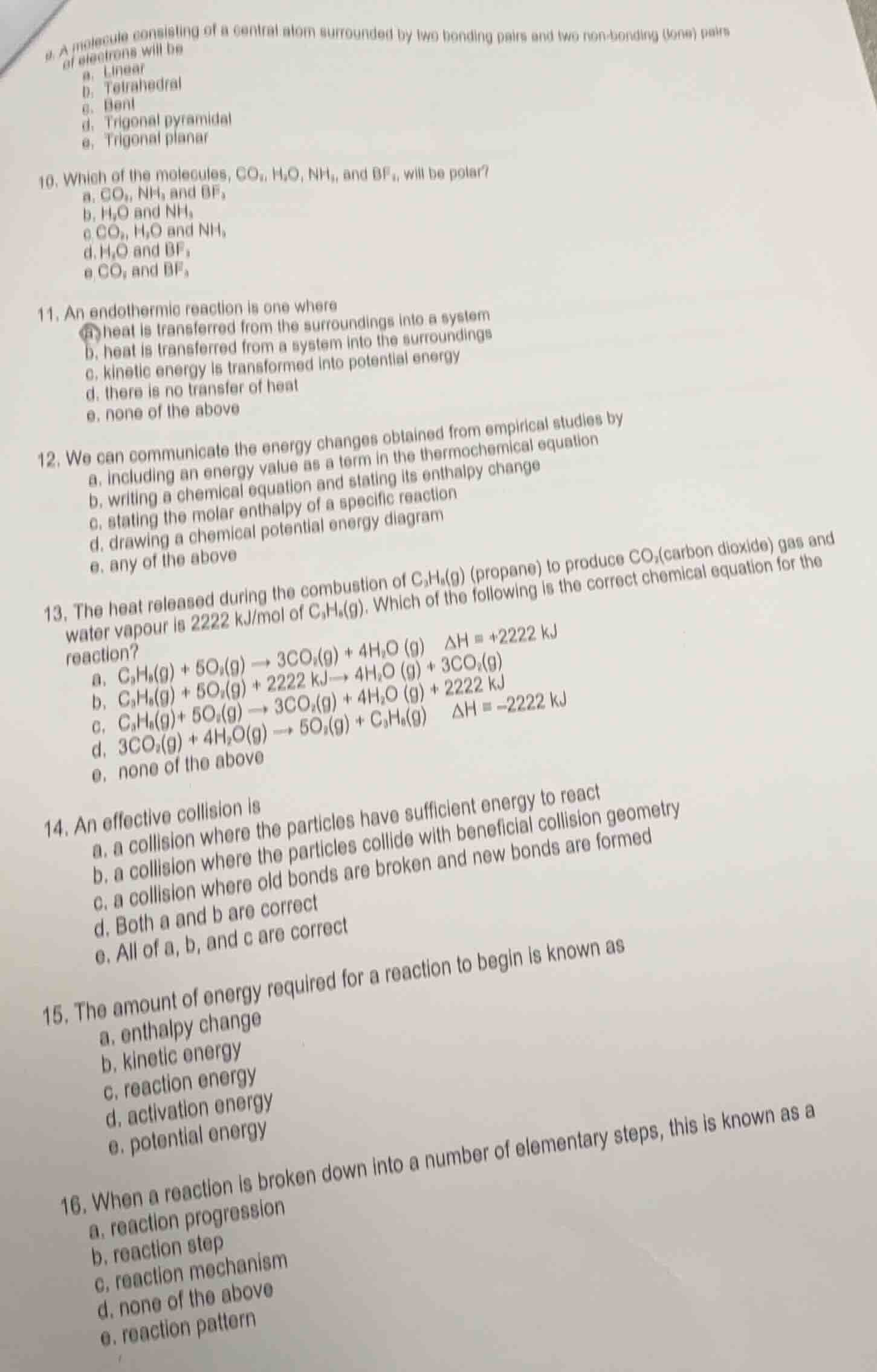
- a molecule consisting of a central atom surrounded by two bonding pairs and two non-bonding (lone) pairs of electrons will be
a. linear
b. tetrahedral
c. bent
d. trigonal pyramidal
e. trigonal planar
- which of the molecules, \\(\text{co}_2\\), \\(\text{h}_2\text{o}\\), \\(\text{nh}_3\\), and \\(\text{bf}_3\\), will be polar?
a. \\(\text{co}_2\\), \\(\text{nh}_3\\), and \\(\text{bf}_3\\)
b. \\(\text{h}_2\text{o}\\) and \\(\text{nh}_3\\)
c. \\(\text{co}_2\\), \\(\text{h}_2\text{o}\\) and \\(\text{nh}_3\\)
d. \\(\text{h}_2\text{o}\\) and \\(\text{bf}_3\\)
e. \\(\text{co}_2\\) and \\(\text{bf}_3\\)
- an endothermic reaction is one where
a. heat is transferred from the surroundings into a system
b. heat is transferred from a system into the surroundings
c. kinetic energy is transformed into potential energy
d. there is no transfer of heat
e. none of the above
- we can communicate the energy changes obtained from empirical studies by
a. including an energy value as a term in the thermochemical equation
b. writing a chemical equation and stating its enthalpy change
c. stating the molar enthalpy of a specific reaction
d. drawing a chemical potential energy diagram
e. any of the above
- the heat released during the combustion of \\(\text{c}_3\text{h}_8(\text{g})\\) (propane) to produce \\(\text{co}_2\\) (carbon dioxide) gas and water vapour is \\(2222\text{ kj/mol}\\) of \\(\text{c}_3\text{h}_8(\text{g})\\). which of the following is the correct chemical equation for the reaction?
a. \\(\text{c}_3\text{h}_8(\text{g}) + 5\text{o}_2(\text{g}) \
ightarrow 3\text{co}_2(\text{g}) + 4\text{h}_2\text{o}(\text{g}) \quad \delta h = +2222\text{ kj}\\)
b. \\(\text{c}_3\text{h}_8(\text{g}) + 5\text{o}_2(\text{g}) + 2222\text{ kj} \
ightarrow 4\text{h}_2\text{o}(\text{g}) + 3\text{co}_2(\text{g})\\)
c. \\(\text{c}_3\text{h}_8(\text{g}) + 5\text{o}_2(\text{g}) \
ightarrow 3\text{co}_2(\text{g}) + 4\text{h}_2\text{o}(\text{g}) + 2222\text{ kj}\\)
d. \\(3\text{co}_2(\text{g}) + 4\text{h}_2\text{o}(\text{g}) \
ightarrow 5\text{o}_2(\text{g}) + \text{c}_3\text{h}_8(\text{g}) \quad \delta h = -2222\text{ kj}\\)
e. none of the above
- an effective collision is
a. a collision where the particles have sufficient energy to react
b. a collision where the particles collide with beneficial collision geometry
c. a collision where old bonds are broken and new bonds are formed
d. both a and b are correct
e. all of a, b, and c are correct
- the amount of energy required for a reaction to begin is known as
a. enthalpy change
b. kinetic energy
c. reaction energy
d. activation energy
e. potential energy
- when a reaction is broken down into a number of elementary steps, this is known as a
a. reaction progression
b. reaction step
c. reaction mechanism
d. none of the above
e. reaction pattern
Question 9: Molecular Geometry
A central atom with two bonding pairs and two non-bonding (lone) pairs has a steric number of 4. According to VSEPR theory, the electron-pair geometry is tetrahedral, but the molecular shape formed by the atoms is bent (like water, \(\text{H}_2\text{O}\)).
Question 10: Molecular Polarity
Let's analyze the polarity of each molecule:
- \(\text{CO}_2\): Linear and symmetrical, so dipoles cancel (non-polar).
- \(\text{H}_2\text{O}\): Bent and asymmetrical, dipoles do not cancel (polar).
- \(\text{NH}_3\): Trigonal pyramidal and asymmetrical, dipoles do not cancel (polar).
- \(\text{BF}_3\): Trigonal planar and symmetrical, dipoles cancel (non-polar).
Thus, \(\text{H}_2\text{O}\) and \(\text{NH}_3\) are polar.
Question 11: Endothermic Reactions
An endothermic reaction is defined as a chemical process where thermal energy (heat) is absorbed by the system from its surroundings.
Question 12: Communicating Energy Changes
Energy changes in chemical reactions can be communicated in several standard ways:
- Including energy as a reactant or product term in a thermochemical equation.
- Writing a balanced equation and stating its enthalpy change (\(\Delta H\)) next to it.
- Stating the molar enthalpy of a specific substance.
- Drawing a potential energy diagram.
Since all options (a, b, c, and d) are valid scientific methods, the correct choice is "any of the above".
Question 13: Combustion of Propane
Using the Combustion Reactions knowledge point:
The combustion of propane (\(\text{C}_3\text{H}_8\)) releases \(2222\text{ kJ/mol}\) of heat. Since heat is released, the reaction is exothermic, meaning:
- The enthalpy change must be negative: \(\Delta H = -2222\text{ kJ}\).
- Alternatively, heat can be written as a product: \(\text{C}_3\text{H}_8(g) + 5\text{O}_2(g)
ightarrow 3\text{CO}_2(g) + 4\text{H}_2\text{O}(g) + 2222\text{ kJ}\).
Looking at the options, option (c) correctly represents this by placing \(2222\text{ kJ}\) on the product side of the equation.
Question 14: Collision Theory
According to collision theory, for a collision between reactant particles to be effective (resulting in a reaction), two conditions must be met:
- The particles must collide with sufficient kinetic energy to overcome the activation energy barrier (statement a).
- The particles must collide with the correct spatial orientation or geometry (statement b).
Therefore, both a and b are correct.
Question 15: Activation Energy
The minimum amount of energy required to initiate a chemical reaction by overcoming the potential energy barrier is defined as the activation energy (\(E_a\)).
Question 16: Reaction Mechanisms
When a complex chemical reaction is broken down into a sequence of simpler, individual elementary steps, this sequence is known as a reaction mechanism.

Snap & solve any problem in the app
Get step-by-step solutions on Sovi AI
Photo-based solutions with guided steps
Explore more problems and detailed explanations
Question 9
- a. Linear
- b. Tetrahedral
- c. Bent (Correct answer)
- d. Trigonal pyramidal
- e. Trigonal planar
Question 10
- a. \(\text{CO}_2\), \(\text{NH}_3\), and \(\text{BF}_3\)
- b. \(\text{H}_2\text{O}\) and \(\text{NH}_3\) (Correct answer)
- c. \(\text{CO}_2\), \(\text{H}_2\text{O}\) and \(\text{NH}_3\)
- d. \(\text{H}_2\text{O}\) and \(\text{BF}_3\)
- e. \(\text{CO}_2\) and \(\text{BF}_3\)
Question 11
- a. heat is transferred from the surroundings into a system (Correct answer)
- b. heat is transferred from a system into the surroundings
- c. kinetic energy is transformed into potential energy
- d. there is no transfer of heat
- e. none of the above
Question 12
- a. including an energy value as a term in the thermochemical equation
- b. writing a chemical equation and stating its enthalpy change
- c. stating the molar enthalpy of a specific reaction
- d. drawing a chemical potential energy diagram
- e. any of the above (Correct answer)
Question 13
- a. \(\text{C}_3\text{H}_8(g) + 5\text{O}_2(g)
ightarrow 3\text{CO}_2(g) + 4\text{H}_2\text{O}(g) \quad \Delta H = +2222\text{ kJ}\)
- b. \(\text{C}_3\text{H}_8(g) + 5\text{O}_2(g) + 2222\text{ kJ}
ightarrow 4\text{H}_2\text{O}(g) + 3\text{CO}_2(g)\)
- **c. \(\text{C}_3\text{H}_8(g) + 5\text{O}_2(g)
ightarrow 3\text{CO}_2(g) + 4\text{H}_2\text{O}(g) + 2222\text{ kJ}\) (Correct answer)**
- d. \(\text{3CO}_2(g) + 4\text{H}_2\text{O}(g)
ightarrow 5\text{O}_2(g) + \text{C}_3\text{H}_8(g) \quad \Delta H = -2222\text{ kJ}\)
- e. none of the above
Question 14
- a. a collision where the particles have sufficient energy to react
- b. a collision where the particles collide with beneficial collision geometry
- c. a collision where old bonds are broken and new bonds are formed
- d. Both a and b are correct (Correct answer)
- e. All of a, b, and c are correct
Question 15
- a. enthalpy change
- b. kinetic energy
- c. reaction energy
- d. activation energy (Correct answer)
- e. potential energy
Question 16
- a. reaction progression
- b. reaction step
- c. reaction mechanism (Correct answer)
- d. none of the above
- e. reaction pattern