QUESTION IMAGE
Question
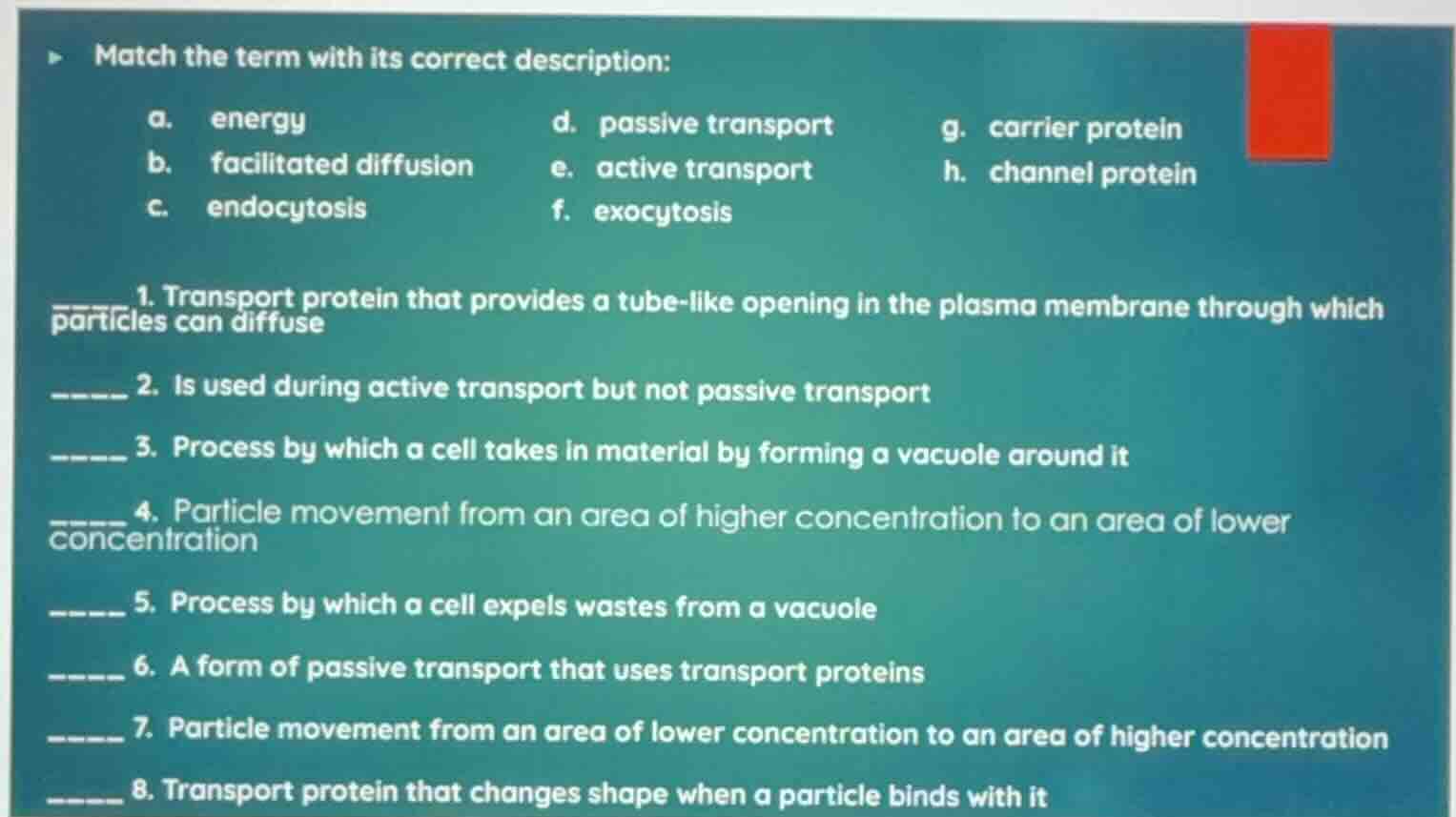
match the term with its correct description:
a. energy
b. facilitated diffusion
c. endocytosis
d. passive transport
e. active transport
f. exocytosis
g. carrier protein
h. channel protein
- transport protein that provides a tube-like opening in the plasma membrane through which particles can diffuse
- is used during active transport but not passive transport
- process by which a cell takes in material by forming a vacuole around it
- particle movement from an area of higher concentration to an area of lower concentration
- process by which a cell expels wastes from a vacuole
- a form of passive transport that uses transport proteins
- particle movement from an area of lower concentration to an area of higher concentration
- transport protein that changes shape when a particle binds with it
<pre_analysis>
{
"quality": "clear",
"question_count": 8,
"skills_matched": [
"direct_cot",
"explain_then_answer",
"quick"
],
"needs_drawing": false,
"concepts_used": [
"Cell Membrane Permeability"
],
"new_concepts": [
"Active Transport",
"Passive Transport",
"Membrane Proteins"
],
"current_concepts": [
"Cell Membrane Permeability",
"Active Transport",
"Passive Transport",
"Membrane Proteins"
]
}
</pre_analysis>
<reasoning>
Match descriptions 1 to 4
- A tube-like opening in the plasma membrane is a channel protein (h).
- Active transport requires energy (a), whereas passive transport does not.
- Taking in material by forming a vacuole is endocytosis (c).
- Movement from higher to lower concentration is passive transport (d).
Match descriptions 5 to 8
- Expelling wastes from a vacuole is exocytosis (f).
- Passive transport using transport proteins is facilitated diffusion (b).
- Movement from lower to higher concentration is active transport (e).
- A transport protein that changes shape upon binding is a carrier protein (g).
</reasoning>
<answer>
- (h) channel protein
- (a) energy
- (c) endocytosis
- (d) passive transport
- (f) exocytosis
- (b) facilitated diffusion
- (e) active transport
- (g) carrier protein
</answer>
<post_analysis>
{
"subject": "Natural Science",
"question_type": "Fill-in-the-blank",
"knowledge_point": [
"Natural Science",
"Biology",
"Cell Transport"
]
}
</post_analysis>
Snap & solve any problem in the app
Get step-by-step solutions on Sovi AI
Photo-based solutions with guided steps
Explore more problems and detailed explanations
<pre_analysis>
{
"quality": "clear",
"question_count": 8,
"skills_matched": [
"direct_cot",
"explain_then_answer",
"quick"
],
"needs_drawing": false,
"concepts_used": [
"Cell Membrane Permeability"
],
"new_concepts": [
"Active Transport",
"Passive Transport",
"Membrane Proteins"
],
"current_concepts": [
"Cell Membrane Permeability",
"Active Transport",
"Passive Transport",
"Membrane Proteins"
]
}
</pre_analysis>
<reasoning>
Match descriptions 1 to 4
- A tube-like opening in the plasma membrane is a channel protein (h).
- Active transport requires energy (a), whereas passive transport does not.
- Taking in material by forming a vacuole is endocytosis (c).
- Movement from higher to lower concentration is passive transport (d).
Match descriptions 5 to 8
- Expelling wastes from a vacuole is exocytosis (f).
- Passive transport using transport proteins is facilitated diffusion (b).
- Movement from lower to higher concentration is active transport (e).
- A transport protein that changes shape upon binding is a carrier protein (g).
</reasoning>
<answer>
- (h) channel protein
- (a) energy
- (c) endocytosis
- (d) passive transport
- (f) exocytosis
- (b) facilitated diffusion
- (e) active transport
- (g) carrier protein
</answer>
<post_analysis>
{
"subject": "Natural Science",
"question_type": "Fill-in-the-blank",
"knowledge_point": [
"Natural Science",
"Biology",
"Cell Transport"
]
}
</post_analysis>