QUESTION IMAGE
Question
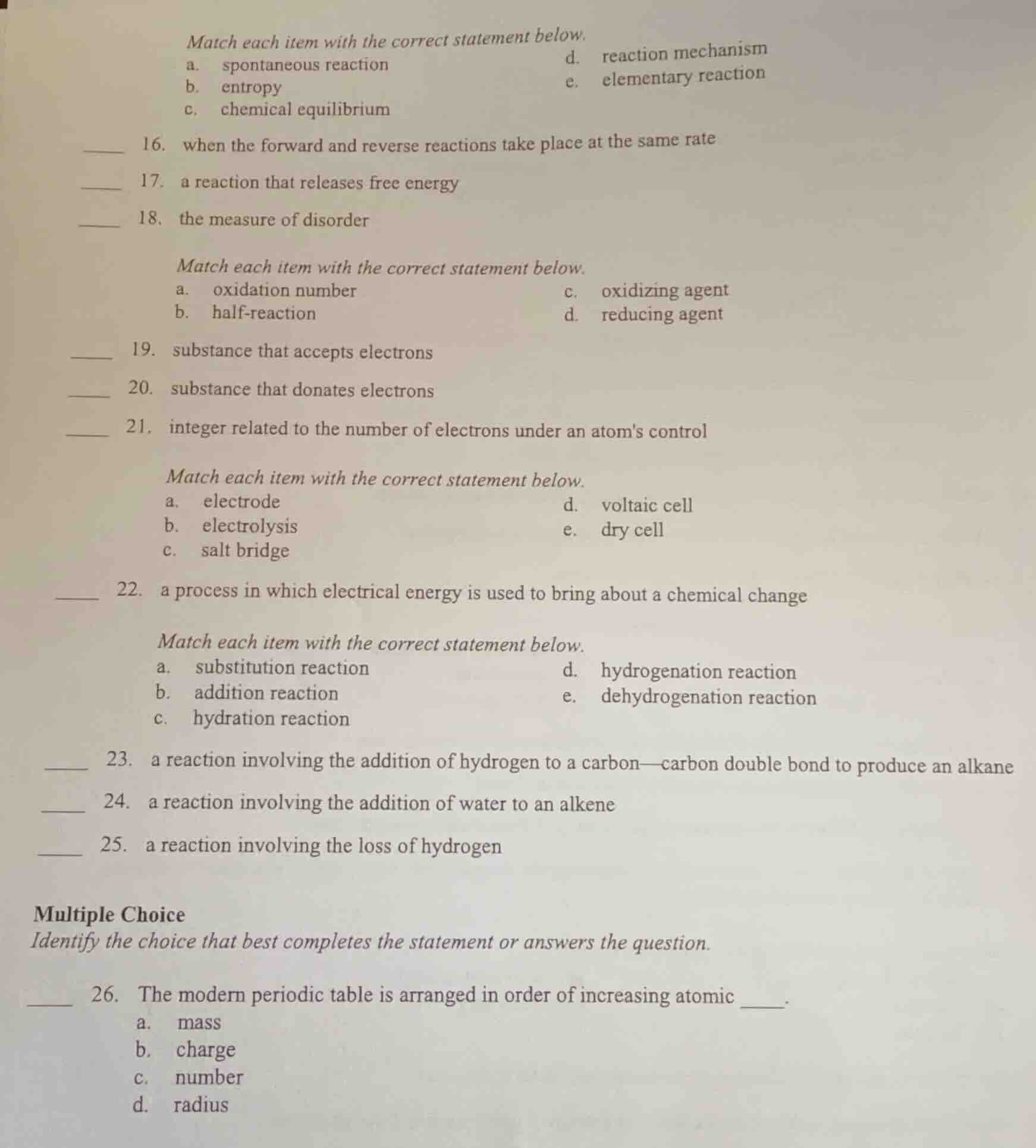
match each item with the correct statement below.
a. spontaneous reaction
b. entropy
c. chemical equilibrium
d. reaction mechanism
e. elementary reaction
- when the forward and reverse reactions take place at the same rate
- a reaction that releases free energy
- the measure of disorder
match each item with the correct statement below.
a. oxidation number
b. half-reaction
c. oxidizing agent
d. reducing agent
- substance that accepts electrons
- substance that donates electrons
- integer related to the number of electrons under an atoms control
match each item with the correct statement below.
a. electrode
b. electrolysis
c. salt bridge
d. voltaic cell
e. dry cell
- a process in which electrical energy is used to bring about a chemical change
match each item with the correct statement below.
a. substitution reaction
b. addition reaction
c. hydration reaction
d. hydrogenation reaction
e. dehydrogenation reaction
- a reaction involving the addition of hydrogen to a carbon-carbon double bond to produce an alkane
- a reaction involving the addition of water to an alkene
- a reaction involving the loss of hydrogen
multiple choice
identify the choice that best completes the statement or answers the question.
- the modern periodic table is arranged in order of increasing atomic ______.
a. mass
b. charge
c. number
d. radius
Match chemical kinetics and thermodynamics
Using the Oxidation Numbers and Redox Rules knowledge points, we analyze statements 16–18:
- Statement 16: When forward and reverse rates are equal, the system is at chemical equilibrium (c).
- Statement 17: A reaction releasing free energy is a spontaneous reaction (a).
- Statement 18: The measure of disorder is entropy (b).
Match redox chemistry definitions
We analyze statements 19–21:
- Statement 19: A substance that accepts electrons is reduced, acting as an oxidizing agent (c).
- Statement 20: A substance that donates electrons is oxidized, acting as a reducing agent (d).
- Statement 21: The integer related to electrons under an atom's control is the oxidation number (a).
Match electrochemistry definitions
We analyze statement 22:
- Statement 22: Using electrical energy to drive a non-spontaneous chemical change is electrolysis (b).
Match organic reaction types
We analyze statements 23–25:
- Statement 23: Adding hydrogen to a double bond to form an alkane is a hydrogenation reaction (d).
- Statement 24: Adding water to an alkene is a hydration reaction (c).
- Statement 25: The loss of hydrogen is a dehydrogenation reaction (e).
Identify periodic table arrangement
We analyze statement 26:
- Statement 26: The modern periodic table is arranged by increasing atomic number (c).

Snap & solve any problem in the app
Get step-by-step solutions on Sovi AI
Photo-based solutions with guided steps
Explore more problems and detailed explanations
| No. | Answer |
|---|---|
| 17 | a |
| 18 | b |
| 19 | c |
| 20 | d |
| 21 | a |
| 22 | b |
| 23 | d |
| 24 | c |
| 25 | e |
| 26 | c |