Sovi.AI - AI Math Tutor

Scan to solve math questions

QUESTION IMAGE

iv. refer to your diagram to explain what bonds are breaking when water…

Question

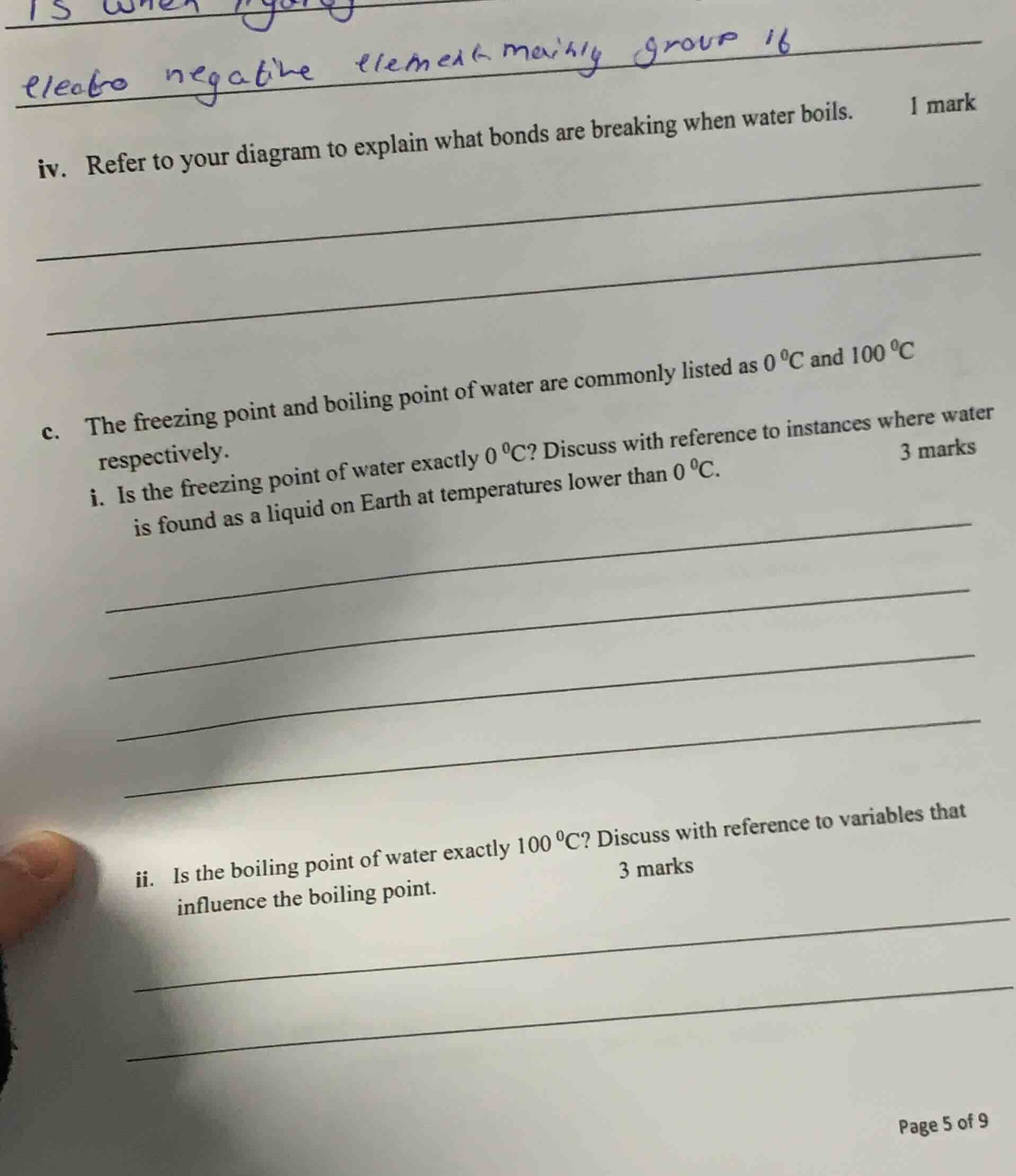
iv. refer to your diagram to explain what bonds are breaking when water boils. 1 mark

c. the freezing point and boiling point of water are commonly listed as \\(0\text{ }^{\circ}\text{c}\\) and \\(100\text{ }^{\circ}\text{c}\\) respectively.
i. is the freezing point of water exactly \\(0\text{ }^{\circ}\text{c}\\)? discuss with reference to instances where water is found as a liquid on earth at temperatures lower than \\(0\text{ }^{\circ}\text{c}\\). 3 marks

ii. is the boiling point of water exactly \\(100\text{ }^{\circ}\text{c}\\)? discuss with reference to variables that influence the boiling point. 3 marks

Explanation:

Response

<pre_analysis>
{
"quality": "clear",
"question_count": 3,
"skills_matched": [
"direct_cot",
"explain_then_answer",
"tutor"
],
"needs_drawing": false,
"concepts_used": [],
"new_concepts": [
"Intermolecular Forces",
"Freezing Point Depression",
"Boiling Point Elevation"
],
"current_concepts": [
"Hydrogen Bonding",
"Phase Changes",
"Colligative Properties",
"Atmospheric Pressure"
]
}
</pre_analysis>

<reasoning>

Identify bonds broken during boiling

Boiling is a physical phase change from liquid to gas. During this process, the covalent bonds within individual water molecules (\(\text{H}_2\text{O}\)) remain intact. Instead, the intermolecular forces holding the molecules together in the liquid phase are overcome. In water, these strong intermolecular attractions are Hydrogen Bonding interactions.

Analyze freezing point variations

The freezing point of pure water is \(0\ ^\circ\text{C}\) only under standard atmospheric pressure (\(1\text{ atm}\)). It is not always exactly \(0\ ^\circ\text{C}\) on Earth due to dissolved solutes and pressure variations. For instance, ocean water remains liquid below \(0\ ^\circ\text{C}\) (typically freezing around \(-1.9\ ^\circ\text{C}\)) due to Freezing Point Depression caused by dissolved salts. Additionally, supercooled water can exist as a liquid in clouds at temperatures well below \(0\ ^\circ\text{C}\) if there are no nucleation sites to initiate crystallization.

Analyze boiling point variations

The boiling point of water is exactly \(100\ ^\circ\text{C}\) only at standard atmospheric pressure (\(1\text{ atm}\) or \(101.3\text{ kPa}\)). Boiling occurs when the vapor pressure of the liquid equals the surrounding atmospheric pressure. Therefore, atmospheric pressure is the primary variable influencing boiling point. At higher altitudes (lower atmospheric pressure), water boils at temperatures below \(100\ ^\circ\text{C}\). Conversely, under higher pressure (such as in a pressure cooker or deep ocean hydrothermal vents), the boiling point increases. Dissolved solutes also elevate the boiling point.
</reasoning>

<answer>

Question iv

When water boils, the intermolecular hydrogen bonds between water molecules are broken, while the intramolecular covalent \(\text{O-H}\) bonds within the water molecules remain intact.

Question c. i

No, the freezing point of water is not always exactly \(0\ ^\circ\text{C}\). It depends on purity and pressure:

  1. Dissolved Solutes: Solutes lower the freezing point (freezing point depression). For example, seawater remains liquid down to approximately \(-1.9\ ^\circ\text{C}\) due to dissolved salts.
  2. Supercooling: Highly pure water can remain liquid below \(0\ ^\circ\text{C}\) (down to nearly \(-40\ ^\circ\text{C}\) in clouds) in the absence of ice nucleating agents.

Question c. ii

No, the boiling point of water is not always exactly \(100\ ^\circ\text{C}\). It is influenced by:

  1. Atmospheric Pressure: Boiling occurs when vapor pressure equals atmospheric pressure. At high altitudes (lower pressure), water boils below \(100\ ^\circ\text{C}\). At high pressures, the boiling point increases.
  2. Dissolved Solutes: Non-volatile solutes increase the boiling point of water (boiling point elevation).

</answer>

<post_analysis>
{
"subject": "Natural Science",
"question_type": "Multi-part",
"knowledge_point": [
"Natural Science",
"Chemistry",
"Intermolecular Forces and Phase Changes"
]
}
</post_analysis>

Answer:

<pre_analysis>
{
"quality": "clear",
"question_count": 3,
"skills_matched": [
"direct_cot",
"explain_then_answer",
"tutor"
],
"needs_drawing": false,
"concepts_used": [],
"new_concepts": [
"Intermolecular Forces",
"Freezing Point Depression",
"Boiling Point Elevation"
],
"current_concepts": [
"Hydrogen Bonding",
"Phase Changes",
"Colligative Properties",
"Atmospheric Pressure"
]
}
</pre_analysis>

<reasoning>

Identify bonds broken during boiling

Boiling is a physical phase change from liquid to gas. During this process, the covalent bonds within individual water molecules (\(\text{H}_2\text{O}\)) remain intact. Instead, the intermolecular forces holding the molecules together in the liquid phase are overcome. In water, these strong intermolecular attractions are Hydrogen Bonding interactions.

Analyze freezing point variations

The freezing point of pure water is \(0\ ^\circ\text{C}\) only under standard atmospheric pressure (\(1\text{ atm}\)). It is not always exactly \(0\ ^\circ\text{C}\) on Earth due to dissolved solutes and pressure variations. For instance, ocean water remains liquid below \(0\ ^\circ\text{C}\) (typically freezing around \(-1.9\ ^\circ\text{C}\)) due to Freezing Point Depression caused by dissolved salts. Additionally, supercooled water can exist as a liquid in clouds at temperatures well below \(0\ ^\circ\text{C}\) if there are no nucleation sites to initiate crystallization.

Analyze boiling point variations

The boiling point of water is exactly \(100\ ^\circ\text{C}\) only at standard atmospheric pressure (\(1\text{ atm}\) or \(101.3\text{ kPa}\)). Boiling occurs when the vapor pressure of the liquid equals the surrounding atmospheric pressure. Therefore, atmospheric pressure is the primary variable influencing boiling point. At higher altitudes (lower atmospheric pressure), water boils at temperatures below \(100\ ^\circ\text{C}\). Conversely, under higher pressure (such as in a pressure cooker or deep ocean hydrothermal vents), the boiling point increases. Dissolved solutes also elevate the boiling point.
</reasoning>

<answer>

Question iv

When water boils, the intermolecular hydrogen bonds between water molecules are broken, while the intramolecular covalent \(\text{O-H}\) bonds within the water molecules remain intact.

Question c. i

No, the freezing point of water is not always exactly \(0\ ^\circ\text{C}\). It depends on purity and pressure:

  1. Dissolved Solutes: Solutes lower the freezing point (freezing point depression). For example, seawater remains liquid down to approximately \(-1.9\ ^\circ\text{C}\) due to dissolved salts.
  2. Supercooling: Highly pure water can remain liquid below \(0\ ^\circ\text{C}\) (down to nearly \(-40\ ^\circ\text{C}\) in clouds) in the absence of ice nucleating agents.

Question c. ii

No, the boiling point of water is not always exactly \(100\ ^\circ\text{C}\). It is influenced by:

  1. Atmospheric Pressure: Boiling occurs when vapor pressure equals atmospheric pressure. At high altitudes (lower pressure), water boils below \(100\ ^\circ\text{C}\). At high pressures, the boiling point increases.
  2. Dissolved Solutes: Non-volatile solutes increase the boiling point of water (boiling point elevation).

</answer>

<post_analysis>
{
"subject": "Natural Science",
"question_type": "Multi-part",
"knowledge_point": [
"Natural Science",
"Chemistry",
"Intermolecular Forces and Phase Changes"
]
}
</post_analysis>