QUESTION IMAGE
Question
interpreting indicators
ph range
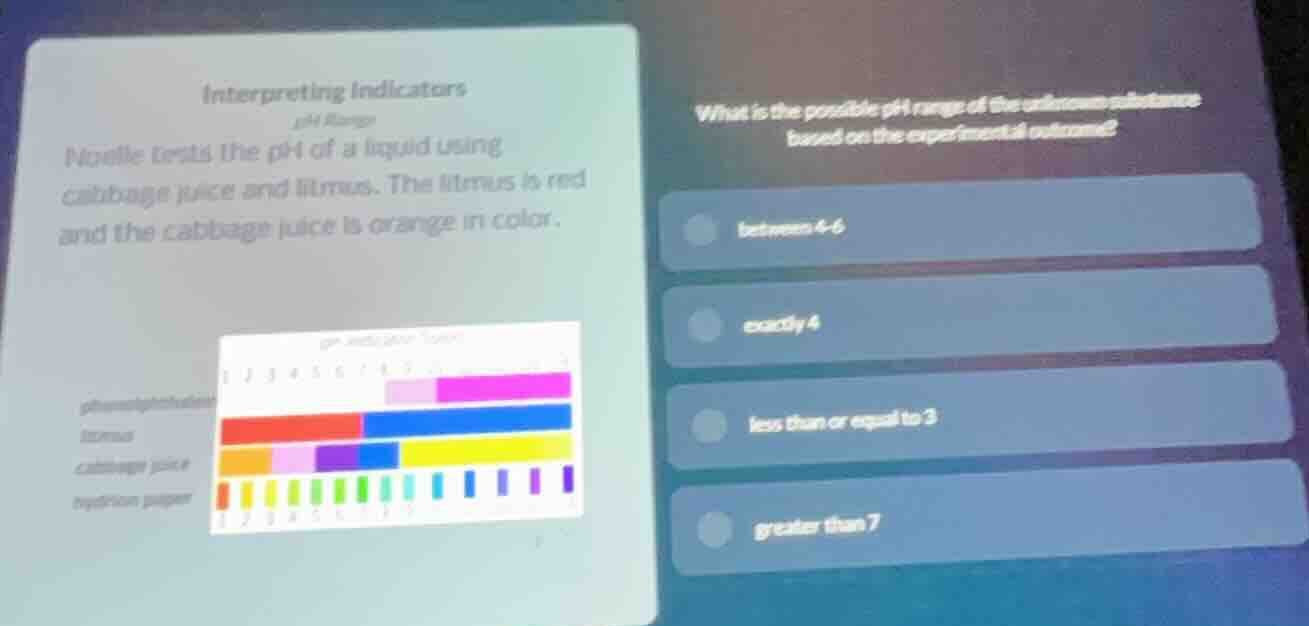
noelle tests the ph of a liquid using cabbage juice and litmus. the litmus is red and the cabbage juice is orange in color.
what is the possible ph range of the unknown substance based on the experimental outcome?
- between 4-6
- exactly 4
- less than or equal to 3
- greater than 7
Analyze the litmus paper result
The problem states that the litmus paper is red. Looking at the pH indicator chart:
- Litmus is red in the pH range from \(1\) to \(5\) (represented by the red bar).
- Litmus turns blue starting at pH \(6\) and above (represented by the blue bar).
- Therefore, a red litmus result indicates a pH of \(5\) or less:
This uses our understanding of pH Indicators and Litmus Paper Color.
Analyze the cabbage juice result
The problem states that the cabbage juice is orange in color. Looking at the pH indicator chart:
- Cabbage juice is orange in the pH range from \(1\) to \(3\) (represented by the orange bar).
- It turns pink/purple at pH \(4\) to \(5\), blue/green at pH \(6\) to \(7\), and yellow at pH \(8\) and above.
- Therefore, an orange cabbage juice result indicates a pH of \(3\) or less:
Determine the overlapping pH range
To find the possible pH range of the unknown substance, we find the intersection of both indicator ranges:
- From litmus: \(\text{pH} \le 5\)
- From cabbage juice: \(\text{pH} \le 3\)
- Combining these two conditions:
This means the pH must be less than or equal to 3.

Snap & solve any problem in the app
Get step-by-step solutions on Sovi AI
Photo-based solutions with guided steps
Explore more problems and detailed explanations
- (A) between 4-6
- (B) exactly 4
- (C) less than or equal to 3 (Correct answer)
- (D) greater than 7