QUESTION IMAGE
Question
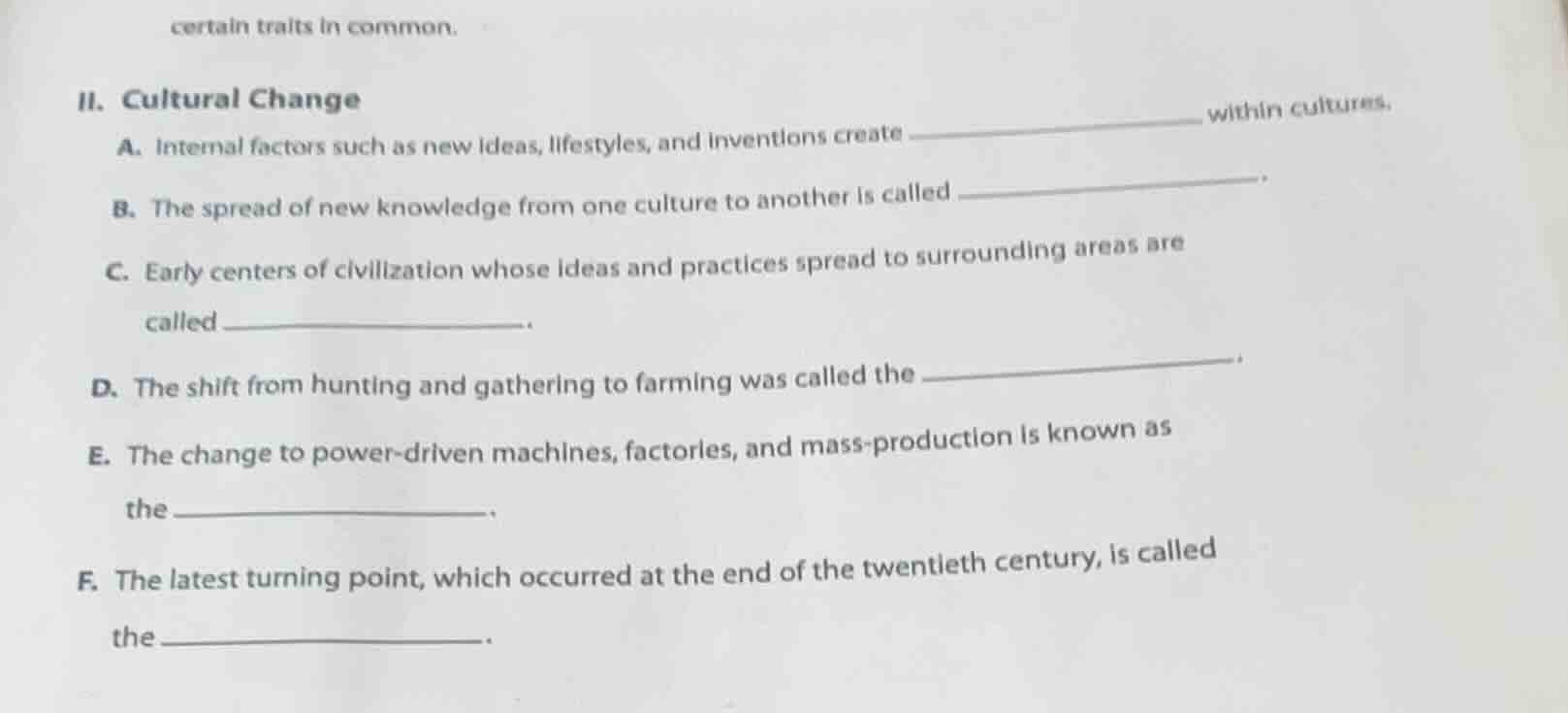
ii. cultural change
a. internal factors such as new ideas, lifestyles, and inventions create ________ within cultures.
b. the spread of new knowledge from one culture to another is called ________.
c. early centers of civilization whose ideas and practices spread to surrounding areas are called ________.
d. the shift from hunting and gathering to farming was called the ________.
e. the change to power-driven machines, factories, and mass-production is known as the ________.
f. the latest turning point, which occurred at the end of the twentieth century, is called the ________.
<pre_analysis>
{
"quality": "clear",
"question_count": 6,
"skills_matched": [
"direct_cot",
"blank_filling_formatter",
"explain_then_answer",
"tutor"
],
"needs_drawing": false,
"concepts_used": [
"Cultural Change"
],
"new_concepts": [
"Agricultural Revolution",
"Industrial Revolution",
"Information Revolution"
],
"current_concepts": [
"Cultural Change",
"Cultural Diffusion",
"Culture Hearths",
"Agricultural Revolution",
"Industrial Revolution",
"Information Revolution"
]
}
</pre_analysis>
<reasoning>
Analyze internal cultural change
We examine how internal factors drive cultural development. New ideas, lifestyles, and inventions create change from within. This process is known as Cultural Change or innovation.
Define spatial cultural spread
We analyze the movement of cultural traits across space. The spread of knowledge, ideas, and behaviors from one culture to another is called cultural diffusion.
Identify historical origin centers
We identify the geographical origins of major cultural developments. Early centers of civilization whose ideas and practices spread to surrounding areas are called culture hearths.
Trace major historical transitions
We examine key turning points in human history. The shift from hunting and gathering to farming is the Agricultural Revolution. The transition to power-driven machines and factories is the Industrial Revolution. The late twentieth-century shift to digital technology is the Information Revolution.
</reasoning>
<answer>
Question A
A. Internal factors such as new ideas, lifestyles, and inventions create <blank>change</blank> within cultures.
Question B
B. The spread of new knowledge from one culture to another is called <blank>cultural diffusion</blank>.
Question C
C. Early centers of civilization whose ideas and practices spread to surrounding areas are called <blank>culture hearths</blank>.
Question D
D. The shift from hunting and gathering to farming was called the <blank>Agricultural Revolution</blank>.
Question E
E. The change to power-driven machines, factories, and mass-production is known as the <blank>Industrial Revolution</blank>.
Question F
F. The latest turning point, which occurred at the end of the twentieth century, is called the <blank>Information Revolution</blank>.
</answer>
<post_analysis>
{
"subject": "Social Science",
"question_type": "Fill-in-the-blank",
"knowledge_point": [
"Social Science",
"Geography",
"Cultural Geography"
]
}
</post_analysis>
Snap & solve any problem in the app
Get step-by-step solutions on Sovi AI
Photo-based solutions with guided steps
Explore more problems and detailed explanations
<pre_analysis>
{
"quality": "clear",
"question_count": 6,
"skills_matched": [
"direct_cot",
"blank_filling_formatter",
"explain_then_answer",
"tutor"
],
"needs_drawing": false,
"concepts_used": [
"Cultural Change"
],
"new_concepts": [
"Agricultural Revolution",
"Industrial Revolution",
"Information Revolution"
],
"current_concepts": [
"Cultural Change",
"Cultural Diffusion",
"Culture Hearths",
"Agricultural Revolution",
"Industrial Revolution",
"Information Revolution"
]
}
</pre_analysis>
<reasoning>
Analyze internal cultural change
We examine how internal factors drive cultural development. New ideas, lifestyles, and inventions create change from within. This process is known as Cultural Change or innovation.
Define spatial cultural spread
We analyze the movement of cultural traits across space. The spread of knowledge, ideas, and behaviors from one culture to another is called cultural diffusion.
Identify historical origin centers
We identify the geographical origins of major cultural developments. Early centers of civilization whose ideas and practices spread to surrounding areas are called culture hearths.
Trace major historical transitions
We examine key turning points in human history. The shift from hunting and gathering to farming is the Agricultural Revolution. The transition to power-driven machines and factories is the Industrial Revolution. The late twentieth-century shift to digital technology is the Information Revolution.
</reasoning>
<answer>
Question A
A. Internal factors such as new ideas, lifestyles, and inventions create <blank>change</blank> within cultures.
Question B
B. The spread of new knowledge from one culture to another is called <blank>cultural diffusion</blank>.
Question C
C. Early centers of civilization whose ideas and practices spread to surrounding areas are called <blank>culture hearths</blank>.
Question D
D. The shift from hunting and gathering to farming was called the <blank>Agricultural Revolution</blank>.
Question E
E. The change to power-driven machines, factories, and mass-production is known as the <blank>Industrial Revolution</blank>.
Question F
F. The latest turning point, which occurred at the end of the twentieth century, is called the <blank>Information Revolution</blank>.
</answer>
<post_analysis>
{
"subject": "Social Science",
"question_type": "Fill-in-the-blank",
"knowledge_point": [
"Social Science",
"Geography",
"Cultural Geography"
]
}
</post_analysis>