QUESTION IMAGE
Question
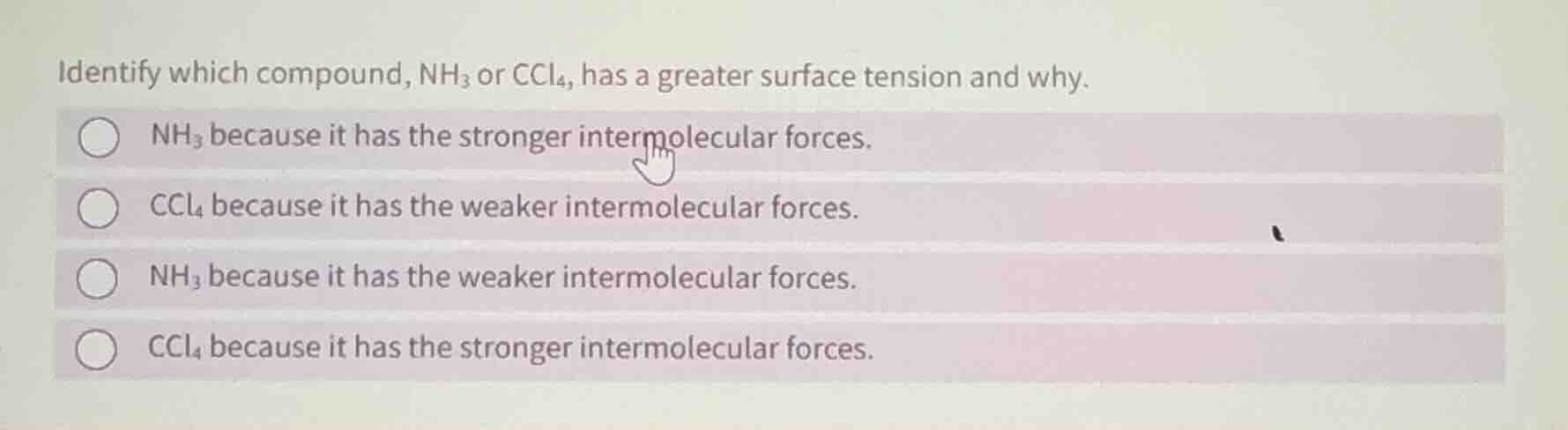
identify which compound, \\(\text{nh}_3\\) or \\(\text{ccl}_4\\), has a greater surface tension and why.
\\(\text{nh}_3\\) because it has the stronger intermolecular forces.
\\(\text{ccl}_4\\) because it has the weaker intermolecular forces.
\\(\text{nh}_3\\) because it has the weaker intermolecular forces.
\\(\text{ccl}_4\\) because it has the stronger intermolecular forces.
Analyze intermolecular forces
Using the Intermolecular Forces knowledge point
- \(\text{NH}_3\) (ammonia) exhibits hydrogen bonding, which is a very strong type of intermolecular force.
- \(\text{CCl}_4\) (carbon tetrachloride) is a nonpolar symmetric molecule that only exhibits weaker London dispersion forces.
Relate forces to surface tension
Using the Surface Tension Factors knowledge point
- Surface tension is directly proportional to the strength of the intermolecular forces holding the liquid molecules together.
- Stronger intermolecular forces lead to a greater surface tension.
- Therefore, \(\text{NH}_3\) has a greater surface tension because it has stronger intermolecular forces.

Snap & solve any problem in the app
Get step-by-step solutions on Sovi AI
Photo-based solutions with guided steps
Explore more problems and detailed explanations
- (A) \(\text{NH}_3\) because it has the stronger intermolecular forces. (Correct answer)
- (B) \(\text{CCl}_4\) because it has the weaker intermolecular forces.
- (C) \(\text{NH}_3\) because it has the weaker intermolecular forces.
- (D) \(\text{CCl}_4\) because it has the stronger intermolecular forces.