QUESTION IMAGE
Question
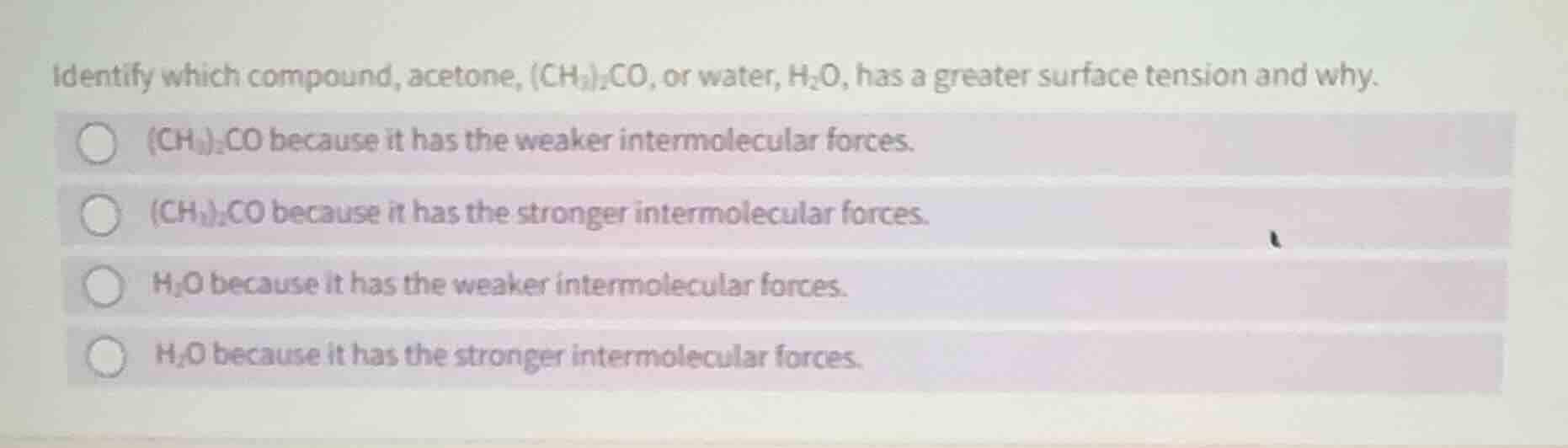
identify which compound, acetone, \\((\text{ch}_3)_2\text{co}\\), or water, \\((\text{h}_2\text{o})\\), has a greater surface tension and why.
\\((\text{ch}_3)_2\text{co}\\) because it has the weaker intermolecular forces.
\\((\text{ch}_3)_2\text{co}\\) because it has the stronger intermolecular forces.
\\(\text{h}_2\text{o}\\) because it has the weaker intermolecular forces.
\\(\text{h}_2\text{o}\\) because it has the stronger intermolecular forces.
Identify intermolecular forces in each compound
Using the Hydrogen Bonding and Intermolecular Forces knowledge points
- Water, \(\text{H}_2\text{O}\), exhibits strong hydrogen bonding.
- Acetone, \((\text{CH}_3)_2\text{CO}\), exhibits weaker dipole-dipole interactions.
Relate intermolecular forces to surface tension
Using the Intermolecular Forces knowledge point
- Stronger intermolecular forces lead to greater surface tension.
- Water has stronger intermolecular forces than acetone.
Determine the correct option
Using the Intermolecular Forces knowledge point
- \(\text{H}_2\text{O}\) has a greater surface tension.
- This is because it has stronger intermolecular forces.

Snap & solve any problem in the app
Get step-by-step solutions on Sovi AI
Photo-based solutions with guided steps
Explore more problems and detailed explanations
- (A) \((\text{CH}_3)_2\text{CO}\) because it has the weaker intermolecular forces.
- (B) \((\text{CH}_3)_2\text{CO}\) because it has the stronger intermolecular forces.
- (C) \(\text{H}_2\text{O}\) because it has the weaker intermolecular forces.
- (D) \(\text{H}_2\text{O}\) because it has the stronger intermolecular forces. (Correct answer)