Sovi.AI - AI Math Tutor

Scan to solve math questions

QUESTION IMAGE

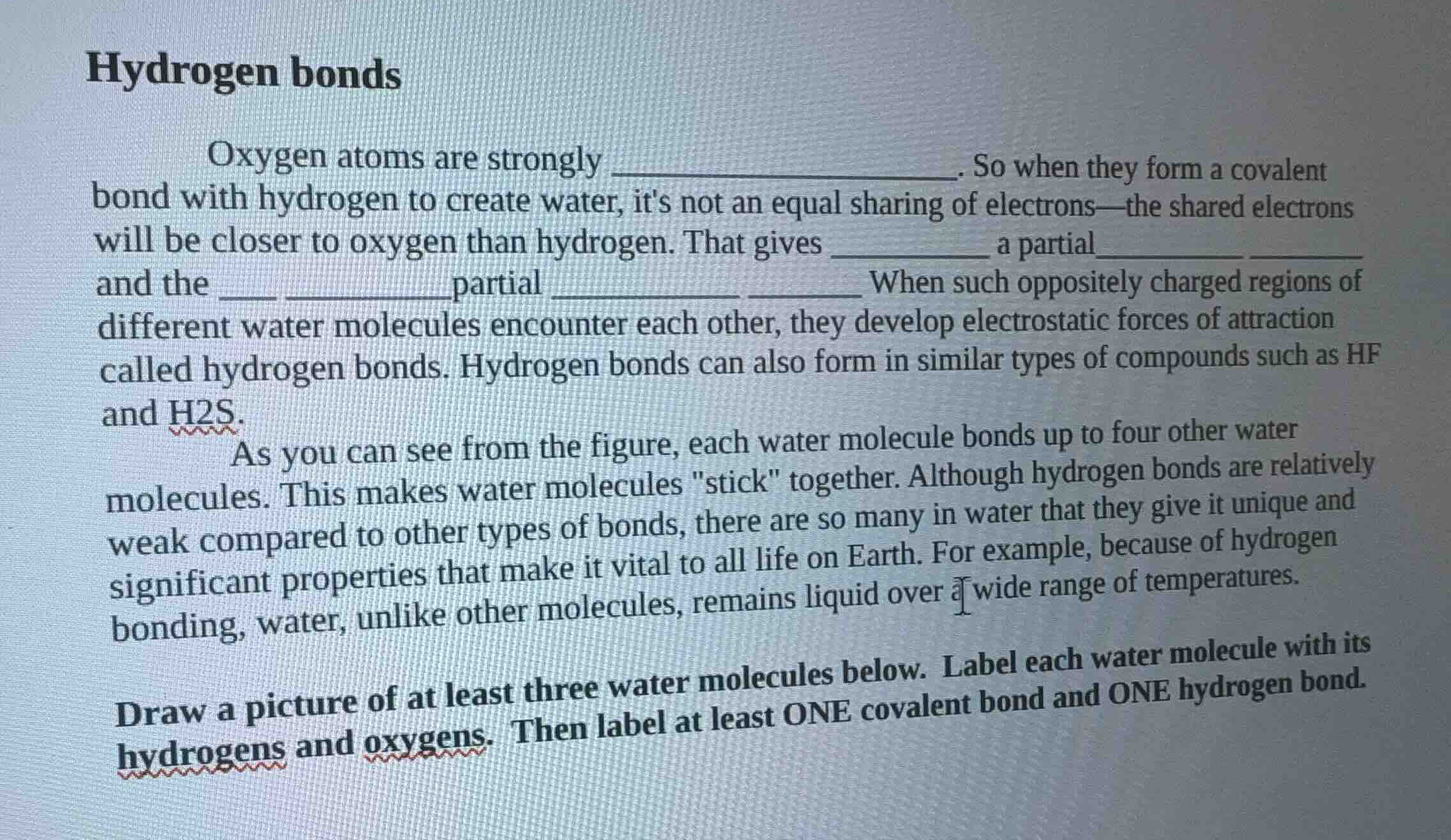
hydrogen bonds oxygen atoms are strongly _______________. so when they …

Question

hydrogen bonds

oxygen atoms are strongly _____________. so when they form a covalent bond with hydrogen to create water, its not an equal sharing of electrons—the shared electrons will be closer to oxygen than hydrogen. that gives ___________ a partial ___________ and the ___________ partial _____________. when such oppositely charged regions of different water molecules encounter each other, they develop electrostatic forces of attraction called hydrogen bonds. hydrogen bonds can also form in similar types of compounds such as hf and h2s.

as you can see from the figure, each water molecule bonds up to four other water molecules. this makes water molecules \stick\ together. although hydrogen bonds are relatively weak compared to other types of bonds, there are so many in water that they give it unique and significant properties that make it vital to all life on earth. for example, because of hydrogen bonding, water, unlike other molecules, remains liquid over a wide range of temperatures.

draw a picture of at least three water molecules below. label each water molecule with its hydrogens and oxygens. then label at least one covalent bond and one hydrogen bond.

Explanation:

Response

<pre_analysis>
{
"quality": "clear",
"question_count": 2,
"skills_matched": [
"direct_cot",
"blank_filling_formatter",
"explain_then_answer",
"tutor",
"mastery_adaptive_brevity"
],
"needs_drawing": true,
"concepts_used": [
"Properties of Water",
"Hydrogen Bonding",
"Water Chemistry",
"Covalent Bonding",
"Polarity"
],
"new_concepts": [],
"current_concepts": [
"Properties of Water",
"Hydrogen Bonding",
"Water Chemistry",
"Covalent Bonding",
"Polarity"
]
}
</pre_analysis>

<reasoning>

Completar el texto sobre puentes de hidrógeno

Using the Polarity and Water Chemistry knowledge points
Para completar el primer párrafo, analizamos la electronegatividad y la distribución de cargas en la molécula de agua:

  • Los átomos de oxígeno son fuertemente electronegativos (electronegative).
  • Al compartir electrones de forma desigual con el hidrógeno, el oxígeno atrae más los electrones, adquiriendo una carga parcial negativa (negative).
  • Los átomos de hidrógeno, al quedar con menor densidad electrónica, adquieren una carga parcial positiva (positive).

Por lo tanto, el texto completo en inglés es:
"Oxygen atoms are strongly electronegative. So when they form a covalent bond with hydrogen to create water, it's not an equal sharing of electrons—the shared electrons will be closer to oxygen than hydrogen. That gives oxygen a partial negative charge and the hydrogen partial positive charge."

Identificar enlaces y dibujar las moléculas de agua

Using the Hydrogen Bonding and Covalent Bonding knowledge points
Para la segunda parte de la tarea, representamos tres moléculas de agua \(H_2O\):

  • Cada molécula tiene un átomo de oxígeno central (O) unido covalentemente a dos átomos de hidrógeno (H).
  • Los enlaces covalentes intramoleculares se forman entre el O y los H de la misma molécula.
  • Los puentes de hidrógeno intermoleculares se forman por la atracción electrostática entre el O (con carga parcial negativa \(\delta^-\)) de una molécula y el H (con carga parcial positiva \(\delta^+\)) de otra molécula vecina.

</reasoning>

<answer>

Question 1

Oxygen atoms are strongly <blank>electronegative</blank>. So when they form a covalent bond with hydrogen to create water, it's not an equal sharing of electrons—the shared electrons will be closer to oxygen than hydrogen. That gives <blank>oxygen</blank> a partial <blank>negative charge</blank> and the <blank>hydrogen</blank> partial <blank>positive charge</blank>.

Question 2

Para dibujar y etiquetar las tres moléculas de agua con sus respectivos átomos y enlaces, puedes guiarte por el siguiente esquema estructural:

      H (δ+)
     /  (Enlace covalente)
    O (δ-)
     \
      H (δ+)  - - - - -  O (δ-)
             (Puente de     /   \
              hidrógeno)   H     H
                           (δ+)  (δ+)
                            |
                          - - - - - (Puente de hidrógeno)
                            |
                            O (δ-)
                           /   \
                          H     H

Etiquetas clave para tu dibujo:

  1. Átomos: Identifica cada Oxígeno (O) y cada Hidrógeno (H) en las tres moléculas.
  2. Enlace Covalente: Señala una de las líneas continuas que unen directamente al oxígeno con el hidrógeno dentro de la misma molécula de agua.
  3. Puente de Hidrógeno: Señala la línea discontinua o de puntos (\(- - -\)) que une el átomo de oxígeno (\(\delta^-\)) de una molécula con el átomo de hidrógeno (\(\delta^+\…

Answer:

<pre_analysis>
{
"quality": "clear",
"question_count": 2,
"skills_matched": [
"direct_cot",
"blank_filling_formatter",
"explain_then_answer",
"tutor",
"mastery_adaptive_brevity"
],
"needs_drawing": true,
"concepts_used": [
"Properties of Water",
"Hydrogen Bonding",
"Water Chemistry",
"Covalent Bonding",
"Polarity"
],
"new_concepts": [],
"current_concepts": [
"Properties of Water",
"Hydrogen Bonding",
"Water Chemistry",
"Covalent Bonding",
"Polarity"
]
}
</pre_analysis>

<reasoning>

Completar el texto sobre puentes de hidrógeno

Using the Polarity and Water Chemistry knowledge points
Para completar el primer párrafo, analizamos la electronegatividad y la distribución de cargas en la molécula de agua:

  • Los átomos de oxígeno son fuertemente electronegativos (electronegative).
  • Al compartir electrones de forma desigual con el hidrógeno, el oxígeno atrae más los electrones, adquiriendo una carga parcial negativa (negative).
  • Los átomos de hidrógeno, al quedar con menor densidad electrónica, adquieren una carga parcial positiva (positive).

Por lo tanto, el texto completo en inglés es:
"Oxygen atoms are strongly electronegative. So when they form a covalent bond with hydrogen to create water, it's not an equal sharing of electrons—the shared electrons will be closer to oxygen than hydrogen. That gives oxygen a partial negative charge and the hydrogen partial positive charge."

Identificar enlaces y dibujar las moléculas de agua

Using the Hydrogen Bonding and Covalent Bonding knowledge points
Para la segunda parte de la tarea, representamos tres moléculas de agua \(H_2O\):

  • Cada molécula tiene un átomo de oxígeno central (O) unido covalentemente a dos átomos de hidrógeno (H).
  • Los enlaces covalentes intramoleculares se forman entre el O y los H de la misma molécula.
  • Los puentes de hidrógeno intermoleculares se forman por la atracción electrostática entre el O (con carga parcial negativa \(\delta^-\)) de una molécula y el H (con carga parcial positiva \(\delta^+\)) de otra molécula vecina.

</reasoning>

<answer>

Question 1

Oxygen atoms are strongly <blank>electronegative</blank>. So when they form a covalent bond with hydrogen to create water, it's not an equal sharing of electrons—the shared electrons will be closer to oxygen than hydrogen. That gives <blank>oxygen</blank> a partial <blank>negative charge</blank> and the <blank>hydrogen</blank> partial <blank>positive charge</blank>.

Question 2

Para dibujar y etiquetar las tres moléculas de agua con sus respectivos átomos y enlaces, puedes guiarte por el siguiente esquema estructural:

      H (δ+)
     /  (Enlace covalente)
    O (δ-)
     \
      H (δ+)  - - - - -  O (δ-)
             (Puente de     /   \
              hidrógeno)   H     H
                           (δ+)  (δ+)
                            |
                          - - - - - (Puente de hidrógeno)
                            |
                            O (δ-)
                           /   \
                          H     H

Etiquetas clave para tu dibujo:

  1. Átomos: Identifica cada Oxígeno (O) y cada Hidrógeno (H) en las tres moléculas.
  2. Enlace Covalente: Señala una de las líneas continuas que unen directamente al oxígeno con el hidrógeno dentro de la misma molécula de agua.
  3. Puente de Hidrógeno: Señala la línea discontinua o de puntos (\(- - -\)) que une el átomo de oxígeno (\(\delta^-\)) de una molécula con el átomo de hidrógeno (\(\delta^+\)) de otra molécula diferente.

</answer>

<plot>
{
"elements": [
{
"type": "point",
"params": [[-2, 2]],
"properties": {
"name": "O1 (δ-)",
"size": 6,
"color": "#F2557F",
"withLabel": true
}
},
{
"type": "point",
"params": [[-3.5, 1]],
"properties": {
"name": "H1 (δ+)",
"size": 4,
"color": "#5583F2",
"withLabel": true
}
},
{
"type": "point",
"params": [[-2, 0.2]],
"properties": {
"name": "H2 (δ+)",
"size": 4,
"color": "#5583F2",
"withLabel": true
}
},
{
"type": "segment",
"params": [[-2, 2], [-3.5, 1]],
"properties": {
"strokeColor": "#583C87",
"strokeWidth": 3,
"name": "Enlace Covalente",
"withLabel": false
}
},
{
"type": "segment",
"params": [[-2, 2], [-2, 0.2]],
"properties": {
"strokeColor": "#583C87",
"strokeWidth": 3
}
},
{
"type": "point",
"params": [[1, 0.2]],
"properties": {
"name": "O2 (δ-)",
"size": 6,
"color": "#F2557F",
"withLabel": true
}
},
{
"type": "point",
"params": [[1, -1.6]],
"properties": {
"name": "H3 (δ+)",
"size": 4,
"color": "#5583F2",
"withLabel": true
}
},
{
"type": "point",
"params": [[2.5, 1]],
"properties": {
"name": "H4 (δ+)",
"size": 4,
"color": "#5583F2",
"withLabel": true
}
},
{
"type": "segment",
"params": [[1, 0.2], [1, -1.6]],
"properties": {
"strokeColor": "#583C87",
"strokeWidth": 3
}
},
{
"type": "segment",
"params": [[1, 0.2], [2.5, 1]],
"properties": {
"strokeColor": "#583C87",
"strokeWidth": 3
}
},
{
"type": "segment",
"params": [[-2, 0.2], [1, 0.2]],
"properties": {
"strokeColor": "#8C55F2",
"strokeWidth": 2,
"dash": 2,
"name": "Puente de Hidrógeno",
"withLabel": false
}
},
{
"type": "point",
"params": [[-1, -2.5]],
"properties": {
"name": "O3 (δ-)",
"size": 6,
"color": "#F2557F",
"withLabel": true
}
},
{
"type": "point",
"params": [[-2.5, -3.5]],
"properties": {
"name": "H5 (δ+)",
"size": 4,
"color": "#5583F2",
"withLabel": true
}
},
{
"type": "point",
"params": [[-0.5, -4]],
"properties": {
"name": "H6 (δ+)",
"size": 4,
"color": "#5583F2",
"withLabel": true
}
},
{
"type": "segment",
"params": [[-1, -2.5], [-2.5, -3.5]],
"properties": {
"strokeColor": "#583C87",
"strokeWidth": 3
}
},
{
"type": "segment",
"params": [[-1, -2.5], [-0.5, -4]],
"properties": {
"strokeColor": "#583C87",
"strokeWidth": 3
}
},
{
"type": "segment",
"params": [[1, -1.6], [-1, -2.5]],
"properties": {
"strokeColor": "#8C55F2",
"strokeWidth": 2,
"dash": 2
}
},
{
"type": "text",
"params": [[-3.8, 2.2], "Enlace Covalente (Línea continua)"]
},
{
"type": "text",
"params": [[-1.2, 0.6], "Puente de Hidrógeno (Línea discontinua)"]
}
]
}
</plot>

<post_analysis>
{
"subject": "Natural Science",
"question_type": "Fill-in-the-blank",
"knowledge_point": [
"Natural Science",
"Chemistry",
"Hydrogen Bonding"
]
}
</post_analysis>