QUESTION IMAGE
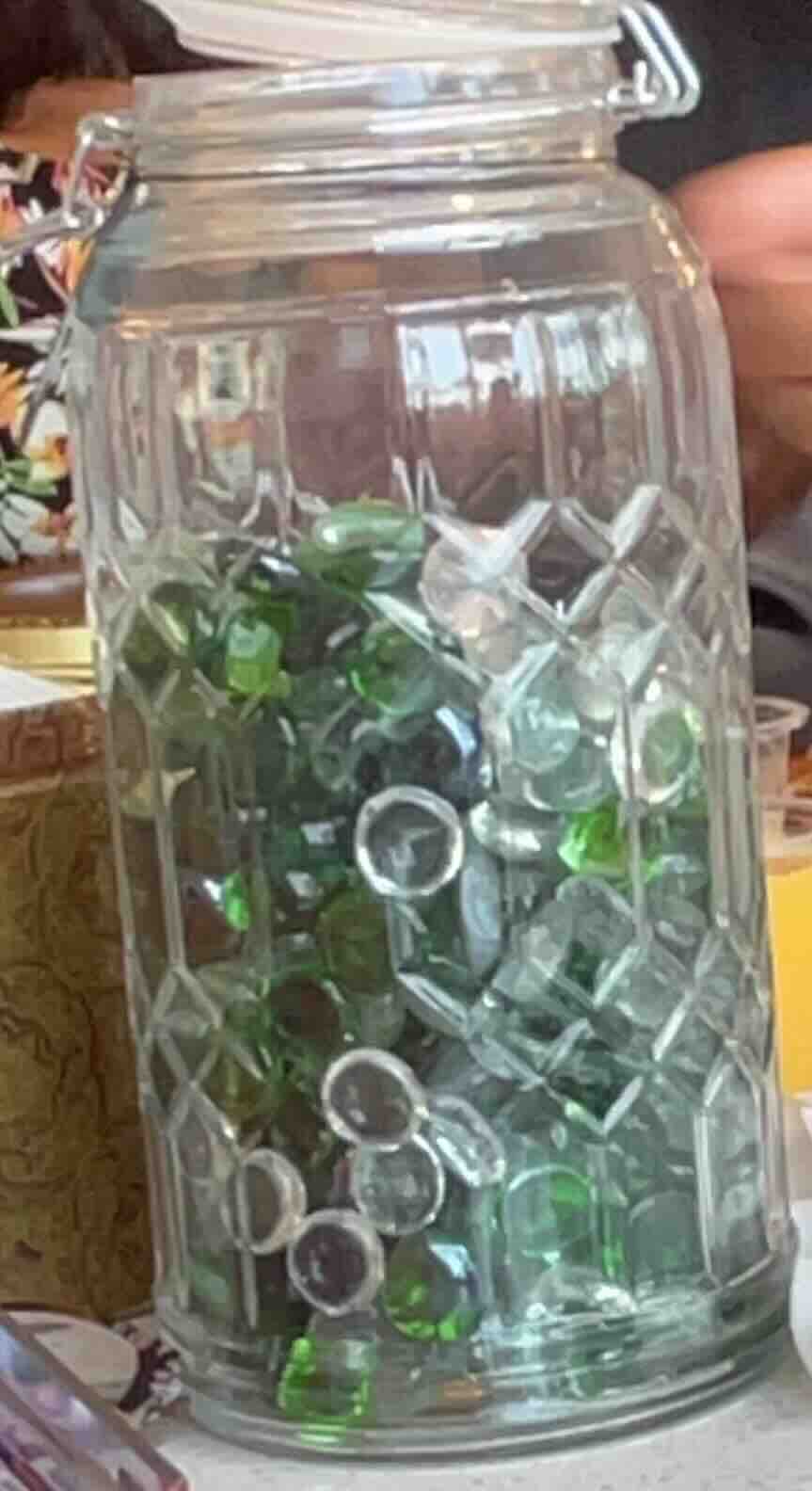
Question
Question was provided via image upload.
🆕 New Concept Discovered: Volume Estimation by Packing
Using container dimensions and item sizes to estimate quantities.
Step 1: Analyze the shape and dimensions of the jar
To estimate the number of glass gems in the jar, we first estimate the volume of the container.
- The jar is a cylinder with a patterned surface.
- Based on standard kitchen storage jars of this style (with a wire-bale clasp lid), it is typically a 1-liter (1000 mL) or 1.5-liter (1500 mL) jar. Looking at the scale relative to the hands and objects in the background, this is likely a 1-liter jar (\(1000\text{ cm}^3\)).
- The jar is not completely full; it is filled to about \(70\%\) of its total capacity.
- Estimated volume occupied by the gems:
Step 2: Estimate the volume of a single glass gem
The items inside are flat-bottomed glass gems (often used as vase fillers).
- A typical medium-sized glass gem has a diameter of about \(1.8\text{ cm}\) to \(2.0\text{ cm}\) and a thickness of about \(0.8\text{ cm}\).
- We can approximate its shape as a small cylinder or disk:
Step 3: Account for the packing density (void space)
Randomly poured flat glass gems do not pack perfectly. They leave empty air spaces (voids) between them.
- For randomly packed oblate spheroids or flat disks, the packing fraction (how much space is actually filled by solid glass) is typically around \(60\%\) to \(65\%\). This means about \(35\%\) to \(40\%\) of the occupied volume is empty air.
- Effective volume occupied by solid glass:
Step 4: Calculate the estimated count
Divide the total solid volume by the volume of a single gem:
Given the variations in packing and exact jar size, a reasonable estimate range is between 180 and 240 gems.

Snap & solve any problem in the app
Get step-by-step solutions on Sovi AI
Photo-based solutions with guided steps
Explore more problems and detailed explanations
Approximately 210 gems (with a likely range of 180 to 240).