QUESTION IMAGE
Question
Question was provided via image upload.
Identify the chemical structures
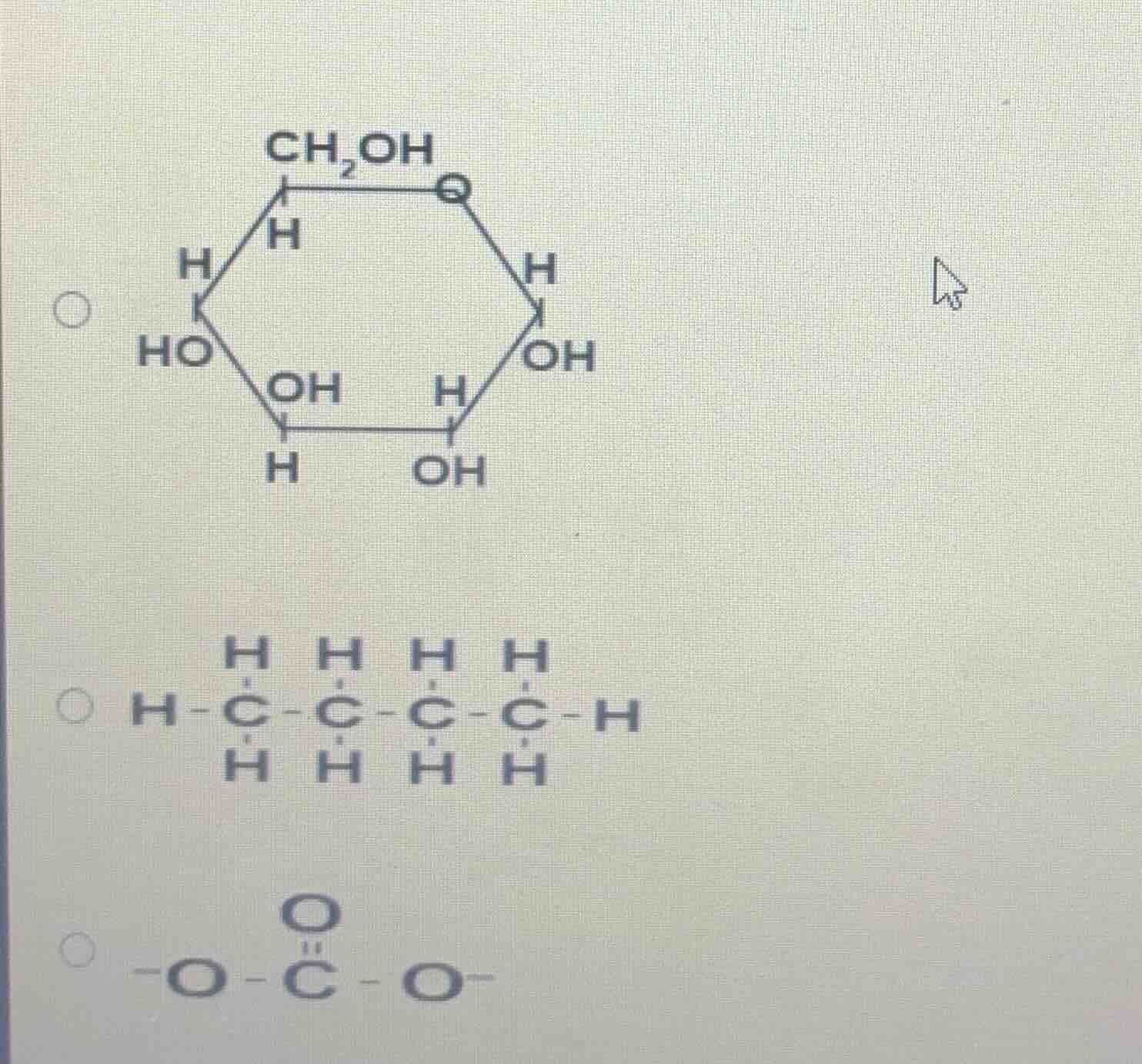
The image displays three chemical structures with selection radio buttons next to them:
- The first structure is a cyclic six-membered ring containing carbon, hydrogen, and oxygen (specifically, a glucose molecule, which is a monosaccharide).
- The second structure is a straight-chain alkane with four carbon atoms, \( \text{C}_4\text{H}_{10} \) (butane).
- The third structure is a carbonate ion, \( \text{CO}_3^{2-} \), showing a central carbon double-bonded to one oxygen and single-bonded to two negatively charged oxygen atoms.
Apply classification rules
Using the Organic Compounds and Inorganic Compounds concepts:
- Organic compounds are primarily carbon-based molecules containing carbon-hydrogen (\(\text{C-H}\)) bonds. Both glucose (the first structure) and butane (the second structure) contain carbon backbones with covalent \(\text{C-H}\) bonds, classifying them as organic.
- Inorganic carbon compounds include simple carbon oxides (like \(\text{CO}_2\)), carbonates (\(\text{CO}_3^{2-}\)), bicarbonates (\(\text{HCO}_3^-\)), and cyanides (\(\text{CN}^-\)). These lack \(\text{C-H}\) bonds and behave chemically as inorganic salts.
Determine the target question
Based on the student's profile and memory summary, the student is exploring classifications of organic versus inorganic compounds. The third structure, the carbonate ion (\(\text{CO}_3^{2-}\)), represents an inorganic carbon-containing species, while the first two are organic.

Snap & solve any problem in the app
Get step-by-step solutions on Sovi AI
Photo-based solutions with guided steps
Explore more problems and detailed explanations
- (A) Glucose (cyclic organic molecule containing carbon, hydrogen, and oxygen)
- (B) Butane (organic hydrocarbon chain containing carbon and hydrogen)
- (C) Carbonate ion (inorganic carbon-containing polyatomic ion) (Correct answer)