QUESTION IMAGE
Question
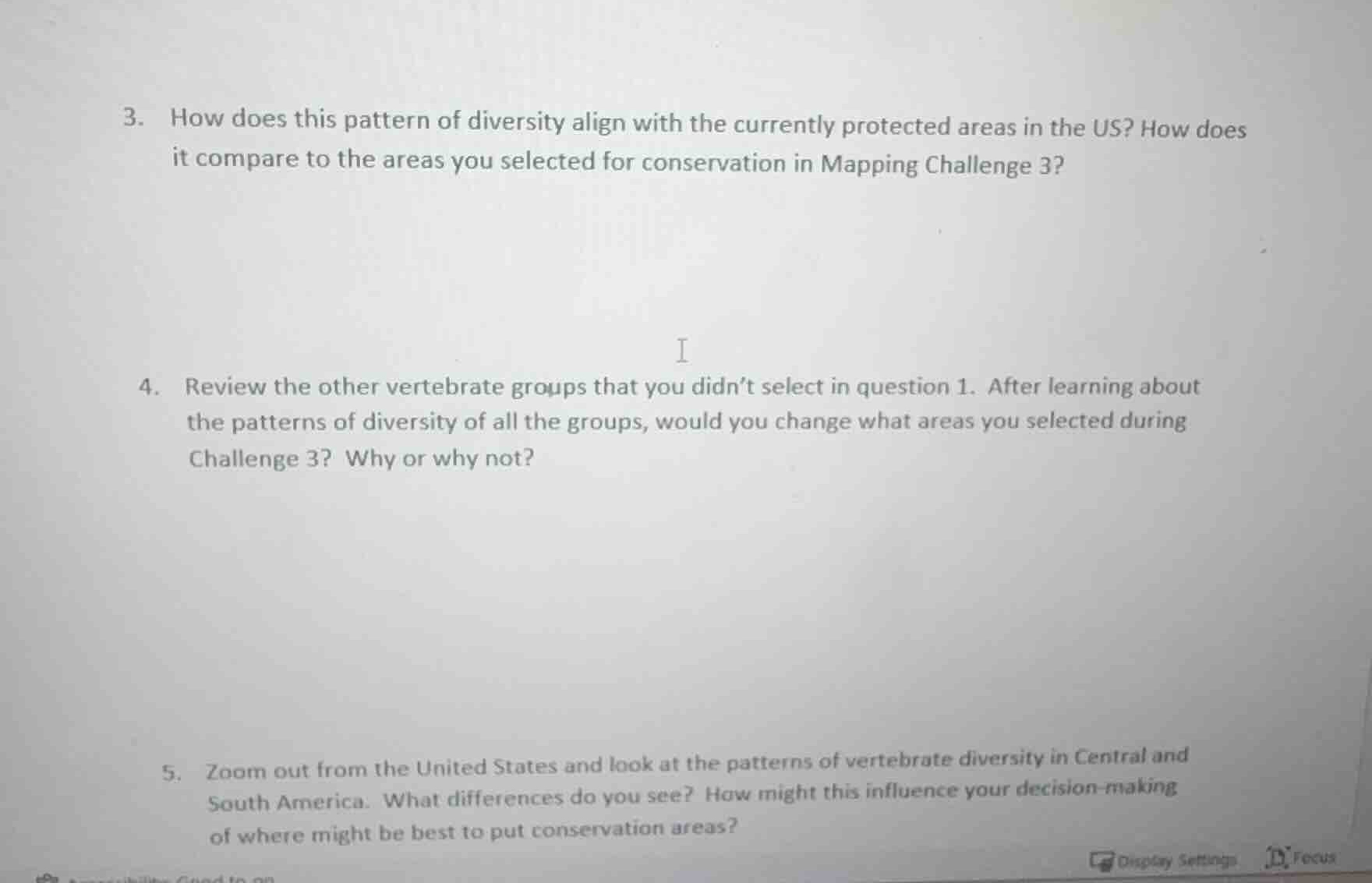
- how does this pattern of diversity align with the currently protected areas in the us? how does it compare to the areas you selected for conservation in mapping challenge 3?
- review the other vertebrate groups that you didnt select in question 1. after learning about the patterns of diversity of all the groups, would you change what areas you selected during challenge 3? why or why not?
- zoom out from the united states and look at the patterns of vertebrate diversity in central and south america. what differences do you see? how might this influence your decision-making of where might be best to put conservation areas?
<pre_analysis>
{
"quality": "clear",
"question_count": 3,
"skills_matched": [
"direct_cot",
"explain_then_answer",
"tutor"
],
"needs_drawing": false,
"concepts_used": [
"Biodiversity Mapping",
"Conservation Biology",
"Protected Area Coverage"
],
"new_concepts": [
"Vertebrate Diversity Patterns",
"Conservation Decision-Making"
],
"current_concepts": [
"Biodiversity Mapping",
"Conservation Biology",
"Protected Area Coverage",
"Vertebrate Diversity Patterns",
"Conservation Decision-Making"
]
}
</pre_analysis>
<reasoning>
Analyze alignment with protected areas
This step evaluates how biodiversity patterns match current reserves.
- Biodiversity Mapping shows high species richness in specific regions (e.g., the US Southeast).
- Protected Area Coverage is often concentrated in different regions (e.g., the federal lands of the US West).
- This creates a spatial mismatch between high-biodiversity zones and actual protected land.
Evaluate vertebrate group patterns
This step examines how different taxa influence conservation priorities.
- Different vertebrate groups (birds, mammals, amphibians, reptiles) have distinct geographic hotspots.
- Incorporating all groups reveals that a single taxon's hotspot may miss critical diversity in another.
- Conservation Biology requires representing all taxonomic groups, which often necessitates expanding or shifting selected conservation areas to maximize total species protection.
Compare continental scale diversity
This step analyzes global versus regional biodiversity gradients.
- Zooming out to Central and South America reveals significantly higher absolute species richness (latitudinal diversity gradient).
- Tropical regions contain dense concentrations of endemic species compared to temperate North America.
- This scale shift influences decision-making by highlighting global conservation priorities over local ones, directing resources where they can protect the greatest number of species.
</reasoning>
<answer>
Question 3
The pattern of high biodiversity (often concentrated in the US Southeast) shows a significant mismatch with currently protected areas, which are heavily concentrated on federal lands in the US West. When compared to areas selected in Mapping Challenge 3, the Western reserves often fail to cover the high-priority species richness zones identified in the East.
Question 4
Yes, incorporating all vertebrate groups typically requires changing the selected conservation areas. Because different taxa (such as amphibians in the Southeast versus mammals in the West) have non-overlapping hotspots, relying on a single group leaves other highly diverse communities unprotected.
Question 5
Central and South America exhibit vastly higher absolute species richness and endemism compared to the United States due to the latitudinal diversity gradient. This shift in scale influences decision-making by demonstrating that global conservation investments yield much higher biodiversity returns in tropical regions than in temperate ones.
</answer>
<post_analysis>
{
"subject": "Natural Science",
"question_type": "Multi-part",
"knowledge_point": [
"Natural Science",
"Environmental Science",
"Conservation Biology"
]
}
</post_analysis>
Snap & solve any problem in the app
Get step-by-step solutions on Sovi AI
Photo-based solutions with guided steps
Explore more problems and detailed explanations
<pre_analysis>
{
"quality": "clear",
"question_count": 3,
"skills_matched": [
"direct_cot",
"explain_then_answer",
"tutor"
],
"needs_drawing": false,
"concepts_used": [
"Biodiversity Mapping",
"Conservation Biology",
"Protected Area Coverage"
],
"new_concepts": [
"Vertebrate Diversity Patterns",
"Conservation Decision-Making"
],
"current_concepts": [
"Biodiversity Mapping",
"Conservation Biology",
"Protected Area Coverage",
"Vertebrate Diversity Patterns",
"Conservation Decision-Making"
]
}
</pre_analysis>
<reasoning>
Analyze alignment with protected areas
This step evaluates how biodiversity patterns match current reserves.
- Biodiversity Mapping shows high species richness in specific regions (e.g., the US Southeast).
- Protected Area Coverage is often concentrated in different regions (e.g., the federal lands of the US West).
- This creates a spatial mismatch between high-biodiversity zones and actual protected land.
Evaluate vertebrate group patterns
This step examines how different taxa influence conservation priorities.
- Different vertebrate groups (birds, mammals, amphibians, reptiles) have distinct geographic hotspots.
- Incorporating all groups reveals that a single taxon's hotspot may miss critical diversity in another.
- Conservation Biology requires representing all taxonomic groups, which often necessitates expanding or shifting selected conservation areas to maximize total species protection.
Compare continental scale diversity
This step analyzes global versus regional biodiversity gradients.
- Zooming out to Central and South America reveals significantly higher absolute species richness (latitudinal diversity gradient).
- Tropical regions contain dense concentrations of endemic species compared to temperate North America.
- This scale shift influences decision-making by highlighting global conservation priorities over local ones, directing resources where they can protect the greatest number of species.
</reasoning>
<answer>
Question 3
The pattern of high biodiversity (often concentrated in the US Southeast) shows a significant mismatch with currently protected areas, which are heavily concentrated on federal lands in the US West. When compared to areas selected in Mapping Challenge 3, the Western reserves often fail to cover the high-priority species richness zones identified in the East.
Question 4
Yes, incorporating all vertebrate groups typically requires changing the selected conservation areas. Because different taxa (such as amphibians in the Southeast versus mammals in the West) have non-overlapping hotspots, relying on a single group leaves other highly diverse communities unprotected.
Question 5
Central and South America exhibit vastly higher absolute species richness and endemism compared to the United States due to the latitudinal diversity gradient. This shift in scale influences decision-making by demonstrating that global conservation investments yield much higher biodiversity returns in tropical regions than in temperate ones.
</answer>
<post_analysis>
{
"subject": "Natural Science",
"question_type": "Multi-part",
"knowledge_point": [
"Natural Science",
"Environmental Science",
"Conservation Biology"
]
}
</post_analysis>