QUESTION IMAGE
Question
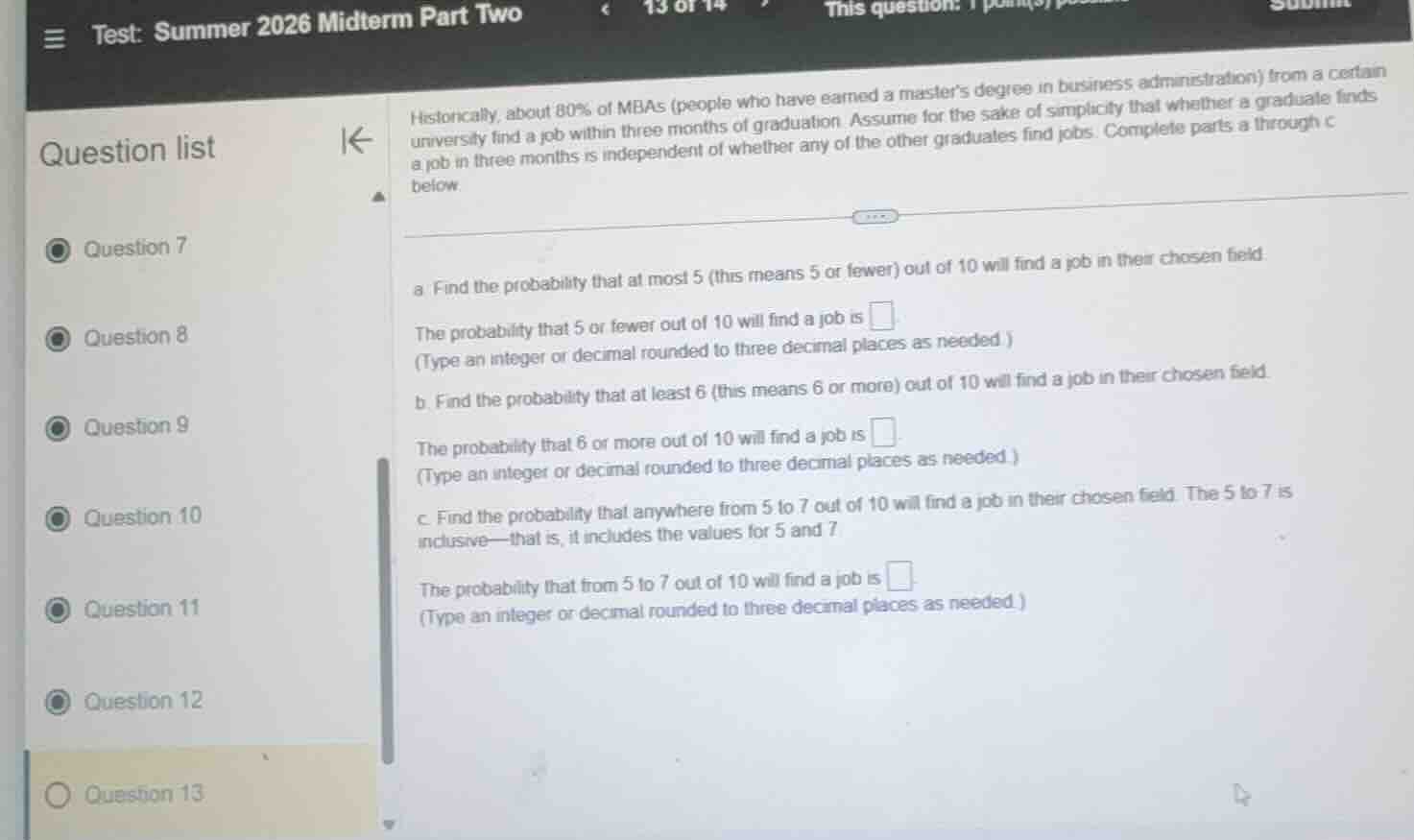
historically, about 80% of mbas (people who have earned a masters degree in business administration) from a certain university find a job within three months of graduation. assume for the sake of simplicity that whether a graduate finds a job in three months is independent of whether any of the other graduates find jobs. complete parts a through c below.
a. find the probability that at most 5 (this means 5 or fewer) out of 10 will find a job in their chosen field.
the probability that 5 or fewer out of 10 will find a job is
(type an integer or decimal rounded to three decimal places as needed.)
b. find the probability that at least 6 (this means 6 or more) out of 10 will find a job in their chosen field.
the probability that 6 or more out of 10 will find a job is
(type an integer or decimal rounded to three decimal places as needed.)
c. find the probability that anywhere from 5 to 7 out of 10 will find a job in their chosen field. the 5 to 7 is inclusive-that is, it includes the values for 5 and 7.
the probability that from 5 to 7 out of 10 will find a job is
(type an integer or decimal rounded to three decimal places as needed.)
🆕 New Concept Discovered: Binomial Probability Distribution
Calculating probabilities for independent yes/no events.
Step 1: Identify the Distribution Parameters
The problem describes a scenario with a fixed number of independent trials, each with two possible outcomes (finding a job or not) and a constant probability of success. This fits a binomial distribution:
- Number of trials: \( n = 10 \)
- Probability of success (finding a job): \( p = 0.80 \)
- Probability of failure: \( q = 1 - p = 0.20 \)
Let \( X \) be the random variable representing the number of graduates who find a job. \( X \sim \text{Binomial}(n = 10, p = 0.80) \).
The probability mass function for a binomial distribution is:
---
Step 2: Solve Part (a)
We need to find the probability that at most 5 out of 10 find a job:
Calculating each term:
- \( P(X = 0) = \binom{10}{0} (0.80)^0 (0.20)^{10} \approx 0.0000001 \)
- \( P(X = 1) = \binom{10}{1} (0.80)^1 (0.20)^9 \approx 0.000004 \)
- \( P(X = 2) = \binom{10}{2} (0.80)^2 (0.20)^8 \approx 0.000074 \)
- \( P(X = 3) = \binom{10}{3} (0.80)^3 (0.20)^7 \approx 0.000786 \)
- \( P(X = 4) = \binom{10}{4} (0.80)^4 (0.20)^6 \approx 0.005505 \)
- \( P(X = 5) = \binom{10}{5} (0.80)^5 (0.20)^5 \approx 0.026424 \)
Summing these values:
Rounded to three decimal places:
---
Step 3: Solve Part (b)
We need to find the probability that at least 6 out of 10 find a job:
Since \( P(X \ge 6) \) is the complement of \( P(X \le 5) \):
Rounded to three decimal places:
---
Step 4: Solve Part (c)
We need to find the probability that from 5 to 7 (inclusive) out of 10 find a job:
We already have:
- \( P(X = 5) \approx 0.026424 \)
Now we calculate \( P(X = 6) \) and \( P(X = 7) \):
- \( P(X = 6) = \binom{10}{6} (0.80)^6 (0.20)^4 = 210 \times 0.262144 \times 0.0016 \approx 0.088080 \)
- \( P(X = 7) = \binom{10}{7} (0.80)^7 (0.20)^3 = 120 \times 0.209715 \times 0.008 \approx 0.201327 \)
Summing these values:
Rounded to three decimal places:

Snap & solve any problem in the app
Get step-by-step solutions on Sovi AI
Photo-based solutions with guided steps
Explore more problems and detailed explanations
- a. The probability that 5 or fewer out of 10 will find a job is 0.033
- b. The probability that 6 or more out of 10 will find a job is 0.967
- c. The probability that from 5 to 7 out of 10 will find a job is 0.316