QUESTION IMAGE
Question
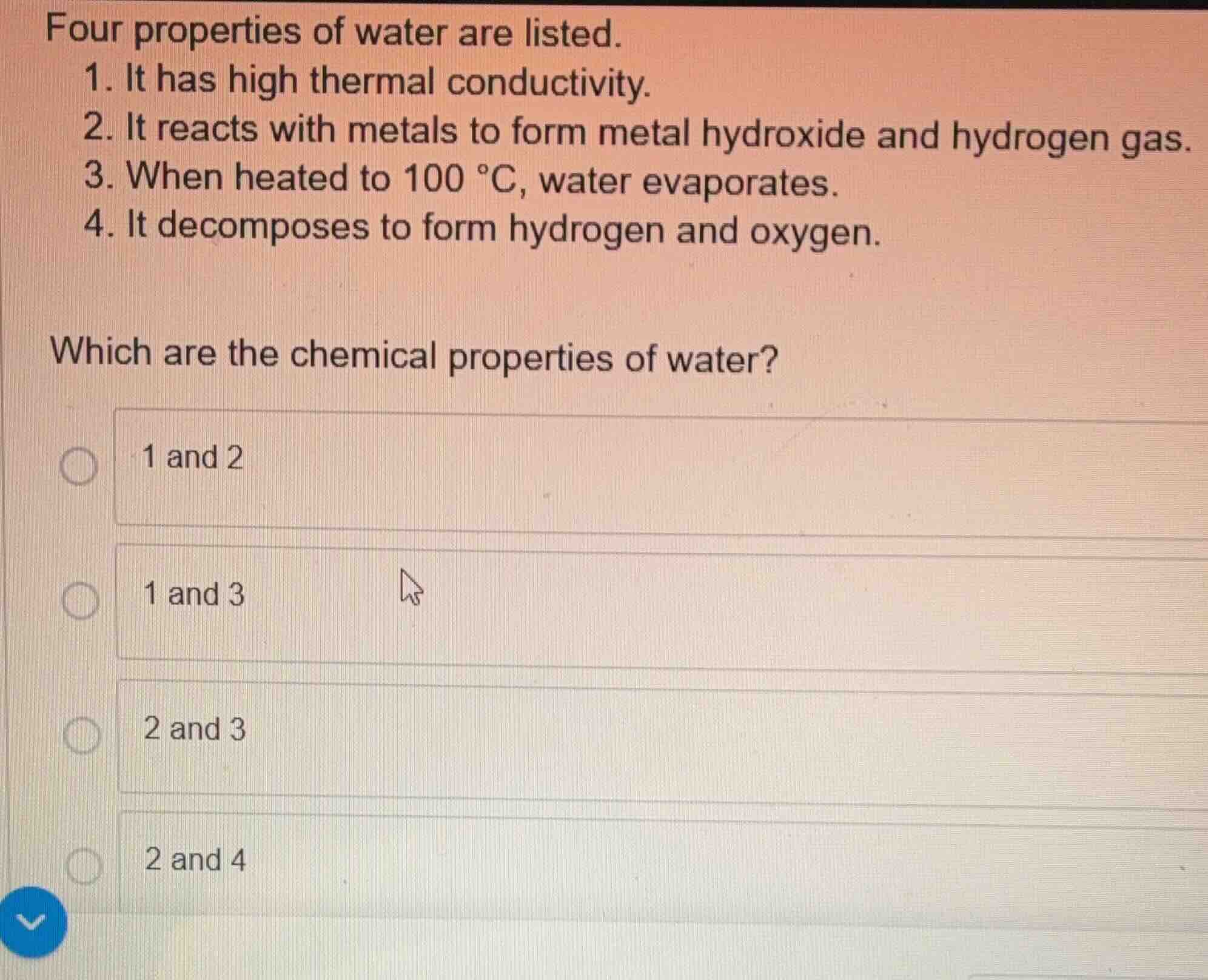
four properties of water are listed.
- it has high thermal conductivity.
- it reacts with metals to form metal hydroxide and hydrogen gas.
- when heated to 100 °c, water evaporates.
- it decomposes to form hydrogen and oxygen.
which are the chemical properties of water?
1 and 2
1 and 3
2 and 3
2 and 4
Define physical and chemical properties
To solve this, we must distinguish between Physical Properties and Chemical Properties. A physical property is a characteristic that can be observed or measured without changing the substance's chemical identity. A chemical property describes the ability of a substance to undergo a specific chemical change, transforming into one or more entirely new substances.
Analyze properties 1 and 3
Let's evaluate the first and third statements:
- Property 1 (Thermal conductivity): This measures how well a substance transfers heat. Observing heat transfer does not alter the chemical composition of water. Therefore, this is a Physical Property.
- Property 3 (Evaporation at \(100\text{ }^\circ\text{C}\)): Evaporation is a phase transition from liquid to gas. The molecules remain \(H_2O\) throughout the process. Since no new substance is formed, this is a Physical Property.
Analyze properties 2 and 4
Now let's evaluate the second and fourth statements:
- Property 2 (Reaction with metals): This describes water reacting with metals to produce new substances (metal hydroxide and hydrogen gas). Because the chemical identity changes, this is a Chemical Property.
- Property 4 (Decomposition): This describes water breaking down chemically into its constituent elements, hydrogen gas and oxygen gas. Since new substances are formed, this is a Chemical Property.
Identify the correct option
Statements 2 and 4 describe chemical properties of water. Looking at the choices:
- 1 and 2
- 1 and 3
- 2 and 3
- 2 and 4
The correct option is "2 and 4".

Snap & solve any problem in the app
Get step-by-step solutions on Sovi AI
Photo-based solutions with guided steps
Explore more problems and detailed explanations
- 1 and 2
- 1 and 3
- 2 and 3
- 2 and 4 (Correct answer)