QUESTION IMAGE
Question
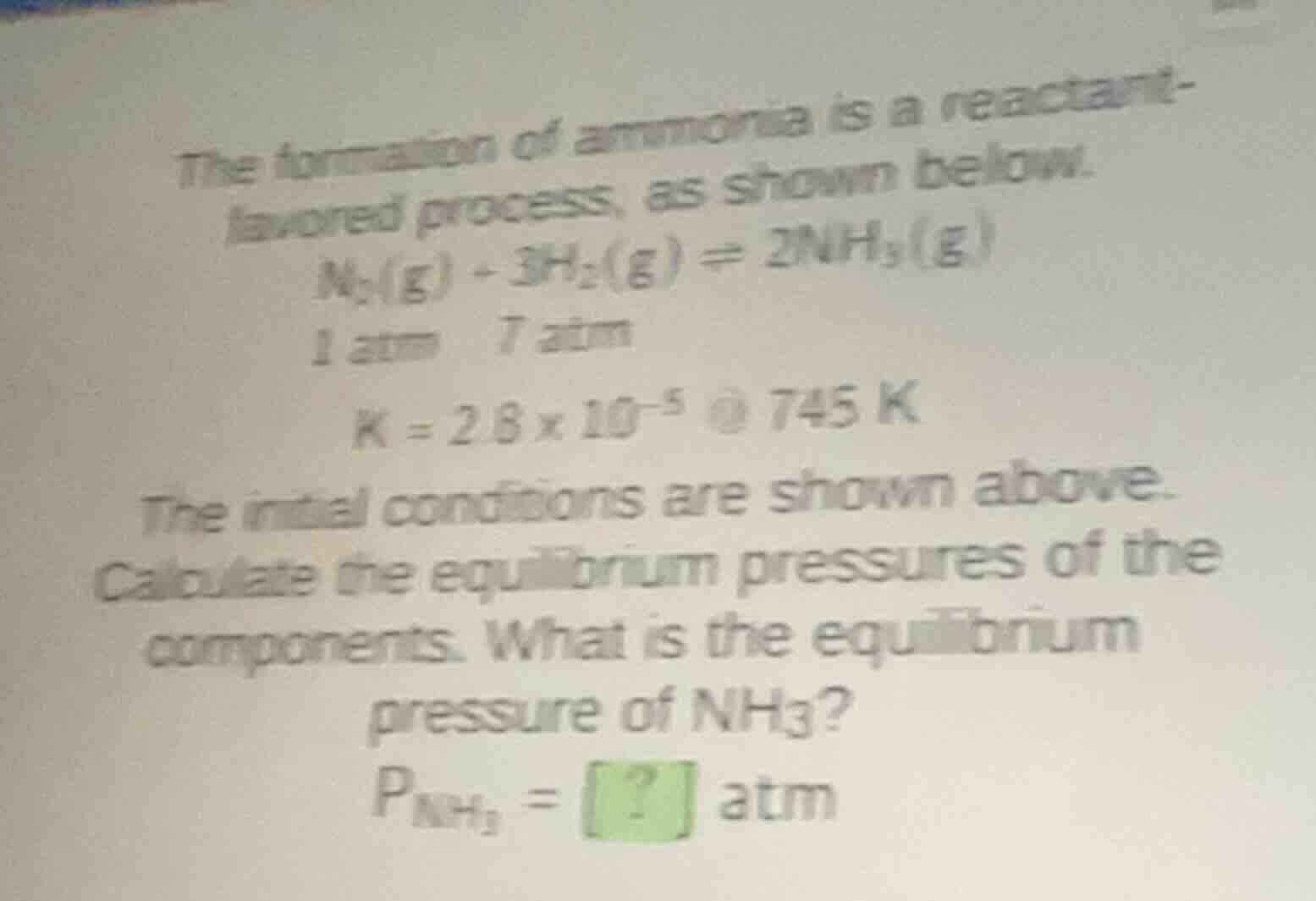
the formation of ammonia is a reactant-favored process, as shown below.
\\(\text{n}_2(g) + 3\text{h}_2(g) \
ightleftharpoons 2\text{nh}_3(g)\\)
\\(1\text{ atm}\\) \\(7\text{ atm}\\)
\\(k = 2.8 \times 10^{-5}\\) @ \\(745\text{ k}\\)
the initial conditions are shown above. calculate the equilibrium pressures of the components. what is the equilibrium pressure of \\(\text{nh}_3\\)?
\\(p_{\text{nh}_3} = ?\text{ atm}\\)
Set up the RICE table
Using the RICE Table Calculations and Chemical Equilibrium knowledge points
Express the equilibrium constant
Using the Equilibrium Constant and Partial Pressure Equilibrium knowledge points
Solve for x using approximation
Using the Chemical Equilibrium knowledge point
Calculate the equilibrium pressure of NH3
Using the Partial Pressure Equilibrium knowledge point

Snap & solve any problem in the app
Get step-by-step solutions on Sovi AI
Photo-based solutions with guided steps
Explore more problems and detailed explanations
The formation of ammonia is a reactant-favored process, as shown below.
\(1\text{ atm}\quad 7\text{ atm}\)
\(K = 2.8 \times 10^{-5}\) @ \(745\text{ K}\)
The initial conditions are shown above. Calculate the equilibrium pressures of the components. What is the equilibrium pressure of \(\text{NH}_3\)?
\(P_{\text{NH}_3} =\) <blank>\(0.098\)</blank> atm