QUESTION IMAGE
Question
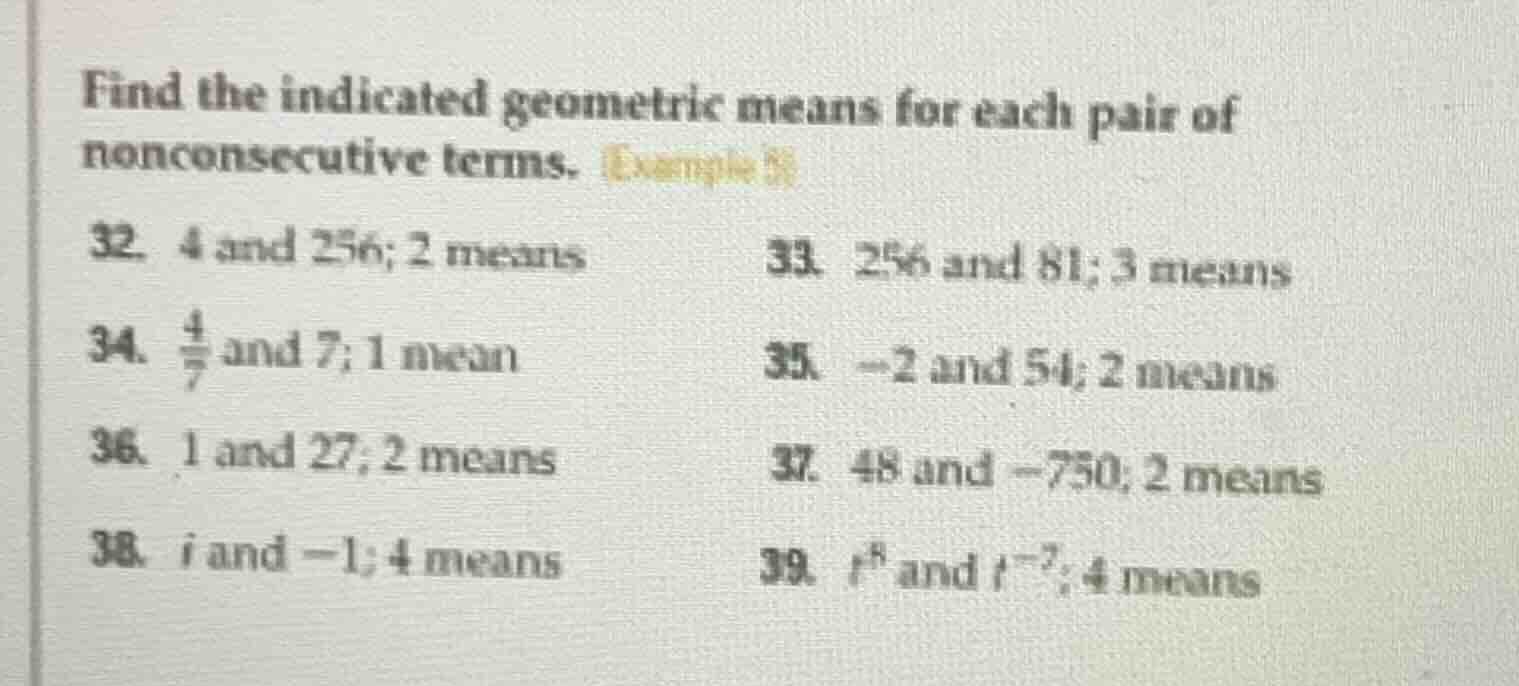
find the indicated geometric means for each pair of nonconsecutive terms.
- 4 and 256; 2 means
- 256 and 81; 3 means
- \\(\frac{4}{7}\\) and 7; 1 mean
- -2 and 54; 2 means
- 1 and 27; 2 means
- 48 and -750; 2 means
- \\(i\\) and -1; 4 means
- \\(t^8\\) and \\(t^{-7}\\); 4 means
Identify the geometric sequence formula
To find the geometric means between two nonconsecutive terms \(a_1\) and \(a_n\), we treat them as terms of a Geometric Sequence. If there are \(k\) geometric means between \(a_1\) and \(a_n\), then \(a_n\) is the \((k+2)\)-th term of the sequence:
where \(r\) is the Common Ratio.
Solve for the common ratio in each problem
We solve for \(r\) using \(r = \sqrt[k+1]{\frac{a_n}{a_1}}\).
- Question 32: 4 and 256; 2 means. \(a_1 = 4\), \(a_4 = 256\).
Means: \(4 \cdot 4 = 16\), \(16 \cdot 4 = 64\).
- Question 33: 256 and 81; 3 means. \(a_1 = 256\), \(a_5 = 81\).
Using positive \(r = \frac{3}{4}\): \(192, 144, 108\).
Using negative \(r = -\frac{3}{4}\): \(-192, 144, -108\).
- Question 34: \(\frac{4}{7}\) and 7; 1 mean. \(a_1 = \frac{4}{7}\), \(a_3 = 7\).
Means: \(\pm 2\).
- Question 35: \(-2\) and 54; 2 means. \(a_1 = -2\), \(a_4 = 54\).
Means: \(6, -18\).
Solve remaining problems
- Question 36: 1 and 27; 2 means. \(a_1 = 1\), \(a_4 = 27\).
Means: \(3, 9\).
- Question 37: 48 and \(-750\); 2 means. \(a_1 = 48\), \(a_4 = -750\).
Means: \(-120, 300\).
- Question 38: \(t\) and \(-1\); 4 means. \(a_1 = t\), \(a_6 = -1\).
Means: \(-t^{4/5}, t^{3/5}, -t^{2/5}, t^{1/5}\).
- Question 39: \(t^8\) and \(t^{-7}\); 4 means. \(a_1 = t^8\), \(a_6 = t^{-7}\).
Means: \(t^5, t^2, t^{-1}, t^{-4}\).

Snap & solve any problem in the app
Get step-by-step solutions on Sovi AI
Photo-based solutions with guided steps
Explore more problems and detailed explanations
| No. | Answer |
|---|---|
| 33 | \(\pm 192, 144, \pm 108\) |
| 34 | \(\pm 2\) |
| 35 | \(6, -18\) |
| 36 | \(3, 9\) |
| 37 | \(-120, 300\) |
| 38 | \(-t^{4/5}, t^{3/5}, -t^{2/5}, t^{1/5}\) |
| 39 | \(t^5, t^2, t^{-1}, t^{-4}\) |