QUESTION IMAGE
Question
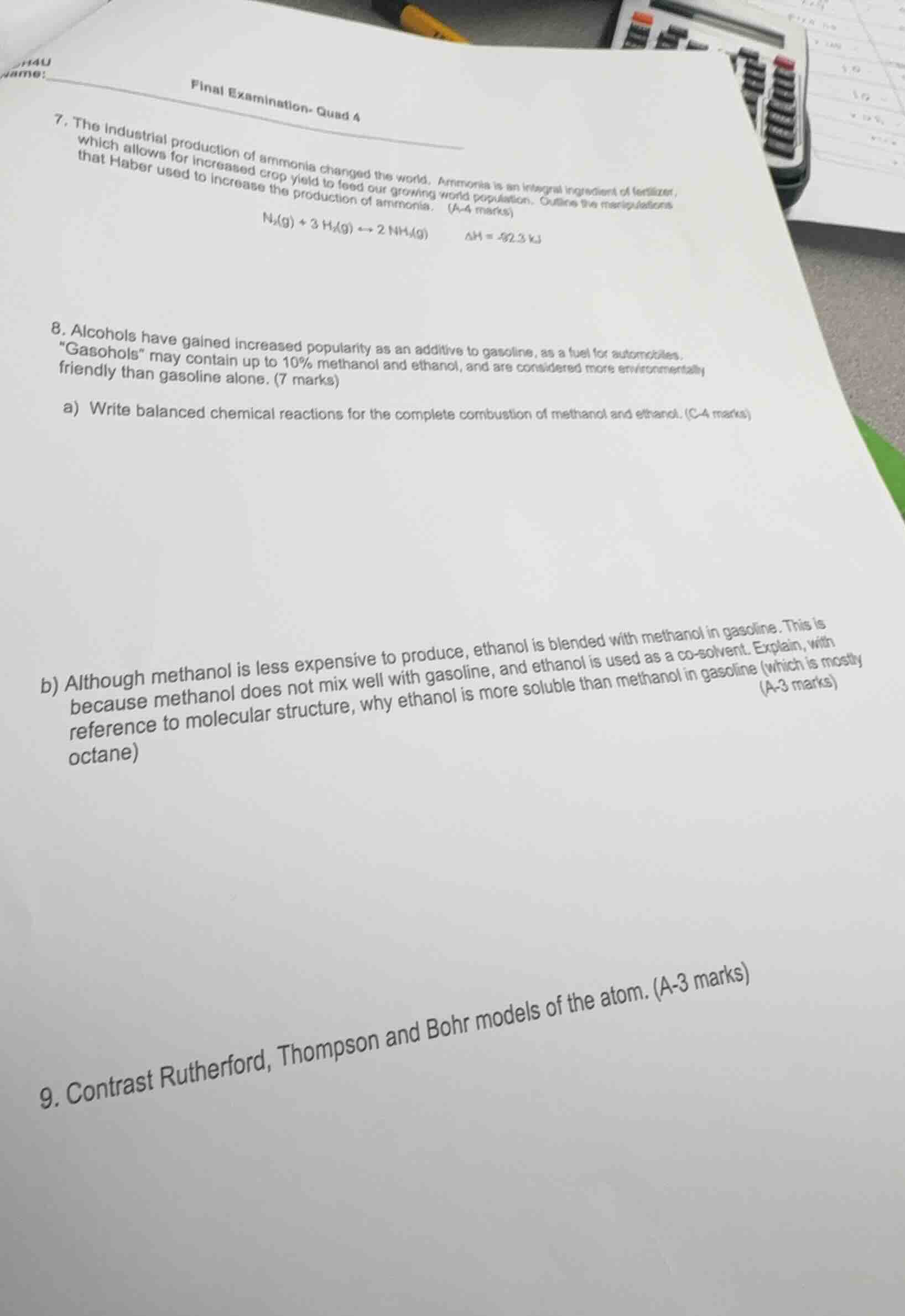
final examination- quad 4
- the industrial production of ammonia changed the world. ammonia is an integral ingredient of fertilizer, which allows for increased crop yield to feed our growing world population. outline the manipulations that haber used to increase the production of ammonia. (a-4 marks)
\\ \text{n}_2(g) + 3\text{h}_2(g) \
ightleftharpoons 2\text{nh}_3(g) \quad \delta h = -92.3\text{ kj} \\
- alcohols have gained increased popularity as an additive to gasoline, as a fuel for automobiles. \gasohols\ may contain up to 10% methanol and ethanol, and are considered more environmentally friendly than gasoline alone. (7 marks)
a) write balanced chemical reactions for the complete combustion of methanol and ethanol. (c-4 marks)
b) although methanol is less expensive to produce, ethanol is blended with methanol in gasoline. this is because methanol does not mix well with gasoline, and ethanol is used as a co-solvent. explain, with reference to molecular structure, why ethanol is more soluble than methanol in gasoline (which is mostly octane) (a-3 marks)
- contrast rutherford, thompson and bohr models of the atom. (a-3 marks)
Outline Haber process manipulations
Using the Chemical Equilibrium knowledge point
To maximize the yield of ammonia in the exothermic equilibrium reaction:
- Increase pressure: Shifting equilibrium to the side with fewer gas moles (right).
- Decrease temperature: Shifting equilibrium in the exothermic direction (right).
- Remove ammonia: Continuously liquefying and removing \(\text{NH}_3\) to shift equilibrium right.
- Add reactants: Continuously adding \(\text{N}_2\) and \(\text{H}_2\) to drive the forward reaction.
Balance combustion of methanol and ethanol
Using the Organic Chemistry Families knowledge point
Complete combustion reactions with oxygen producing carbon dioxide and water:
- Methanol (\(\text{CH}_3\text{OH}\)):
- Ethanol (\(\text{C}_2\text{H}_5\text{OH}\)):
Explain solubility in octane
Using the Solubility Equilibrium knowledge point
- Octane (\(\text{C}_8\text{H}_{18}\)) is a non-polar hydrocarbon.
- Methanol (\(\text{CH}_3\text{OH}\)) has a very short, highly polar methyl group, making its overall molecular character highly polar and dominated by hydrogen bonding.
- Ethanol (\(\text{C}_2\text{H}_5\text{OH}\)) has a longer non-polar ethyl group (\(-\text{CH}_2\text{CH}_3\)), which increases its dispersion forces and hydrophobic character.
- This larger non-polar region allows ethanol to interact more favorably with non-polar octane molecules via London dispersion forces, making it more soluble than methanol.
Contrast atomic models
Using the Atomic Structure History knowledge point
- Thomson's Plum Pudding Model: Atom is a positive sphere with embedded negative electrons; no nucleus.
- Rutherford's Nuclear Model: Atom has a tiny, dense, positively charged nucleus at the center; electrons orbit randomly around it; mostly empty space.
- Bohr's Planetary Model: Electrons travel around the nucleus only in specific, quantized circular orbits (energy levels).

Snap & solve any problem in the app
Get step-by-step solutions on Sovi AI
Photo-based solutions with guided steps
Explore more problems and detailed explanations
Question 7
To increase the yield of ammonia (\(\text{NH}_3\)) using Le Chatelier's principle:
- High Pressure: Shifting the equilibrium to the right (from 4 moles of gas to 2 moles).
- Low Temperature: Shifting the equilibrium to the right because the forward reaction is exothermic (\(\Delta H < 0\)).
- Continuous Removal of Ammonia: Condensing and removing \(\text{NH}_3\text{(g)}\) as it forms to shift the reaction forward.
- Catalyst: Adding an iron catalyst to increase the rate of reaction to reach equilibrium faster.
---
Question 8
a) Complete Combustion Reactions
- Methanol:
- Ethanol:
b) Solubility Explanation
Octane is a non-polar hydrocarbon. While both methanol and ethanol possess a polar hydroxyl group (\(-\text{OH}\)) capable of hydrogen bonding, ethanol has a larger non-polar hydrocarbon chain (an ethyl group, \(-\text{CH}_2\text{CH}_3\)) compared to methanol's smaller methyl group (\(-\text{CH}_3\)). This larger non-polar region allows ethanol to form stronger London dispersion forces with non-polar octane, making it more soluble in gasoline than the highly polar methanol.
---
Question 9
- Thomson Model: A solid sphere of positive charge with negative electrons embedded throughout (no nucleus).
- Rutherford Model: A tiny, dense, positively charged nucleus at the center of the atom, with electrons orbiting randomly around it in mostly empty space.
- Bohr Model: Electrons orbit the positive nucleus in specific, quantized circular paths (energy levels) with fixed energies.