QUESTION IMAGE
Question
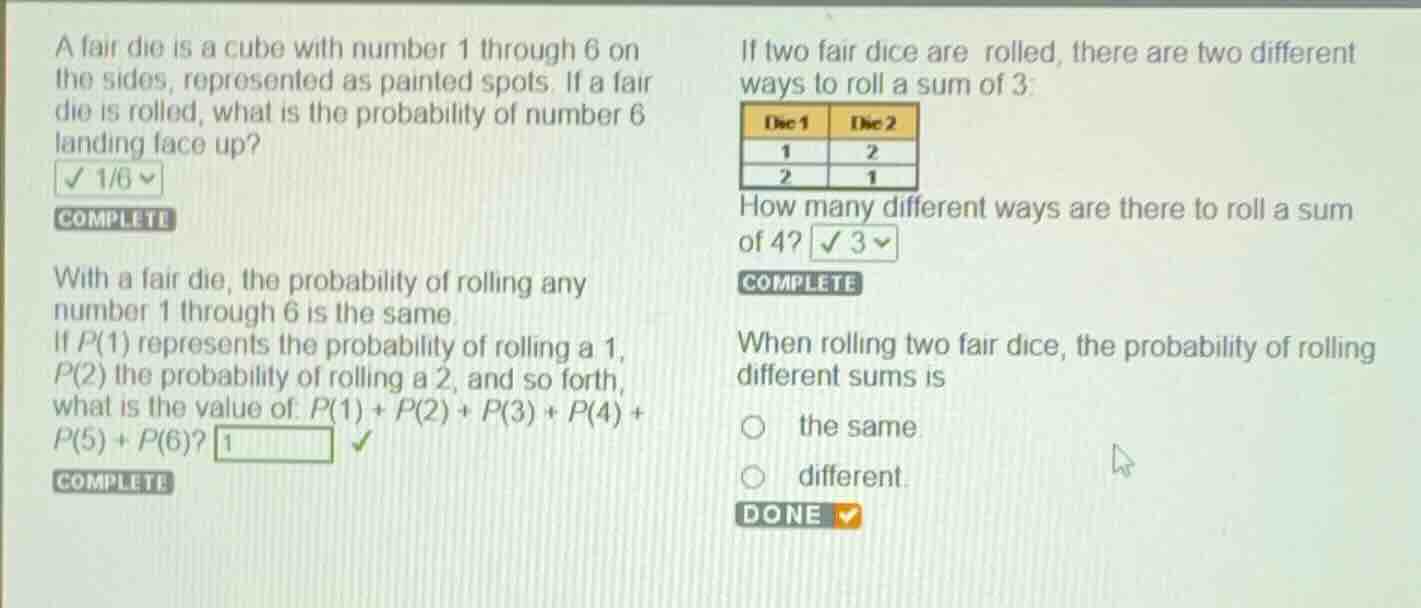
a fair die is a cube with number 1 through 6 on the sides, represented as painted spots. if a fair die is rolled, what is the probability of number 6 landing face up?
with a fair die, the probability of rolling any number 1 through 6 is the same.
if \\(p(1)\\) represents the probability of rolling a 1, \\(p(2)\\) the probability of rolling a 2, and so forth, what is the value of \\(p(1) + p(2) + p(3) + p(4) + p(5) + p(6)\\)?
if two fair dice are rolled, there are two different ways to roll a sum of 3:
\
how many different ways are there to roll a sum of 4?
when rolling two fair dice, the probability of rolling different sums is
- the same
- different
Calculate single die probability
Using the Theoretical Probability and Sample Space knowledge points
Sum of probabilities of all outcomes
Using the Probability Axioms and Sample Space Probability knowledge points
Find ways to roll a sum of 4
Using the Sample Space and Favorable Outcomes knowledge points
Analyze probability of different sums
Using the Theoretical Probability and Sample Space knowledge points

Snap & solve any problem in the app
Get step-by-step solutions on Sovi AI
Photo-based solutions with guided steps
Explore more problems and detailed explanations
Question 1
A fair die is a cube with number 1 through 6 on the sides, represented as painted spots. If a fair die is rolled, what is the probability of number 6 landing face up?
<blank>\(1/6\)</blank>
Question 2
With a fair die, the probability of rolling any number 1 through 6 is the same. If \(P(1)\) represents the probability of rolling a 1, \(P(2)\) the probability of rolling a 2, and so forth, what is the value of \(P(1) + P(2) + P(3) + P(4) + P(5) + P(6)\)?
<blank>1</blank>
Question 3
How many different ways are there to roll a sum of 4?
<blank>3</blank>
Question 4
When rolling two fair dice, the probability of rolling different sums is
- the same
- different (Correct answer)