QUESTION IMAGE
Question
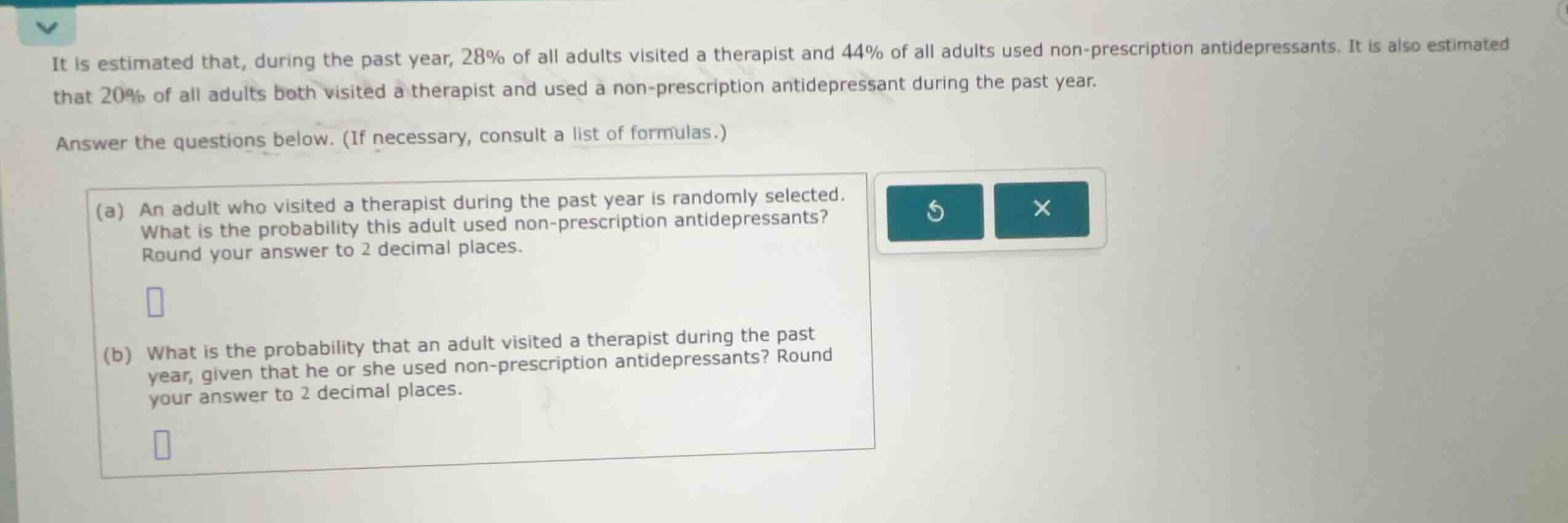
it is estimated that, during the past year, 28% of all adults visited a therapist and 44% of all adults used non-prescription antidepressants. it is also estimated that 20% of all adults both visited a therapist and used a non-prescription antidepressant during the past year.
answer the questions below. (if necessary, consult a list of formulas.)
(a) an adult who visited a therapist during the past year is randomly selected. what is the probability this adult used non-prescription antidepressants? round your answer to 2 decimal places.
(b) what is the probability that an adult visited a therapist during the past year, given that he or she used non-prescription antidepressants? round your answer to 2 decimal places.
Define events and given probabilities
Using the Probability of Events knowledge point, we define the events and extract their probabilities from the problem statement:
- Let \(T\) be the event that a randomly selected adult visited a therapist during the past year.
- Let \(A\) be the event that a randomly selected adult used non-prescription antidepressants during the past year.
From the text, we have:
- \(P(T) = 0.28\)
- \(P(A) = 0.44\)
- \(P(T \cap A) = 0.20\)
Calculate conditional probability for part (a)
Using the Conditional Probability knowledge point, we find the probability that a randomly selected adult used non-prescription antidepressants given that they visited a therapist:
Substituting the known values:
Rounding to 2 decimal places gives \(0.71\).
Calculate conditional probability for part (b)
Using the Conditional Probability knowledge point, we find the probability that a randomly selected adult visited a therapist given that they used non-prescription antidepressants:
Substituting the known values:
Rounding to 2 decimal places gives \(0.45\).

Snap & solve any problem in the app
Get step-by-step solutions on Sovi AI
Photo-based solutions with guided steps
Explore more problems and detailed explanations
Question (a)
0.71
Question (b)
0.45