QUESTION IMAGE
Question
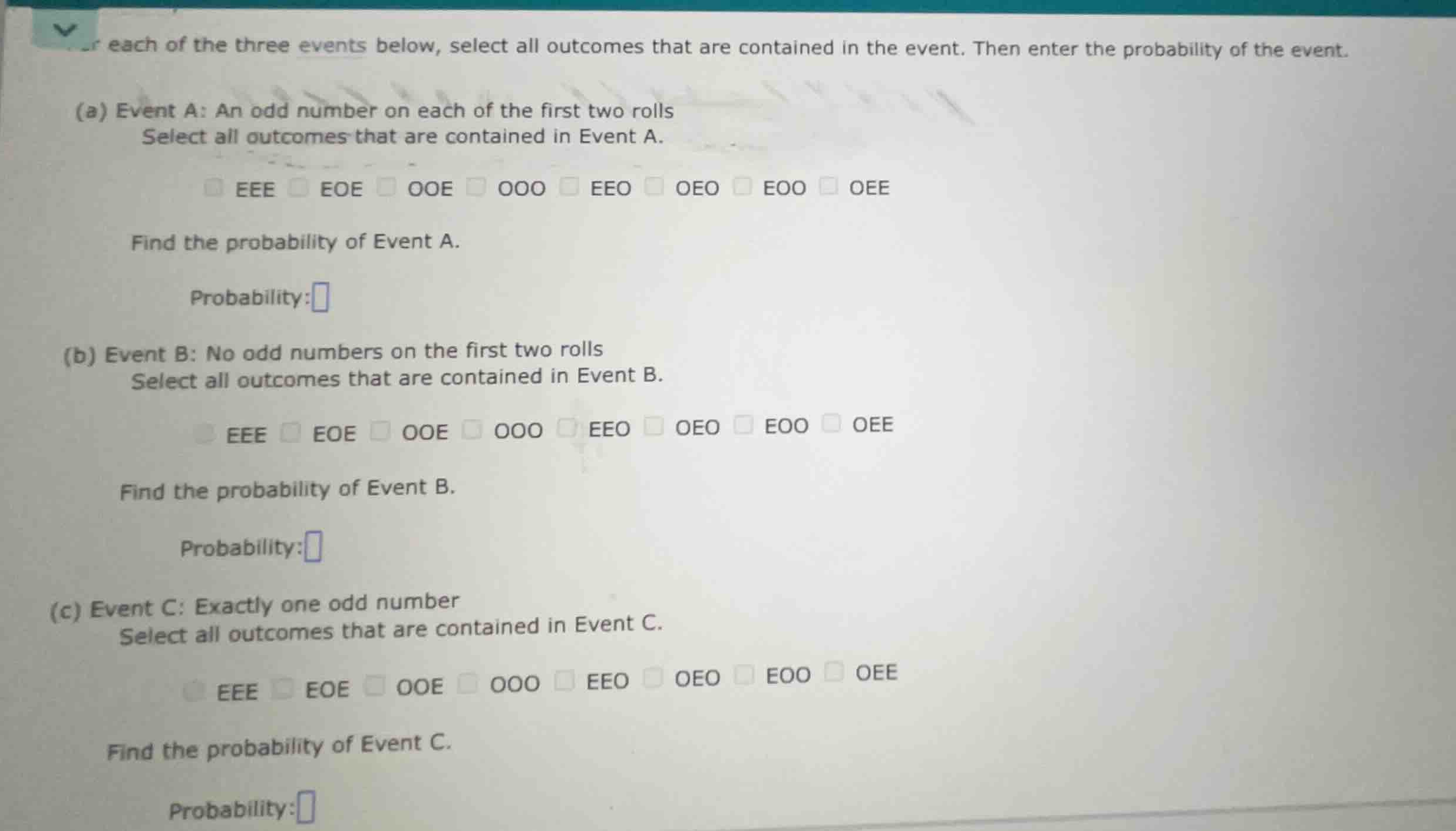
for each of the three events below, select all outcomes that are contained in the event. then enter the probability of the event.
(a) event a: an odd number on each of the first two rolls
select all outcomes that are contained in event a.
eee eoe ooe ooo eeo oeo eoo oee
find the probability of event a.
probability:
(b) event b: no odd numbers on the first two rolls
select all outcomes that are contained in event b.
eee eoe ooe ooo eeo oeo eoo oee
find the probability of event b.
probability:
(c) event c: exactly one odd number
select all outcomes that are contained in event c.
eee eoe ooe ooo eeo oeo eoo oee
find the probability of event c.
probability:
Identify the sample space
The experiment consists of rolling a die three times, where each roll results in either an Even (E) or Odd (O) number. Assuming a standard fair 6-sided die, the probability of rolling an even number is \(P(E) = \frac{1}{2}\) and an odd number is \(P(O) = \frac{1}{2}\).
The sample space consists of \(2^3 = 8\) equally likely outcomes:
Since each outcome is equally likely, the probability of any single outcome is \(\frac{1}{8}\).
Analyze Event A
Event A is defined as: "An odd number on each of the first two rolls."
We look for outcomes where the first letter is 'O' and the second letter is 'O':
- \(OOE\) (First is O, second is O, third is E)
- \(OOO\) (First is O, second is O, third is O)
The outcomes contained in Event A are: \(OOE, OOO\).
The number of favorable outcomes is 2.
The probability of Event A is:
Analyze Event B
Event B is defined as: "No odd numbers on the first two rolls."
This means the first two rolls must both be even ('E' on the first and 'E' on the second):
- \(EEE\) (First is E, second is E, third is E)
- \(EEO\) (First is E, second is E, third is O)
The outcomes contained in Event B are: \(EEE, EEO\).
The number of favorable outcomes is 2.
The probability of Event B is:
Analyze Event C
Event C is defined as: "Exactly one odd number."
We look for outcomes that contain exactly one 'O' (and therefore exactly two 'E's):
- \(EEO\) (One O at the end)
- \(EOE\) (One O in the middle)
- \(OEE\) (One O at the start)
The outcomes contained in Event C are: \(EEO, EOE, OEE\).
The number of favorable outcomes is 3.
The probability of Event C is:

Snap & solve any problem in the app
Get step-by-step solutions on Sovi AI
Photo-based solutions with guided steps
Explore more problems and detailed explanations
Question 1
For Event A: "An odd number on each of the first two rolls"
- Outcomes contained in Event A: OOE, OOO
- Probability: \(\frac{1}{4}\) (or \(0.25\))
Question 2
For Event B: "No odd numbers on the first two rolls"
- Outcomes contained in Event B: EEE, EEO
- Probability: \(\frac{1}{4}\) (or \(0.25\))
Question 3
For Event C: "Exactly one odd number"
- Outcomes contained in Event C: EEO, EOE, OEE
- Probability: \(\frac{3}{8}\) (or \(0.375\))