QUESTION IMAGE
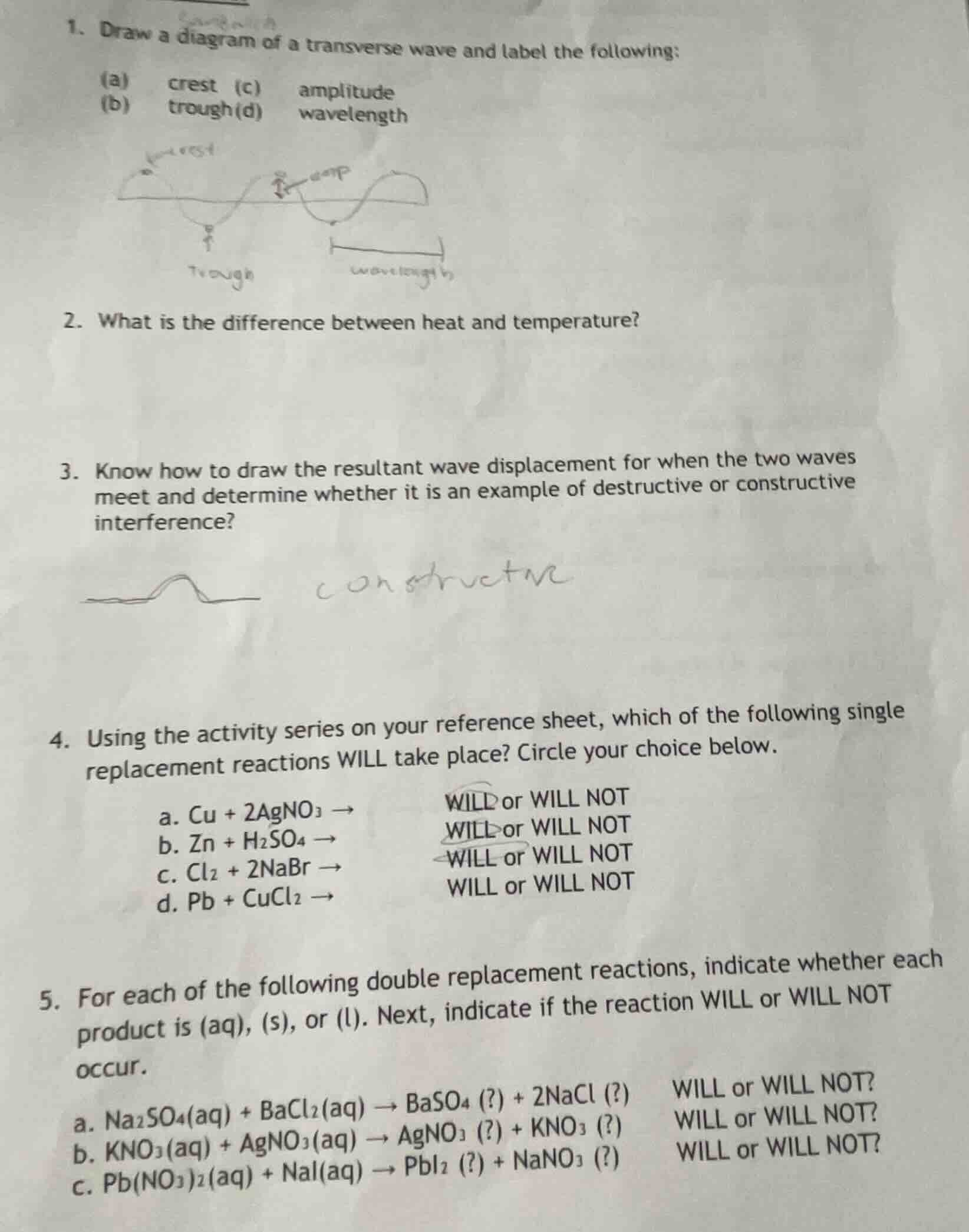
Question
- draw a diagram of a transverse wave and label the following:
(a) crest
(b) trough
(c) amplitude
(d) wavelength
- what is the difference between heat and temperature?
- know how to draw the resultant wave displacement for when the two waves meet and determine whether it is an example of destructive or constructive interference?
- using the activity series on your reference sheet, which of the following single replacement reactions will take place? circle your choice below.
a. \\(\text{cu} + 2\text{agno}_3 \
ightarrow\\) will or will not
b. \\(\text{zn} + \text{h}_2\text{so}_4 \
ightarrow\\) will or will not
c. \\(\text{cl}_2 + 2\text{nabr} \
ightarrow\\) will or will not
d. \\(\text{pb} + \text{cucl}_2 \
ightarrow\\) will or will not
- for each of the following double replacement reactions, indicate whether each product is (aq), (s), or (l). next, indicate if the reaction will or will not occur.
a. \\(\text{na}_2\text{so}_4(\text{aq}) + \text{bacl}_2(\text{aq}) \
ightarrow \text{baso}_4(?) + 2\text{nacl}(?)\\) will or will not?
b. \\(\text{kno}_3(\text{aq}) + \text{agno}_3(\text{aq}) \
ightarrow \text{agno}_3(?) + \text{kno}_3(?)\\) will or will not?
c. \\(\text{pb}(\text{no}_3)_2(\text{aq}) + \text{nai}(\text{aq}) \
ightarrow \text{pbi}_2(?) + \text{nano}_3(?)\\) will or will not?
Identify wave characteristics
A transverse wave consists of alternating crests (highest points) and troughs (lowest points). The amplitude is the maximum displacement from the equilibrium position, and the wavelength is the distance between two consecutive identical points (such as crest to crest).
Distinguish heat and temperature
Heat is the total thermal energy transferred between systems due to a temperature difference. Temperature is a measure of the average kinetic energy of the particles in a substance.
Analyze wave interference
When two wave pulses meet, their displacements add together. If two upward pulses overlap, they reinforce each other to produce a larger pulse, which is constructive interference.
Evaluate single replacement reactions
Using the metal and halogen activity series:
- a. \(\text{Cu} + 2\text{AgNO}_3
ightarrow\): Copper is more active than silver (\(\text{Cu} > \text{Ag}\)), so the reaction WILL occur.
- b. \(\text{Zn} + \text{H}_2\text{SO}_4
ightarrow\): Zinc is more active than hydrogen (\(\text{Zn} > \text{H}\)), so the reaction WILL occur.
- c. \(\text{Cl}_2 + 2\text{NaBr}
ightarrow\): Chlorine is more active than bromine (\(\text{Cl} > \text{Br}\)), so the reaction WILL occur.
- d. \(\text{Pb} + \text{CuCl}_2
ightarrow\): Lead is more active than copper (\(\text{Pb} > \text{Cu}\)), so the reaction WILL occur.
Evaluate double replacement reactions
Using solubility rules:
- a. \(\text{Na}_2\text{SO}_4(aq) + \text{BaCl}_2(aq)
ightarrow \text{BaSO}_4(s) + 2\text{NaCl}(aq)\): Barium sulfate is insoluble, so a precipitate forms. The reaction WILL occur.
- b. \(\text{KNO}_3(aq) + \text{AgNO}_3(aq)\): Both reactants share the nitrate anion; no reaction occurs.
- c. \(\text{Pb(NO}_3)_2(aq) + 2\text{NaI}(aq)
ightarrow \text{PbI}_2(s) + 2\text{NaNO}_3(aq)\): Lead(II) iodide is insoluble, so a precipitate forms. The reaction WILL occur.

Snap & solve any problem in the app
Get step-by-step solutions on Sovi AI
Photo-based solutions with guided steps
Explore more problems and detailed explanations
Question 1
- (a) Crest: The highest point of the wave.
- (b) Trough: The lowest point of the wave.
- (c) Amplitude: The height from the center line to a crest or trough.
- (d) Wavelength: The horizontal distance between two adjacent crests.
Question 2
- Heat: The transfer of thermal energy between substances.
- Temperature: The average kinetic energy of the particles.
Question 3
- Resultant: A single larger wave pulse.
- Type: Constructive interference.
Question 4
- a. WILL
- b. WILL
- c. WILL
- d. WILL
Question 5
- a. \(\text{BaSO}_4(s) + 2\text{NaCl}(aq)\) | WILL
- b. No reaction occurs (both contain nitrate).
- c. \(\text{PbI}_2(s) + 2\text{NaNO}_3(aq)\) | WILL