QUESTION IMAGE
Question
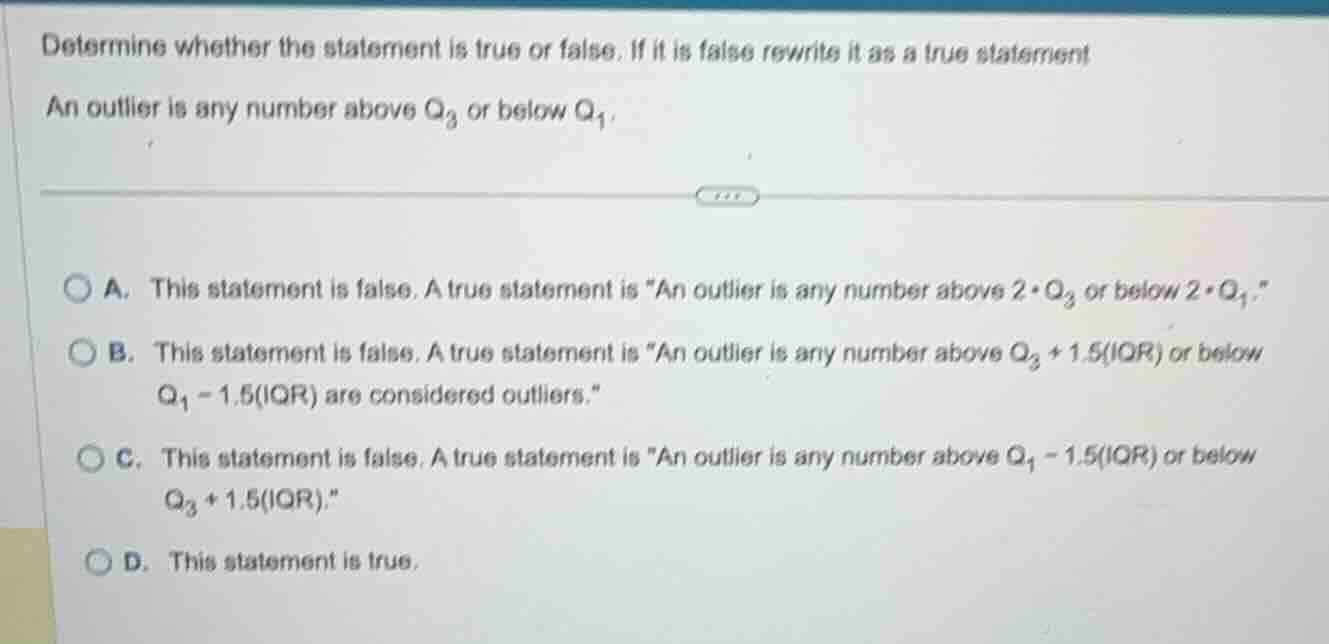
determine whether the statement is true or false. if it is false rewrite it as a true statement
an outlier is any number above \\(q_3\\) or below \\(q_1\\).
a. this statement is false. a true statement is \an outlier is any number above \\(2 \cdot q_3\\) or below \\(2 \cdot q_1\\).\
b. this statement is false. a true statement is \an outlier is any number above \\(q_3 + 1.5(\text{iqr})\\) or below \\(q_1 - 1.5(\text{iqr})\\) are considered outliers.\
c. this statement is false. a true statement is \an outlier is any number above \\(q_1 - 1.5(\text{iqr})\\) or below \\(q_3 + 1.5(\text{iqr})\\).\
d. this statement is true.
Analyze the given statement
Using the Outlier Detection knowledge point
The statement claims: "An outlier is any number above \(Q_3\) or below \(Q_1\)."
This statement is false because \(Q_1\) and \(Q_3\) represent the 25th and 75th percentiles, meaning approximately \(50\%\) of any dataset lies outside this range, which are not outliers.
Identify the correct outlier rule
Using the Outlier Detection knowledge point
The standard mathematical rule (Tukey's fences) defines outliers using the Interquartile Range (\(\text{IQR} = Q_3 - Q_1\)):
- An outlier is any value below \(Q_1 - 1.5(\text{IQR})\)
- An outlier is any value above \(Q_3 + 1.5(\text{IQR})\)
Evaluate the given options
Using the Outlier Detection knowledge point
- Option A suggests \(2 \cdot Q_3\) and \(2 \cdot Q_1\), which is incorrect.
- Option B states: "An outlier is any number above \(Q_3 + 1.5(\text{IQR})\) or below \(Q_1 - 1.5(\text{IQR})\) are considered outliers." This matches the standard definition.
- Option C mixes up the addition and subtraction signs with the quartiles.
- Option D claims the statement is true, which is incorrect.
Therefore, Option B is the correct choice.

Snap & solve any problem in the app
Get step-by-step solutions on Sovi AI
Photo-based solutions with guided steps
Explore more problems and detailed explanations
- A. This statement is false. A true statement is "An outlier is any number above \(2 \cdot Q_3\) or below \(2 \cdot Q_1\)."
- B. This statement is false. A true statement is "An outlier is any number above \(Q_3 + 1.5(\text{IQR})\) or below \(Q_1 - 1.5(\text{IQR})\) are considered outliers." (Correct answer)
- C. This statement is false. A true statement is "An outlier is any number above \(Q_1 - 1.5(\text{IQR})\) or below \(Q_3 + 1.5(\text{IQR})\)."
- D. This statement is true.