QUESTION IMAGE
Question
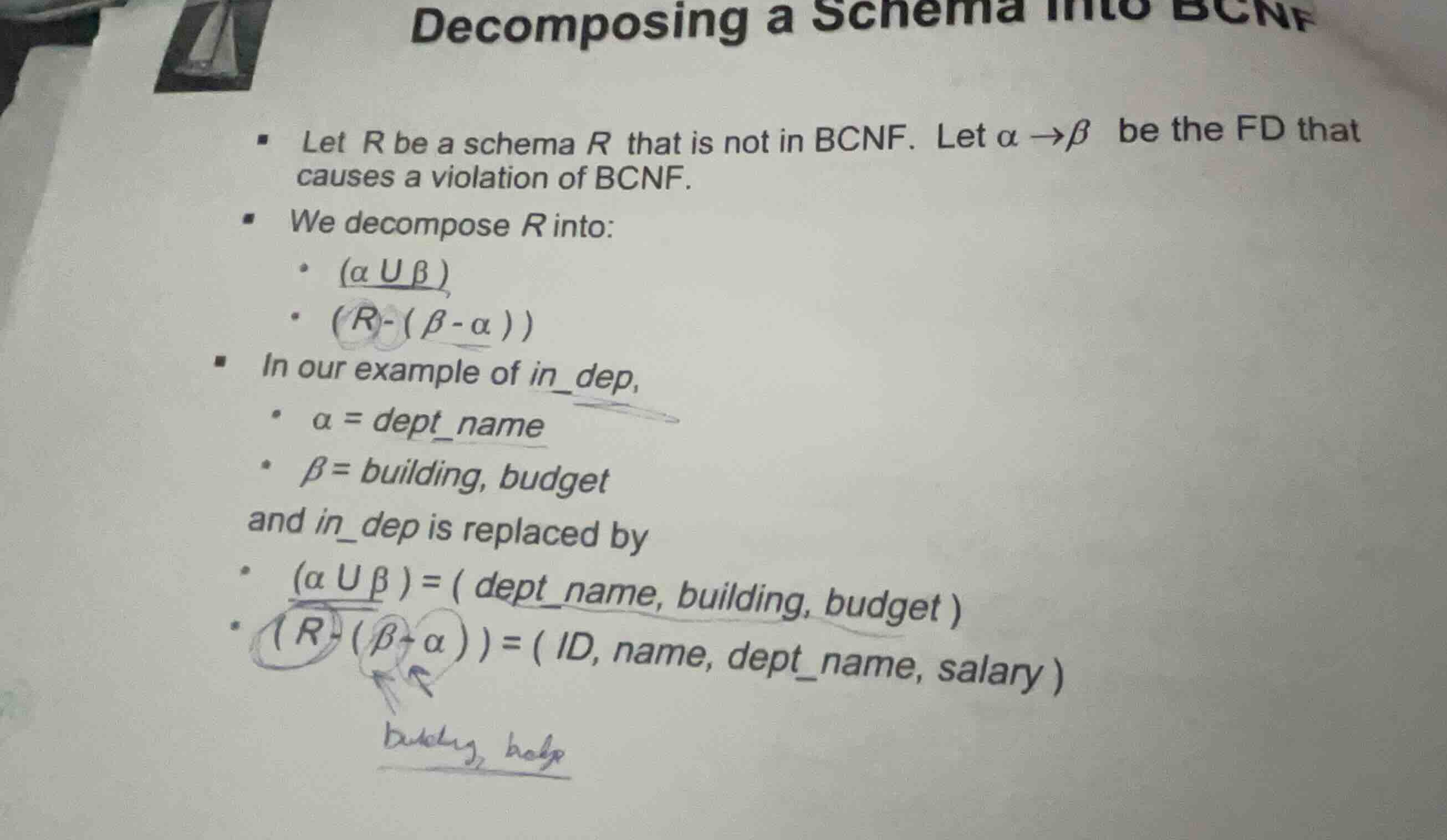
decomposing a schema into bcnf
- let \\(r\\) be a schema \\(r\\) that is not in bcnf. let \\(\alpha \
ightarrow \beta\\) be the fd that causes a violation of bcnf.
- we decompose \\(r\\) into:
- \\((\alpha \cup \beta)\\)
- \\((r - (\beta - \alpha))\\)
- in our example of \\(in\\_dep\\),
- \\(\alpha = dept\\_name\\)
- \\(\beta = building, budget\\)
and \\(in\\_dep\\) is replaced by
- \\((\alpha \cup \beta) = ( dept\\_name, building, budget )\\)
- \\((r - (\beta - \alpha)) = ( id, name, dept\\_name, salary )\\)
Identify the original schema and violation
The slide describes decomposing a schema \(R\) into Boyce-Codd Normal Form (BCNF).
From the example, the original schema is \(in\_dep\).
The attributes of the decomposed schemas are:
- \(\alpha \cup \beta = (\text{dept\_name}, \text{building}, \text{budget})\)
- \((R - (\beta - \alpha)) = (\text{ID}, \text{name}, \text{dept\_name}, \text{salary})\)
Combining all unique attributes from these two decomposed schemas gives the original schema \(R\):
The functional dependency (FD) causing the BCNF violation is \(\alpha
ightarrow \beta\), where:
- \(\alpha = \{\text{dept\_name}\}\)
- \(\beta = \{\text{building}, \text{budget}\}\)
Thus, the violating FD is:
Apply the BCNF decomposition rules
The BCNF decomposition rule splits a violating schema \(R\) using a violating FD \(\alpha
ightarrow \beta\) into two schemas:
- \(R_1 = \alpha \cup \beta\)
- \(R_2 = R - (\beta - \alpha)\)
Let's calculate each component step-by-step:
- \(\beta - \alpha = \{\text{building}, \text{budget}\} - \{\text{dept\_name}\} = \{\text{building}, \text{budget}\}\)
- \(R_1 = \{\text{dept\_name}\} \cup \{\text{building}, \text{budget}\} = \{\text{dept\_name}, \text{building}, \text{budget}\}\)
- \(R_2 = \{\text{ID}, \text{name}, \text{dept\_name}, \text{salary}, \text{building}, \text{budget}\} - \{\text{building}, \text{budget}\} = \{\text{ID}, \text{name}, \text{dept\_name}, \text{salary}\}\)
Verify the handwritten correction
There is a handwritten note in the image pointing to the formula \((R - (\beta - \alpha))\).
The note points to \(\beta - \alpha\) and has a correction pointing to \(\beta\) and \(\alpha\), with the text "building, budget" written below.
This confirms that:
And subtracting this set from \(R\) leaves:
This matches the slide's output perfectly.

Snap & solve any problem in the app
Get step-by-step solutions on Sovi AI
Photo-based solutions with guided steps
Explore more problems and detailed explanations
Based on the provided slide, the BCNF decomposition of the schema \(R = \text{in\_dep}\) with the violating functional dependency \(\alpha
ightarrow \beta\) is formulated as follows:
- Original Schema \(R\):
- **Violating Functional Dependency (\(\alpha
ightarrow \beta\))**:
where \(\alpha = \{\text{dept\_name}\}\) and \(\beta = \{\text{building}, \text{budget}\}\).
- Decomposed Schemas:
- \(R_1 = \alpha \cup \beta = (\text{dept\_name}, \text{building}, \text{budget})\)
- \(R_2 = R - (\beta - \alpha) = (\text{ID}, \text{name}, \text{dept\_name}, \text{salary})\)