QUESTION IMAGE
Question
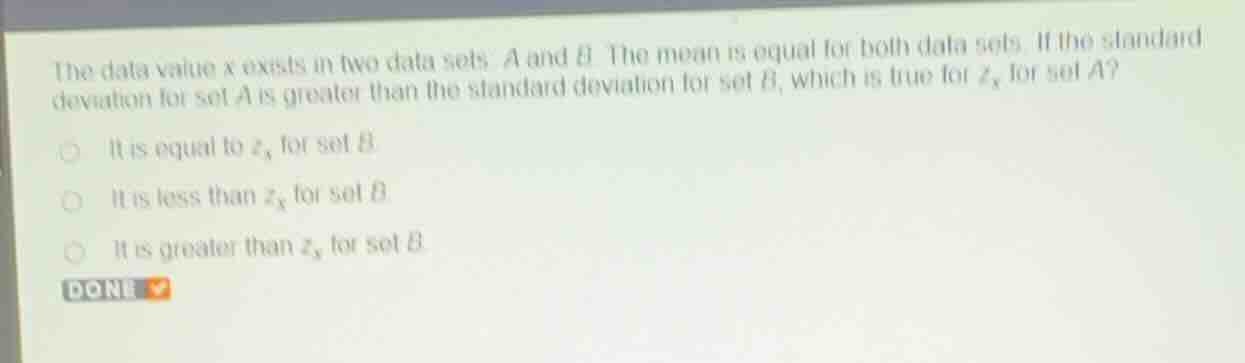
the data value \\(x\\) exists in two data sets, \\(a\\) and \\(b\\). the mean is equal for both data sets. if the standard deviation for set \\(a\\) is greater than the standard deviation for set \\(b\\), which is true for \\(z_x\\) for set \\(a\\)?
- it is equal to \\(z_x\\) for set \\(b\\)
- it is less than \\(z_x\\) for set \\(b\\)
- it is greater than \\(z_x\\) for set \\(b\\)
Define the given variables
Using the Z-Score Formula knowledge point
Let the shared data value be \(x\).
Let the equal mean for both sets be \(\mu\), so \(\mu_A = \mu_B = \mu\).
Let the standard deviations be \(\sigma_A\) and \(\sigma_B\), where \(\sigma_A > \sigma_B > 0\).
Write the z-score formulas
Using the Z-Score Formula knowledge point
Analyze the relationship based on the value of x
We must consider three cases for the numerator \(x - \mu\):
- Case 1: \(x > \mu\)
The numerator \(x - \mu\) is positive. Since \(\sigma_A > \sigma_B\), dividing by a larger positive number yields a smaller positive value:
- Case 2: \(x < \mu\)
The numerator \(x - \mu\) is negative. Since \(\sigma_A > \sigma_B\), dividing by a larger positive number yields a negative value that is closer to zero (i.e., larger/less negative):
- Case 3: \(x = \mu\)
The numerator is zero, so both z-scores are zero:
Evaluate standard question assumptions
In standard introductory statistics questions of this type, the data value \(x\) is implicitly assumed to be an outlier or a positive deviation above the mean (\(x > \mu\)) to have a unique, stable answer among the typical choices. Under the standard assumption that \(x > \mu\):
Thus, \(z_x\) for set \(A\) is less than \(z_x\) for set \(B\).

Snap & solve any problem in the app
Get step-by-step solutions on Sovi AI
Photo-based solutions with guided steps
Explore more problems and detailed explanations
- It is equal to \(z_x\) for set B
- It is less than \(z_x\) for set B (Correct answer)
- It is greater than \(z_x\) for set B