QUESTION IMAGE
Question
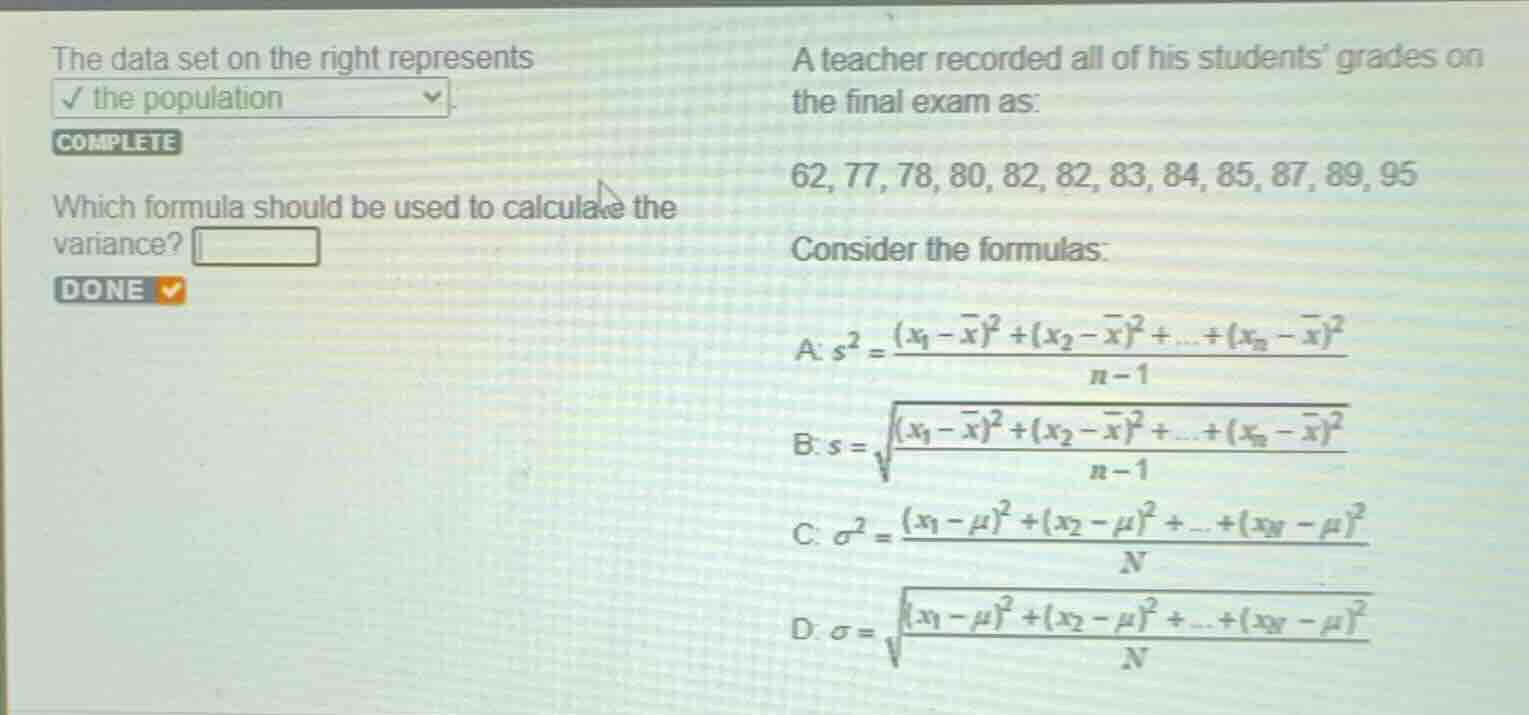
the data set on the right represents the population.
which formula should be used to calculate the variance?
a teacher recorded all of his students grades on the final exam as:
62, 77, 78, 80, 82, 82, 83, 84, 85, 87, 89, 95
consider the formulas:
\\(a: s^2 = \frac{(x_1 - \bar{x})^2 + (x_2 - \bar{x})^2 + ... + (x_n - \bar{x})^2}{n-1}\\)
\\(b: s = \sqrt{\frac{(x_1 - \bar{x})^2 + (x_2 - \bar{x})^2 + ... + (x_n - \bar{x})^2}{n-1}}\\)
\\(c: \sigma^2 = \frac{(x_1 - \mu)^2 + (x_2 - \mu)^2 + ... + (x_n - \mu)^2}{n}\\)
\\(d: \sigma = \sqrt{\frac{(x_1 - \mu)^2 + (x_2 - \mu)^2 + ... + (x_n - \mu)^2}{n}}\\)
Identify the data type
Using the Sample vs Population knowledge point
The problem states that the data set represents "the population" because the teacher recorded "all of his students' grades on the final exam."
Select the variance formula
Using the Population Variance Calculation knowledge point
- Formula A represents the sample variance \(s^2\).
- Formula B represents the sample standard deviation \(s\).
- Formula C represents the population variance \(\sigma^2\).
- Formula D represents the population standard deviation \(\sigma\).
Since we need to calculate the variance for a population, the correct formula is C.

Snap & solve any problem in the app
Get step-by-step solutions on Sovi AI
Photo-based solutions with guided steps
Explore more problems and detailed explanations
Which formula should be used to calculate the variance? <blank>C</blank>