QUESTION IMAGE
Question
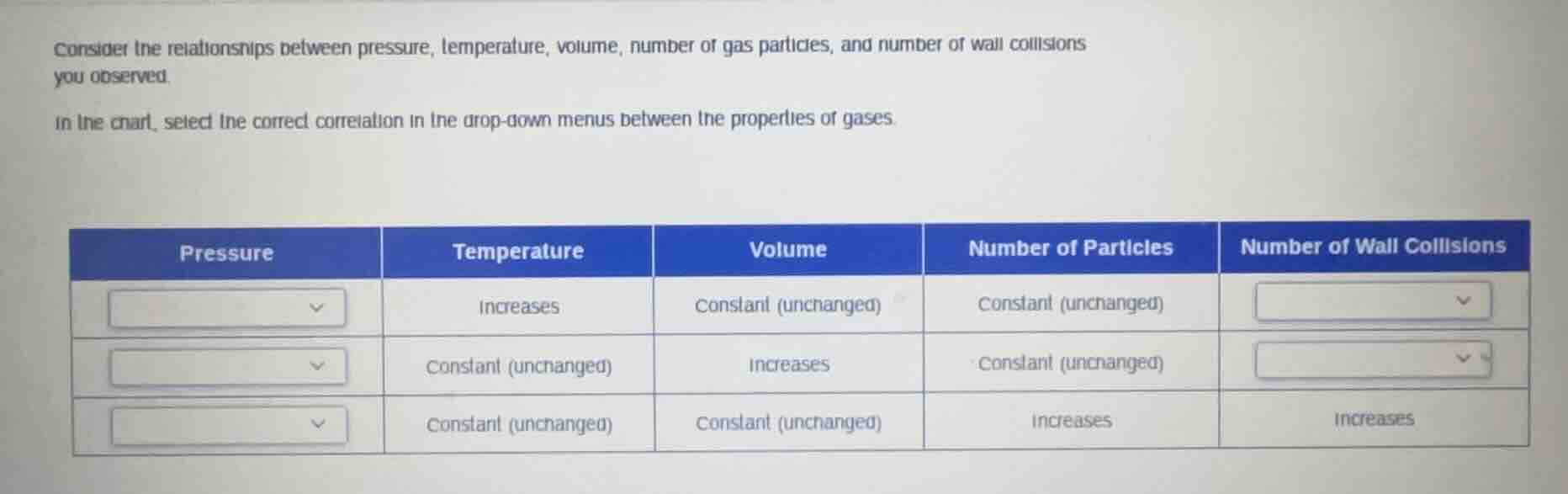
consider the relationships between pressure, temperature, volume, number of gas particles, and number of wall collisions you observed.
in the chart, select the correct correlation in the drop-down menus between the properties of gases.
\
$$\begin{tabular}{|c|c|c|c|c|}
\\hline
\\textbf{pressure} & \\textbf{temperature} & \\textbf{volume} & \\textbf{number of particles} & \\textbf{number of wall collisions} \\\\
\\hline
drop-down & increases & constant (unchanged) & constant (unchanged) & drop-down \\\\
\\hline
drop-down & constant (unchanged) & increases & constant (unchanged) & drop-down \\\\
\\hline
drop-down & constant (unchanged) & constant (unchanged) & increases & increases \\\\
\\hline
\\end{tabular}$$
Analyze the first scenario
Using the Pressure-Volume-Temperature Relationships and Wall Collisions knowledge points
- Temperature increases, while volume and number of particles remain constant.
- According to Gay-Lussac's Law, pressure is directly proportional to temperature when volume and amount of gas are constant:
$$
P \propto T
$$
- Therefore, pressure Increases.
- As temperature increases, gas particles move faster, leading to more frequent and energetic collisions with the container walls. Thus, the number of wall collisions Increases.
Analyze the second scenario
Using the Gas Laws and Wall Collisions knowledge points
- Volume increases, while temperature and number of particles remain constant.
- According to Boyle's Law, pressure is inversely proportional to volume when temperature and amount of gas are constant:
$$
P \propto \frac{1}{V}
$$
- Therefore, pressure Decreases.
- With a larger volume, particles are more spread out and take longer to travel between walls, resulting in fewer collisions per unit time. Thus, the number of wall collisions Decreases.
Analyze the third scenario
Using the Gas Laws and Wall Collisions knowledge points
- Number of particles increases, while temperature and volume remain constant.
- According to the Ideal Gas Law, pressure is directly proportional to the number of particles when volume and temperature are constant:
$$
P \propto n
$$
- Therefore, pressure Increases.

Snap & solve any problem in the app
Get step-by-step solutions on Sovi AI
Photo-based solutions with guided steps
Explore more problems and detailed explanations
| Pressure | Temperature | Volume | Number of Particles | Number of Wall Collisions |
|---|---|---|---|---|
| Decreases | Constant (unchanged) | Increases | Constant (unchanged) | Decreases |
| Increases | Constant (unchanged) | Constant (unchanged) | Increases | Increases |