QUESTION IMAGE
Question
competency 16 (part 2): mathematical communication
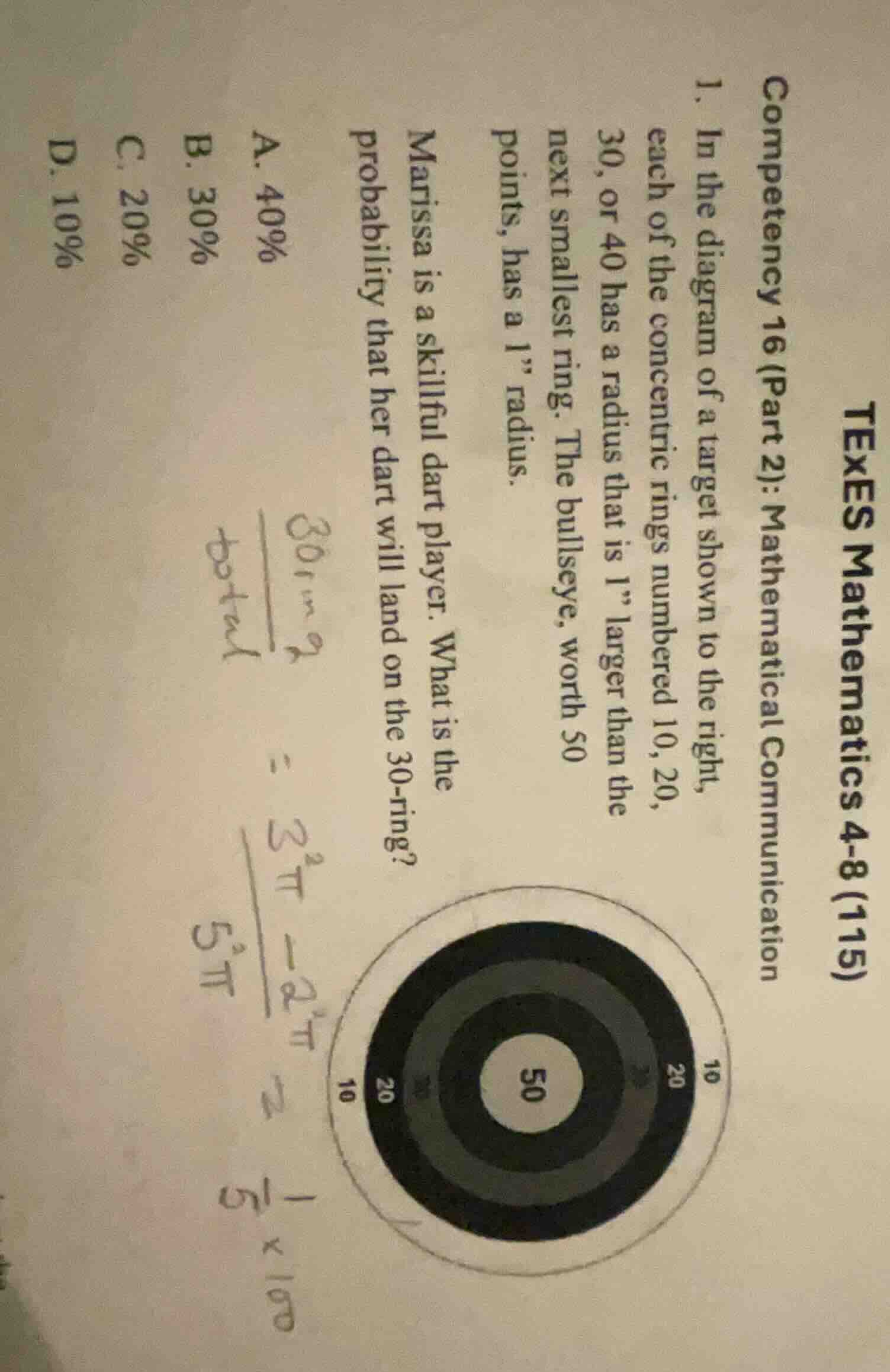
- in the diagram of a target shown to the right, each of the concentric rings numbered 10, 20, 30, or 40 has a radius that is 1\ larger than the next smallest ring. the bullseye, worth 50 points, has a 1\ radius.
marissa is a skillful dart player. what is the probability that her dart will land on the 30-ring?
a. 40%
b. 30%
c. 20%
d. 10%
⚡ Using what you learned: Density, Mass, and Geometric Probability
Step 1: Determine the radii of the concentric circles
The target consists of concentric circles starting from the center (bullseye) outward:
- Bullseye (\(50\) points): radius \(r_1 = 1\text{ inch}\)
- \(40\)-ring: radius \(r_2 = 1 + 1 = 2\text{ inches}\)
- \(30\)-ring: radius \(r_3 = 2 + 1 = 3\text{ inches}\)
- \(20\)-ring: radius \(r_4 = 3 + 1 = 4\text{ inches}\)
- \(10\)-ring: radius \(r_5 = 4 + 1 = 5\text{ inches}\)
Step 2: Calculate the total area of the target
The total area is the area of the outermost circle with radius \(r_5 = 5\text{ inches}\):
Step 3: Calculate the area of the 30-ring
The \(30\)-ring is the region between the circle of radius \(r_3 = 3\text{ inches}\) and the circle of radius \(r_2 = 2\text{ inches}\):
Step 4: Calculate the geometric probability
The probability that the dart lands on the \(30\)-ring is the ratio of the area of the \(30\)-ring to the total area:

Snap & solve any problem in the app
Get step-by-step solutions on Sovi AI
Photo-based solutions with guided steps
Explore more problems and detailed explanations
C. 20%