QUESTION IMAGE
Question
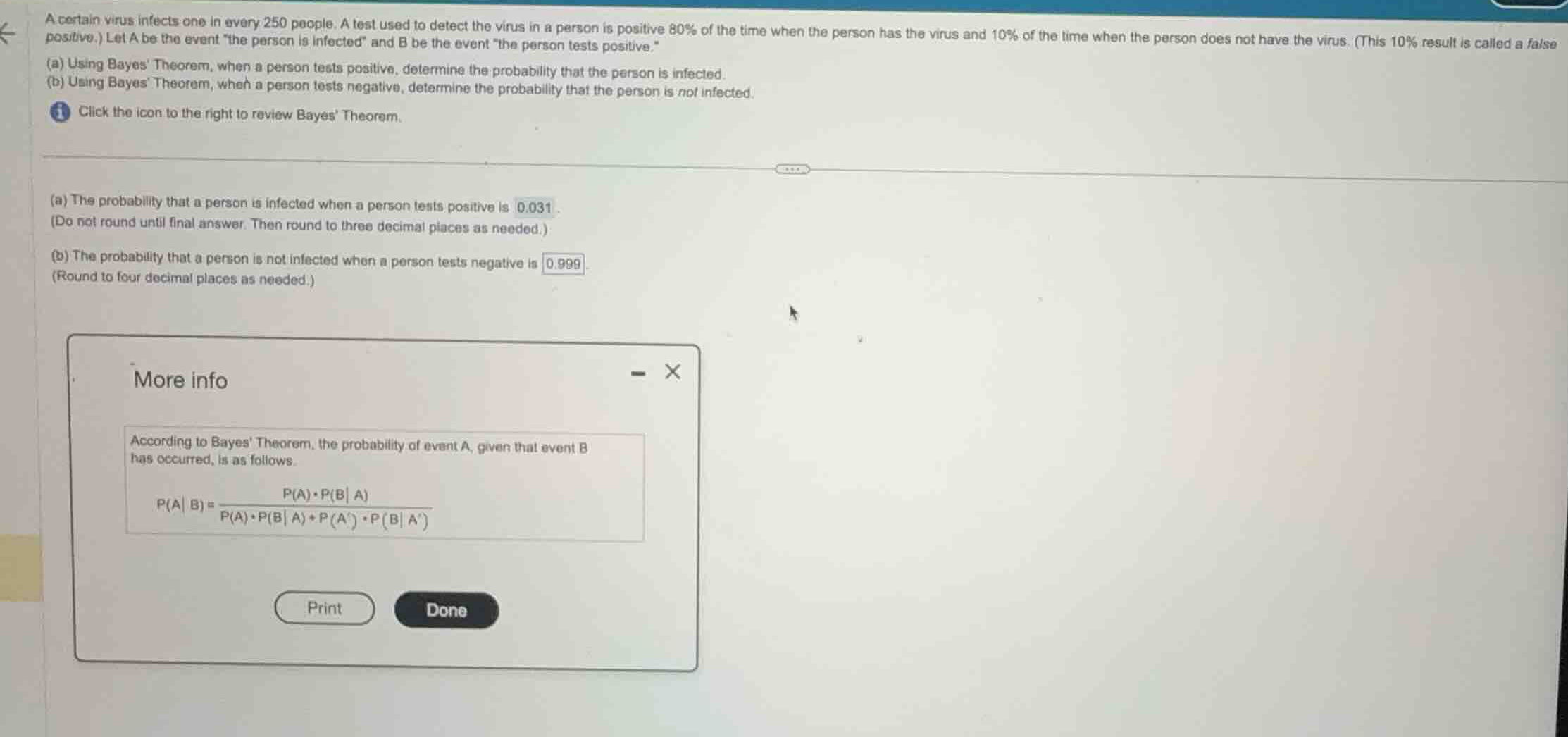
a certain virus infects one in every 250 people. a test used to detect the virus in a person is positive 80% of the time when the person has the virus and 10% of the time when the person does not have the virus. (this 10% result is called a false positive.) let a be the event \the person is infected\ and b be the event \the person tests positive.\
(a) using bayes theorem, when a person tests positive, determine the probability that the person is infected.
(b) using bayes theorem, when a person tests negative, determine the probability that the person is not infected.
(a) the probability that a person is infected when a person tests positive is 0.031.
(do not round until final answer. then round to three decimal places as needed.)
(b) the probability that a person is not infected when a person tests negative is 0.999.
(round to four decimal places as needed.)
Define the given probabilities
Using the Bayes Theorem and Posterior Probability knowledge points
Calculate the probability for part (a)
Using the Bayes Theorem and Posterior Probability knowledge points
Calculate the probability for part (b)
Using the Bayes Theorem and Posterior Probability knowledge points

Snap & solve any problem in the app
Get step-by-step solutions on Sovi AI
Photo-based solutions with guided steps
Explore more problems and detailed explanations
Question 1
The probability that a person is infected when a person tests positive is <blank>0.031</blank>.
Question 2
The probability that a person is not infected when a person tests negative is <blank>0.9991</blank>.