QUESTION IMAGE
Question
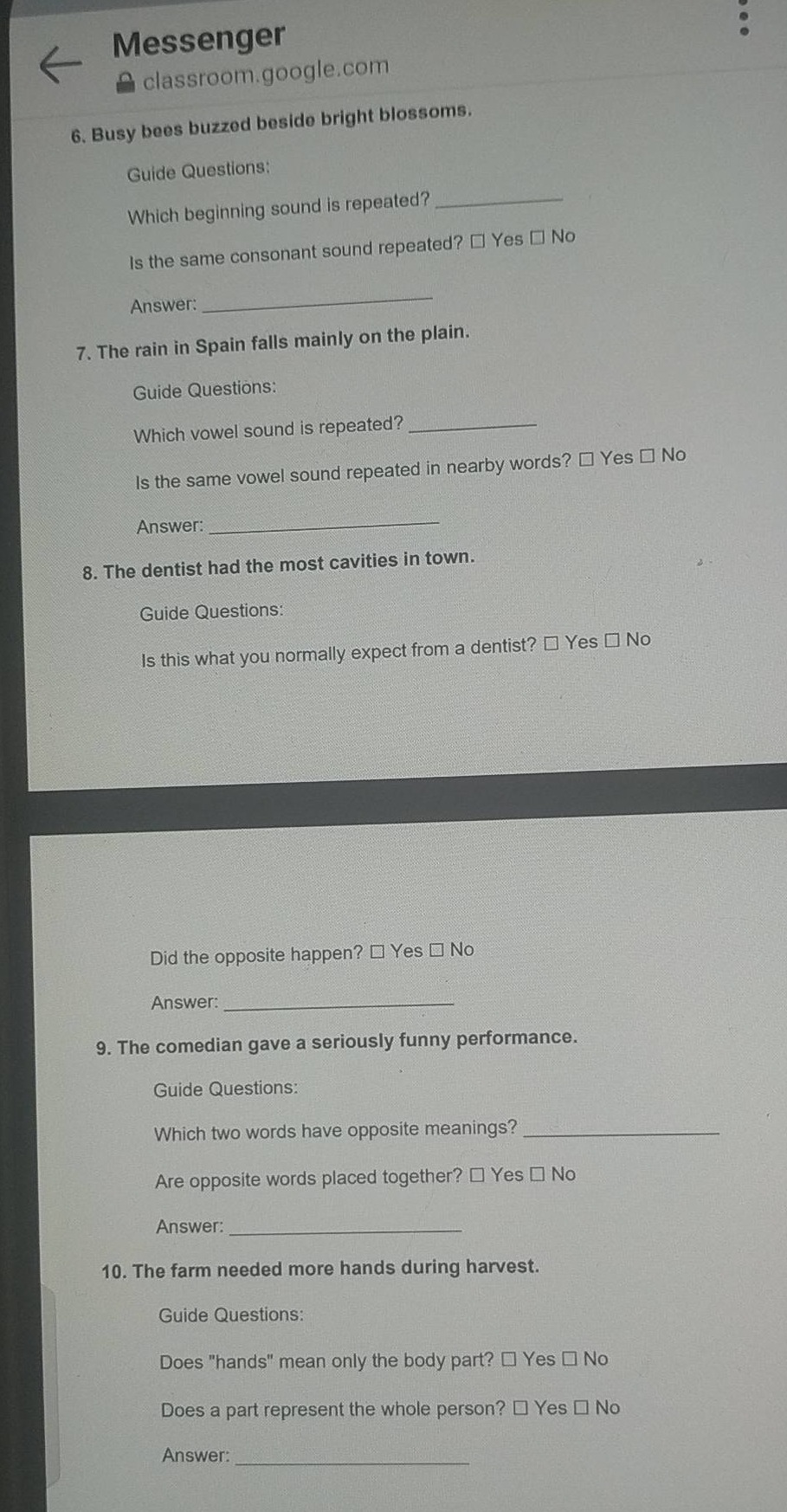
- busy bees buzzed beside bright blossoms.
guide questions:
which beginning sound is repeated? _______
is the same consonant sound repeated? yes no
answer: _____________________
- the rain in spain falls mainly on the plain.
guide questions:
which vowel sound is repeated? _______
is the same vowel sound repeated in nearby words? yes no
answer: _____________________
- the dentist had the most cavities in town.
guide questions:
is this what you normally expect from a dentist? yes no
did the opposite happen? yes no
answer: _____________________
- the comedian gave a seriously funny performance.
guide questions:
which two words have opposite meanings? _____________________
are opposite words placed together? yes no
answer: _____________________
- the farm needed more hands during harvest.
guide questions:
does \hands\ mean only the body part? yes no
does a part represent the whole person? yes no
answer: _____________________
⚡ Using: function of poetic devices in verse · 🆕 New: Figurative Language Devices
Identifying special literary devices like irony, oxymoron, and synecdoche
---
Step 1: Analyze Question 6
- Sentence: "Busy bees buzzed beside bright blossoms."
- Guide Questions:
- Which beginning sound is repeated? The words "Busy", "bees", "buzzed", "beside", and "bright" all start with the \(/b/\) sound.
- Is the same consonant sound repeated? Yes, \(/b/\) is a consonant sound.
- Device Identification: The repetition of the same consonant sound at the beginning of adjacent or closely connected words is called alliteration.
---
Step 2: Analyze Question 7
- Sentence: "The rain in Spain falls mainly on the plain."
- Guide Questions:
- Which vowel sound is repeated? The words "rain", "Spain", "mainly", and "plain" all share the long "a" sound, written phonetically as \(/eɪ/\).
- Is the same vowel sound repeated in nearby words? Yes, the long "a" sound is repeated across several words.
- Device Identification: The repetition of identical or similar vowel sounds in nearby words is called assonance.
---
Step 3: Analyze Question 8
- Sentence: "The dentist had the most cavities in town."
- Guide Questions:
- Is this what you normally expect from a dentist? No. We expect a dentist to have the healthiest teeth because they are dental health experts.
- Did the opposite happen? Yes. The person who is supposed to prevent cavities has the most of them.
- Device Identification: A situation where the actual outcome is the exact opposite of what is logically expected is called situational irony.
---
Step 4: Analyze Question 9
- Sentence: "The comedian gave a seriously funny performance."
- Guide Questions:
- Which two words have opposite meanings? "seriously" (grave, solemn) and "funny" (humorous, lighthearted).
- Are opposite words placed together? Yes, they are placed right next to each other to describe the performance.
- Device Identification: A figure of speech in which apparently contradictory terms appear in conjunction is called an oxymoron.
---
Step 5: Analyze Question 10
- Sentence: "The farm needed more hands during harvest."
- Guide Questions:
- Does "hands" mean only the body part? No. It refers to manual laborers or workers.
- Does a part represent the whole person? Yes. The physical "hands" (a part of the body) are used to represent the entire worker (the whole person).
- Device Identification: A figure of speech in which a part is made to represent the whole (or vice versa) is called synecdoche.
---

Snap & solve any problem in the app
Get step-by-step solutions on Sovi AI
Photo-based solutions with guided steps
Explore more problems and detailed explanations
6. Busy bees buzzed beside bright blossoms.
- Which beginning sound is repeated? \(/b/\)
- Is the same consonant sound repeated? [x] Yes [ ] No
- Answer: Alliteration
---
7. The rain in Spain falls mainly on the plain.
- Which vowel sound is repeated? Long "a" sound \(/eɪ/\)
- Is the same vowel sound repeated in nearby words? [x] Yes [ ] No
- Answer: Assonance
---
8. The dentist had the most cavities in town.
- Is this what you normally expect from a dentist? [ ] Yes [x] No
- Did the opposite happen? [x] Yes [ ] No
- Answer: Irony (Situational Irony)
---
9. The comedian gave a seriously funny performance.
- Which two words have opposite meanings? seriously, funny
- Are opposite words placed together? [x] Yes [ ] No
- Answer: Oxymoron
---
10. The farm needed more hands during harvest.
- Does "hands" mean only the body part? [ ] Yes [x] No
- Does a part represent the whole person? [x] Yes [ ] No
- Answer: Synecdoche