QUESTION IMAGE
Question
bulnesol is a key ingredient of oil of guaiac, a fragrance.
ratcliffe, heathcock, j. am. chem. soc. 1971, 93, 1746.
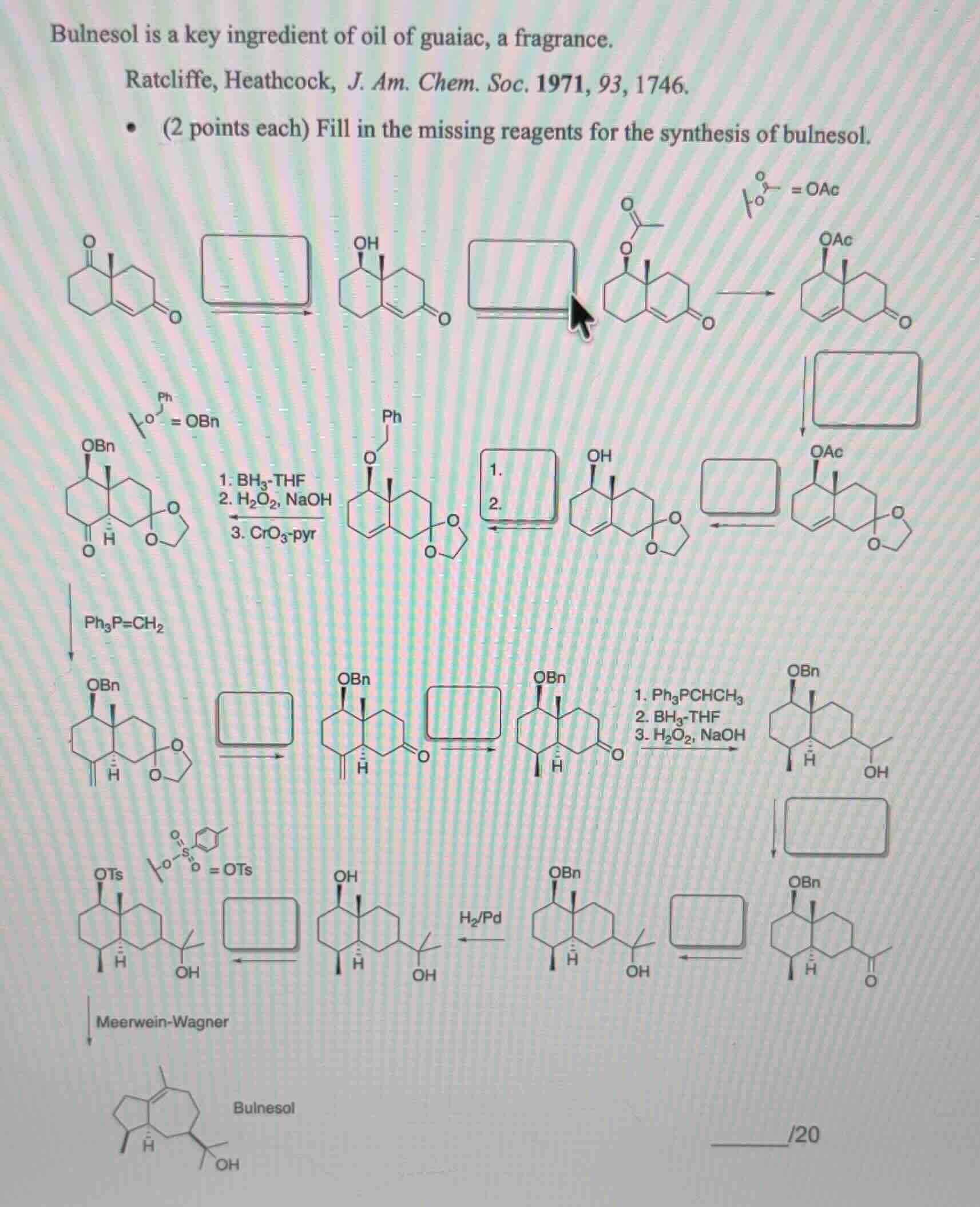
- (2 points each) fill in the missing reagents for the synthesis of bulnesol.
This multi-step organic synthesis pathway outlines the total synthesis of bulnesol, starting from a bicyclic enone precursor. We need to identify the missing reagents for each of the 10 blank boxes.
Reduce the non-conjugated ketone selectively
The starting material contains a conjugated enone system and a non-conjugated ketone. To selectively reduce the non-conjugated ketone to a secondary alcohol while leaving the enone intact, we can use a mild reducing agent.
Using the Carbonyl Reduction knowledge point:
Sodium borohydride (\(\text{NaBH}_3\text{CN}\) or \(\text{NaBH}_4\) at low temperature) can selectively reduce the more reactive, non-conjugated ketone.
Reagent: \(\text{NaBH}_4\)
Acetylate the secondary alcohol
The secondary alcohol is converted into an acetate ester (\(-\text{OAc}\)).
Using the Esterification knowledge point:
This transformation is achieved using acetic anhydride and a base.
Reagents: \(\text{Ac}_2\text{O}\), \(\text{pyridine}\) (or \(\text{NEt}_3\))
Protect the remaining ketone as an acetal
The ketone in the enone system needs to be protected as a cyclic acetal (ethylene glycol acetal) to prevent reaction in subsequent steps.
Using the Acetal Protection knowledge point:
This is accomplished using ethylene glycol in the presence of an acid catalyst with removal of water.
Reagents: \(\text{HOCH}_2\text{CH}_2\text{OH}\), \(\text{TsOH}\) (or \(\text{H}^+\))
Deprotect the acetate to regenerate the alcohol
The acetate group (\(-\text{OAc}\)) is hydrolyzed back to a secondary alcohol (\(-\text{OH}\)) under basic conditions.
Reagents:
- \(\text{NaOH}\) (or \(\text{KOH}\))
- \(\text{H}_2\text{O}\)
Convert the alcohol to a benzyl ether
The secondary alcohol is protected as a benzyl ether (\(-\text{OBn}\)).
Using the Ether Synthesis knowledge point:
This is typically done via a Williamson ether synthesis using a strong base to deprotonate the alcohol followed by benzyl bromide.
Reagents:
- \(\text{NaH}\)
- \(\text{BnBr}\)
Hydrolyze the acetal protecting group
The cyclic acetal protecting group is cleaved to regenerate the ketone.
Using the Acetal Protection knowledge point:
This is achieved via acid-catalyzed hydrolysis.
Reagents: \(\text{H}_3\text{O}^+\) (or \(\text{HCl}\), \(\text{H}_2\text{O}\))
Isomerize the exocyclic double bond to endocyclic
The exocyclic alkene formed by the Wittig reaction (\(\text{Ph}_3\text{P}=\text{CH}_2\)) is isomerized to the more stable endocyclic tetrasubstituted double bond.
Reagents: \(\text{TsOH}\) (or \(\text{H}^+\), heat)
Convert the methyl ketone to a tertiary alcohol
The methyl ketone is converted to a tertiary alcohol containing a dimethyl carbinol group (\(-\text{C(OH)(CH}_3)_2\)).
Using the Grignard Reaction knowledge point:
This is achieved by adding a methyl nucleophile to the ketone.
Reagents:
- \(\text{MeMgBr}\) (or \(\text{MeLi}\))
- \(\text{H}_3\text{O}^+\)
Deprotect the benzyl ether to regenerat…

Snap & solve any problem in the app
Get step-by-step solutions on Sovi AI
Photo-based solutions with guided steps
Explore more problems and detailed explanations
The missing reagents for the synthesis of bulnesol (ordered from top-left to bottom-right following the synthetic sequence) are:
- First box (top-left): \(\text{NaBH}_4\)
- Second box (top-middle): \(\text{Ac}_2\text{O}\), \(\text{pyridine}\)
- Third box (top-right): \(\text{HOCH}_2\text{CH}_2\text{OH}\), \(\text{TsOH}\)
- Fourth box (middle-right, step 1 & 2):
- \(\text{NaOH}\), \(\text{H}_2\text{O}\)
- \(\text{NaH}\), \(\text{BnBr}\)
- Fifth box (middle-middle): \(\text{H}_3\text{O}^+\) (or \(\text{HCl}\), \(\text{H}_2\text{O}\))
- Sixth box (middle-left): \(\text{TsOH}\) (or \(\text{H}^+\), heat)
- Seventh box (middle-right, below Wittig): \(\text{MeMgBr}\) (then \(\text{H}_3\text{O}^+\))
- Eighth box (bottom-right): \(\text{H}_2\), \(\text{Pd/C}\)
- Ninth box (bottom-left): \(\text{TsCl}\), \(\text{pyridine}\)