Sovi.AI - AI Math Tutor

Scan to solve math questions

QUESTION IMAGE

besides assisting in the breakdown of glucose for use by the cells, ins…

Question

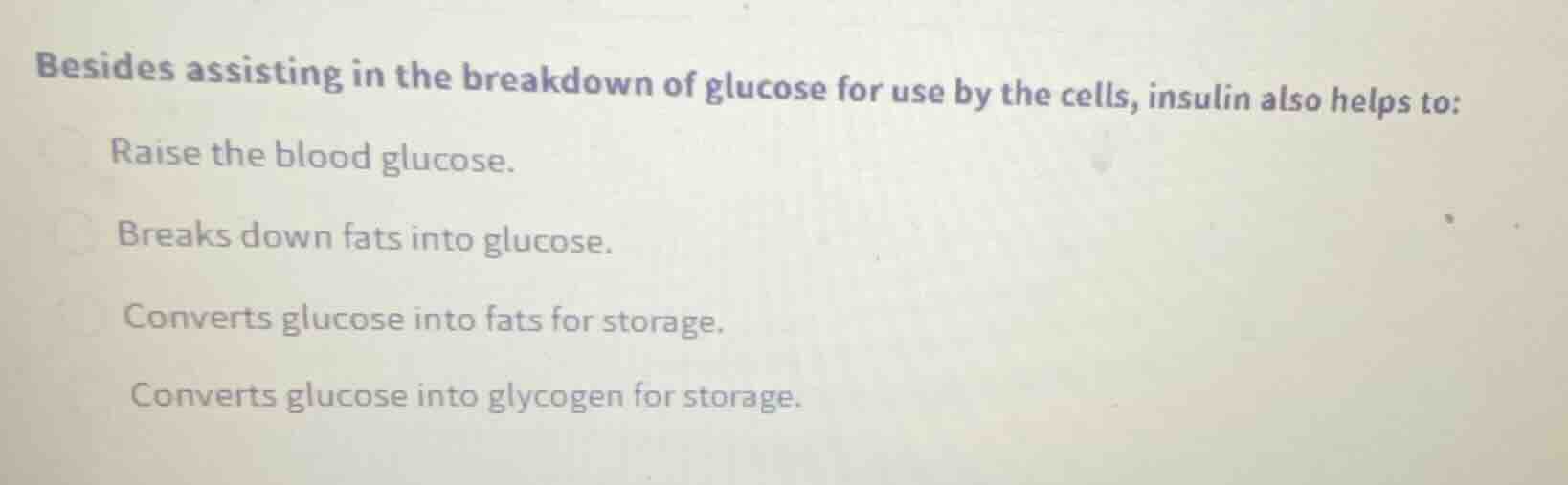
besides assisting in the breakdown of glucose for use by the cells, insulin also helps to:

raise the blood glucose.
breaks down fats into glucose.
converts glucose into fats for storage.
converts glucose into glycogen for storage.

Explanation:

Response

<pre_analysis>
{
"quality": "clear",
"question_count": 1,
"skills_matched": [
"direct_cot",
"multiple_choice_formatter",
"explain_then_answer",
"tutor",
"mastery_adaptive_brevity"
],
"needs_drawing": false,
"concepts_used": [
"Insulin Secretion",
"Glucose Homeostasis"
],
"new_concepts": [
"Glycogenesis",
"Insulin Physiological Actions"
],
"current_concepts": [
"Insulin Secretion",
"Glucose Homeostasis",
"Glycogenesis",
"Insulin Physiological Actions"
]
}
</pre_analysis>

<reasoning>

Analyze the physiological role of insulin

Using the Insulin Secretion and Glucose Homeostasis knowledge points

Insulin is an anabolic hormone secreted by the beta cells of the pancreas. Its primary function is to lower blood glucose levels when they are elevated (such as after a meal) by promoting cellular uptake, utilization, and storage of glucose.

Evaluate the given options

  • Raise the blood glucose: Incorrect. This is the function of glucagon, not insulin.
  • Breaks down fats into glucose: Incorrect. Insulin inhibits lipolysis (fat breakdown) and gluconeogenesis.
  • Converts glucose into fats for storage: While insulin promotes lipogenesis (converting excess glucose to fatty acids in the liver), the primary and most direct storage pathway for glucose in liver and muscle cells is its conversion into glycogen.
  • Converts glucose into glycogen for storage: Correct. Insulin directly stimulates glycogenesis (the conversion of glucose into glycogen) in both liver and skeletal muscle tissues to store excess glucose for future use.

</reasoning>

<answer>
<mcq-option>Raise the blood glucose.</mcq-option>
<mcq-option>Breaks down fats into glucose.</mcq-option>
<mcq-option>Converts glucose into fats for storage.</mcq-option>
<mcq-correct>Converts glucose into glycogen for storage.</mcq-correct>
</answer>

<post_analysis>
{
"subject": "Natural Science",
"question_type": "Multiple Choice",
"knowledge_point": [
"Natural Science",
"Biology",
"Endocrine System"
]
}
</post_analysis>

Answer:

<pre_analysis>
{
"quality": "clear",
"question_count": 1,
"skills_matched": [
"direct_cot",
"multiple_choice_formatter",
"explain_then_answer",
"tutor",
"mastery_adaptive_brevity"
],
"needs_drawing": false,
"concepts_used": [
"Insulin Secretion",
"Glucose Homeostasis"
],
"new_concepts": [
"Glycogenesis",
"Insulin Physiological Actions"
],
"current_concepts": [
"Insulin Secretion",
"Glucose Homeostasis",
"Glycogenesis",
"Insulin Physiological Actions"
]
}
</pre_analysis>

<reasoning>

Analyze the physiological role of insulin

Using the Insulin Secretion and Glucose Homeostasis knowledge points

Insulin is an anabolic hormone secreted by the beta cells of the pancreas. Its primary function is to lower blood glucose levels when they are elevated (such as after a meal) by promoting cellular uptake, utilization, and storage of glucose.

Evaluate the given options

  • Raise the blood glucose: Incorrect. This is the function of glucagon, not insulin.
  • Breaks down fats into glucose: Incorrect. Insulin inhibits lipolysis (fat breakdown) and gluconeogenesis.
  • Converts glucose into fats for storage: While insulin promotes lipogenesis (converting excess glucose to fatty acids in the liver), the primary and most direct storage pathway for glucose in liver and muscle cells is its conversion into glycogen.
  • Converts glucose into glycogen for storage: Correct. Insulin directly stimulates glycogenesis (the conversion of glucose into glycogen) in both liver and skeletal muscle tissues to store excess glucose for future use.

</reasoning>

<answer>
<mcq-option>Raise the blood glucose.</mcq-option>
<mcq-option>Breaks down fats into glucose.</mcq-option>
<mcq-option>Converts glucose into fats for storage.</mcq-option>
<mcq-correct>Converts glucose into glycogen for storage.</mcq-correct>
</answer>

<post_analysis>
{
"subject": "Natural Science",
"question_type": "Multiple Choice",
"knowledge_point": [
"Natural Science",
"Biology",
"Endocrine System"
]
}
</post_analysis>