QUESTION IMAGE
Question
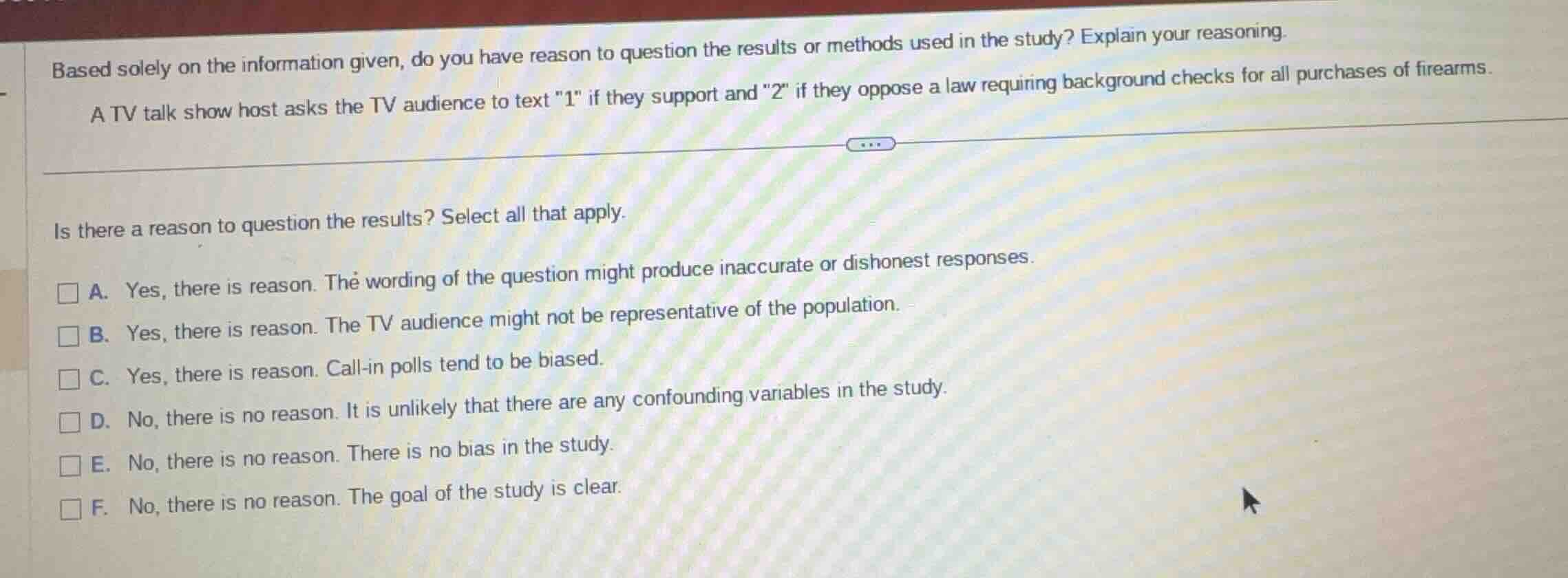
based solely on the information given, do you have reason to question the results or methods used in the study? explain your reasoning.
a tv talk show host asks the tv audience to text \1\ if they support and \2\ if they oppose a law requiring background checks for all purchases of firearms.
is there a reason to question the results? select all that apply.
a. yes, there is reason. the wording of the question might produce inaccurate or dishonest responses.
b. yes, there is reason. the tv audience might not be representative of the population.
c. yes, there is reason. call-in polls tend to be biased.
d. no, there is no reason. it is unlikely that there are any confounding variables in the study.
e. no, there is no reason. there is no bias in the study.
f. no, there is no reason. the goal of the study is clear.
Identify the sampling method and potential biases
The study relies on a TV talk show host asking the audience to text in their responses ("1" for support, "2" for oppose). This is a voluntary response sample (often referred to as a call-in or text-in poll), which is highly susceptible to sampling bias.
Evaluate the options based on statistical principles
- Option A: The wording of the question is neutral and straightforward ("1" if they support, "2" if they oppose), so wording bias is not a primary issue here.
- Option B: The TV audience is self-selected and limited to viewers of this specific show, meaning they are highly unlikely to be representative of the general population.
- Option C: Text-in/call-in polls rely on voluntary response, where people with strong opinions are more likely to participate, leading to significant bias.
- Options D, E, F: These claim there is no reason to question the results, which is incorrect due to the severe sampling and voluntary response biases present.

Snap & solve any problem in the app
Get step-by-step solutions on Sovi AI
Photo-based solutions with guided steps
Explore more problems and detailed explanations
- A. Yes, there is reason. The wording of the question might produce inaccurate or dishonest responses.
- B. Yes, there is reason. The TV audience might not be representative of the population. (Correct answer)
- C. Yes, there is reason. Call-in polls tend to be biased. (Correct answer)
- D. No, there is no reason. It is unlikely that there are any confounding variables in the study.
- E. No, there is no reason. There is no bias in the study.
- F. No, there is no reason. The goal of the study is clear.