QUESTION IMAGE
Question
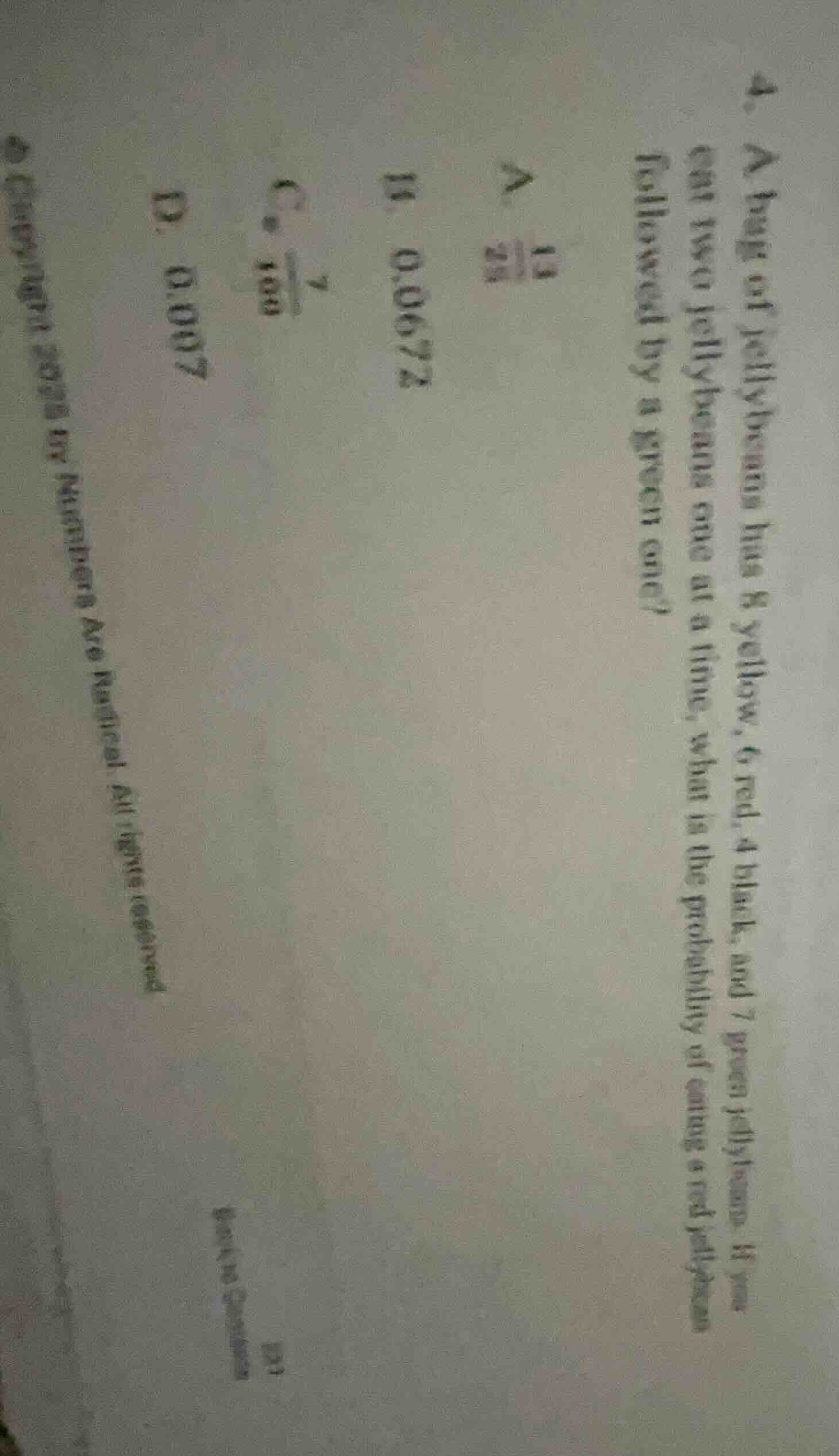
- a bag of jellybeans has 8 yellow, 6 red, 4 black, and 7 green jellybeans. if you eat two jellybeans one at a time, what is the probability of eating a red jellybean followed by a green one?
a. \\(\frac{13}{25}\\)
b. 0.0672
c. \\(\frac{7}{100}\\)
d. 0.007
🆕 New Concept Discovered: Dependent Events Probability
Finding the chance of consecutive events when the first outcome changes the next.
Step 1: Identify the total number of jellybeans
First, find the total number of jellybeans in the bag by adding all the colors together:
Step 2: Find the probability of eating a red jellybean first
The probability of choosing a red jellybean first is the number of red jellybeans divided by the total number of jellybeans:
Step 3: Find the probability of eating a green jellybean second
Since you eat the first jellybean, it is not replaced. This means both the number of green jellybeans and the total number of jellybeans change for the second draw:
- The number of green jellybeans remains \( 7 \).
- The total number of jellybeans remaining in the bag is now \( 25 - 1 = 24 \).
The probability of choosing a green jellybean second, given that a red one was eaten first, is:
Step 4: Calculate the combined probability
To find the probability of both events happening in sequence, multiply the two individual probabilities:
Simplify the calculation by cross-canceling \( 6 \) and \( 24 \):
Converting this fraction to a decimal:
Comparing this with the given options:
- A. \( \frac{13}{25} \)
- B. \( 0.0672 \)
- C. \( \frac{7}{100} \)
- D. \( 0.007 \)
The correct option is C.

Snap & solve any problem in the app
Get step-by-step solutions on Sovi AI
Photo-based solutions with guided steps
Explore more problems and detailed explanations
C. \( \frac{7}{100} \)