QUESTION IMAGE
Question
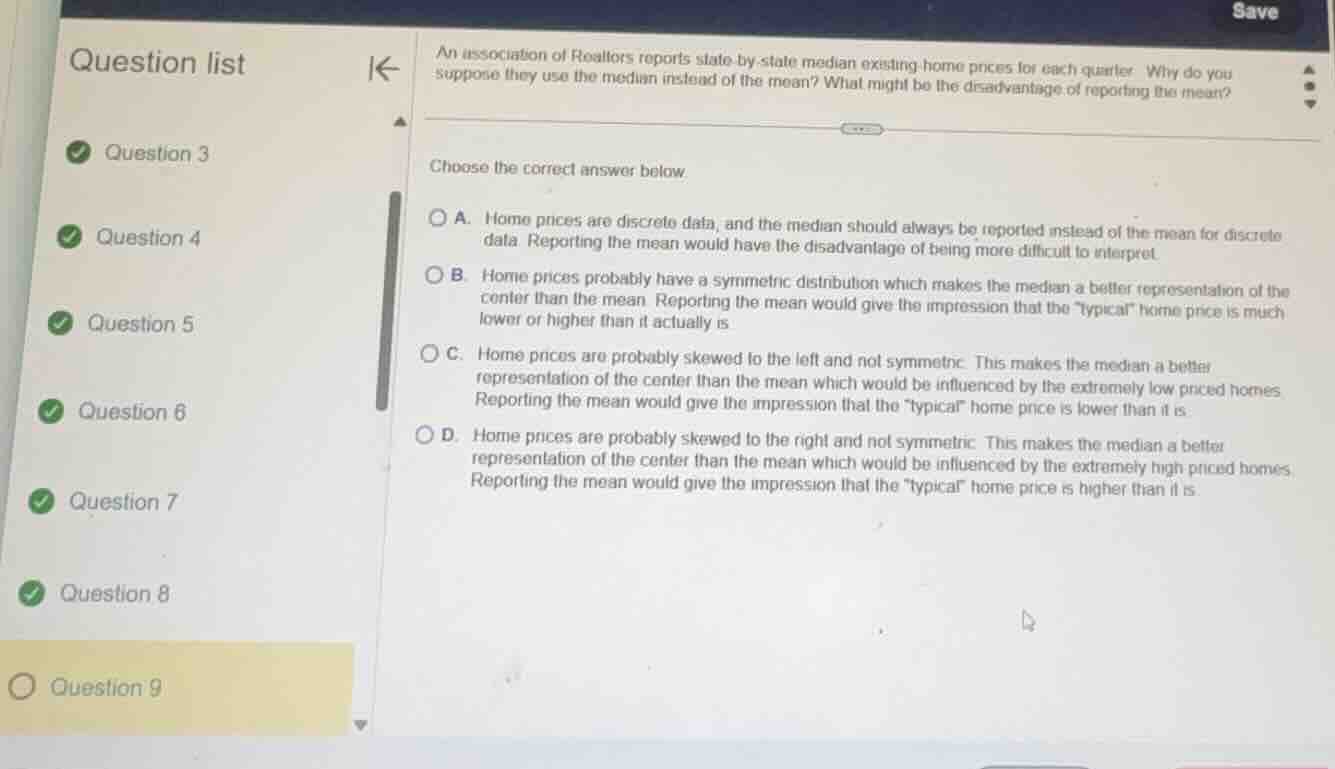
an association of realtors reports state-by-state median existing-home prices for each quarter. why do you suppose they use the median instead of the mean? what might be the disadvantage of reporting the mean?
choose the correct answer below.
a. home prices are discrete data, and the median should always be reported instead of the mean for discrete data. reporting the mean would have the disadvantage of being more difficult to interpret.
b. home prices probably have a symmetric distribution which makes the median a better representation of the center than the mean. reporting the mean would give the impression that the \typical\ home price is much lower or higher than it actually is.
c. home prices are probably skewed to the left and not symmetric. this makes the median a better representation of the center than the mean which would be influenced by the extremely low priced homes. reporting the mean would give the impression that the \typical\ home price is lower than it is.
d. home prices are probably skewed to the right and not symmetric. this makes the median a better representation of the center than the mean which would be influenced by the extremely high priced homes. reporting the mean would give the impression that the \typical\ home price is higher than it is.
⚡ Using what you learned: comparing measures of center & spread
Step 1: Analyze the shape of home price distributions
Home prices in a state or region typically have a lower limit (no home can cost less than \$0), but there is no upper limit. While most homes cluster around a moderate price range, a small number of extremely expensive luxury mansions exist. This creates a distribution with a long tail stretching to the right, meaning the data is skewed to the right.
Step 2: Compare the mean and median in skewed data
- Mean (Average): The mean is highly sensitive to extreme values (outliers). The few extremely high-priced homes pull the mean upward, making it higher than what most people actually pay.
- Median (Middle value): The median is resistant to outliers because it simply represents the middle point of the data. Half of the homes cost less than the median, and half cost more, regardless of how expensive the top 1% of homes are.
Therefore, the median provides a much more accurate representation of a "typical" home price in a skewed market.
Step 3: Evaluate the given options
- A: Incorrect. Home prices are continuous numerical data, not discrete, and the choice of median over mean is due to skewness, not data type.
- B: Incorrect. Home prices are not symmetric; they are highly skewed.
- C: Incorrect. Home prices are skewed to the right (due to high-end luxury homes), not skewed to the left.
- D: Correct. Home prices are skewed to the right. The median is a better representation of the center because the mean is pulled upward by extremely high-priced homes, which would give a misleadingly high impression of the "typical" home price.

Snap & solve any problem in the app
Get step-by-step solutions on Sovi AI
Photo-based solutions with guided steps
Explore more problems and detailed explanations
D. Home prices are probably skewed to the right and not symmetric. This makes the median a better representation of the center than the mean which would be influenced by the extremely high priced homes. Reporting the mean would give the impression that the "typical" home price is higher than it is.