QUESTION IMAGE
Question
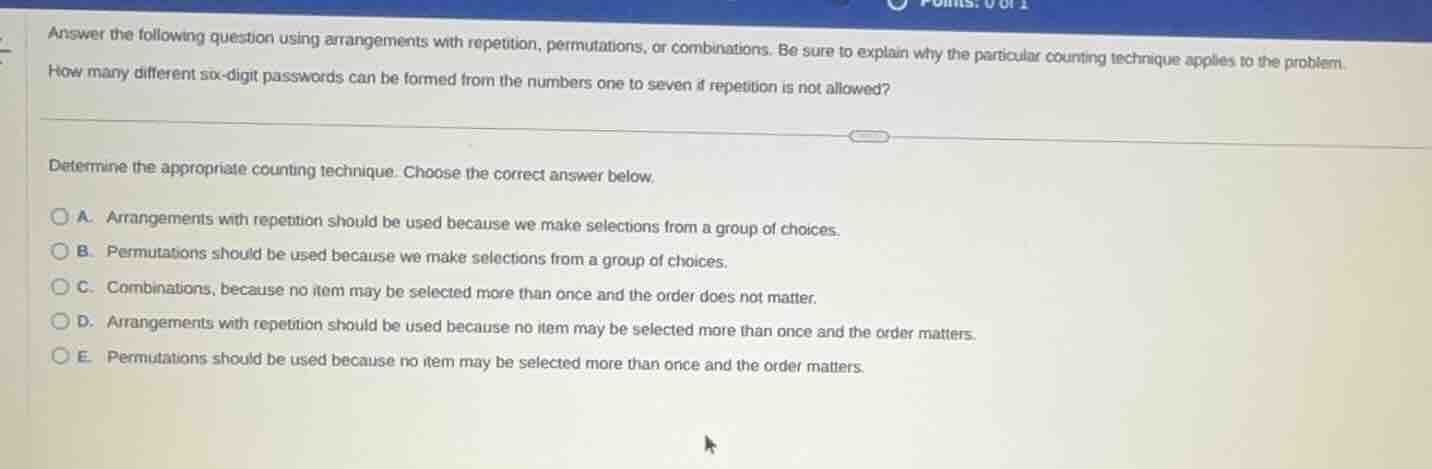
answer the following question using arrangements with repetition, permutations, or combinations. be sure to explain why the particular counting technique applies to the problem.
how many different six-digit passwords can be formed from the numbers one to seven if repetition is not allowed?
determine the appropriate counting technique. choose the correct answer below.
a. arrangements with repetition should be used because we make selections from a group of choices.
b. permutations should be used because we make selections from a group of choices.
c. combinations, because no item may be selected more than once and the order does not matter.
d. arrangements with repetition should be used because no item may be selected more than once and the order matters.
e. permutations should be used because no item may be selected more than once and the order matters.
Analyze the problem constraints
The problem asks how to form six-digit passwords from the numbers one to seven (1, 2, 3, 4, 5, 6, 7) under the condition that repetition is not allowed. We need to determine the appropriate counting technique.
Evaluate the role of order
Using the Permutations concept, we analyze if order matters. For passwords, the order of digits is critical (e.g., 123456 is a different password than 654321). Therefore, order matters.
Evaluate repetition
The problem explicitly states "if repetition is not allowed." This means no item may be selected more than once.
Select the counting technique
Since no item may be selected more than once and the order of selection matters, we must use permutations rather than combinations (where order does not matter) or arrangements with repetition. This matches option E.

Snap & solve any problem in the app
Get step-by-step solutions on Sovi AI
Photo-based solutions with guided steps
Explore more problems and detailed explanations
- A. Arrangements with repetition should be used because we make selections from a group of choices.
- B. Permutations should be used because we make selections from a group of choices.
- C. Combinations, because no item may be selected more than once and the order does not matter.
- D. Arrangements with repetition should be used because no item may be selected more than once and the order matters.
- E. Permutations should be used because no item may be selected more than once and the order matters. (Correct answer)