Sovi.AI - AI Math Tutor

Scan to solve math questions

QUESTION IMAGE

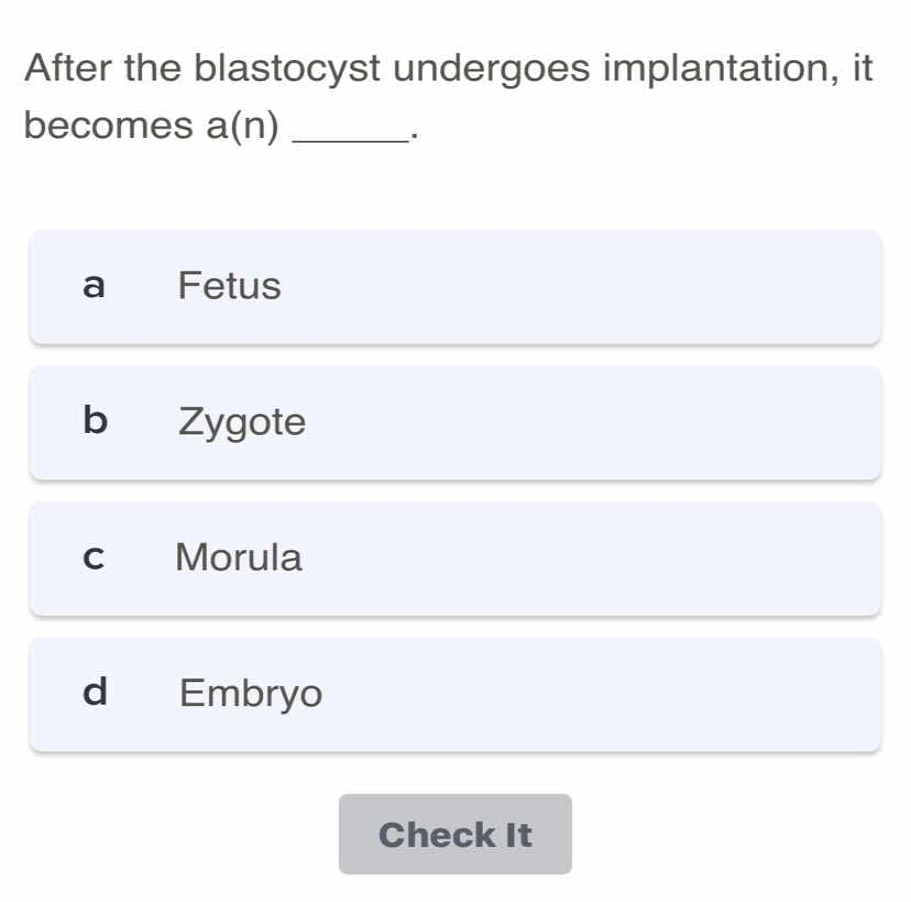
after the blastocyst undergoes implantation, it becomes a(n) ______. a …

Question

after the blastocyst undergoes implantation, it becomes a(n) ______.

a fetus
b zygote
c morula
d embryo

Explanation:

Response

<pre_analysis>
{
"quality": "clear",
"question_count": 1,
"skills_matched": [
"direct_cot",
"multiple_choice_formatter",
"explain_then_answer",
"tutor",
"mastery_adaptive_brevity"
],
"needs_drawing": false,
"concepts_used": [
"Embryonic Stage",
"Human Prenatal Development"
],
"new_concepts": [
"Blastocyst Implantation",
"Early Embryogenesis"
],
"current_concepts": [
"Human Prenatal Development",
"Embryonic Stage",
"Blastocyst Implantation",
"Early Embryogenesis"
]
}
</pre_analysis>

<reasoning>

Identify the stages of early development

Using the Human Prenatal Development knowledge point, we trace the sequence of early human development:

  1. Fertilization creates a single-celled zygote.
  2. Cleavage divisions turn the zygote into a solid ball of cells called a morula.
  3. Further division and fluid accumulation form a hollow ball of cells called a blastocyst.

Determine the post-implantation stage

Using the Embryonic Stage knowledge point, we identify the transition that occurs during implantation:

  • The blastocyst embeds itself into the uterine lining (implantation).
  • Once successfully implanted, the developing organism enters the embryonic period and is officially referred to as an embryo.
  • The embryonic stage lasts until about the eighth week of development, after which it becomes a fetus.

Evaluate the given options

  • a Fetus: This stage begins at week 9 of development, well after implantation.
  • b Zygote: This is the single-celled stage immediately following fertilization.
  • c Morula: This is an early pre-implantation stage consisting of a solid ball of cells.
  • d Embryo: This is the correct term for the developing organism after implantation.

</reasoning>

<answer>
<mcq-option>a Fetus</mcq-option>
<mcq-option>b Zygote</mcq-option>
<mcq-option>c Morula</mcq-option>
<mcq-correct>d Embryo</mcq-correct>
</answer>

<post_analysis>
{
"subject": "Natural Science",
"question_type": "Multiple Choice",
"knowledge_point": [
"Natural Science",
"Biology",
"Human Prenatal Development"
]
}
</post_analysis>

Answer:

<pre_analysis>
{
"quality": "clear",
"question_count": 1,
"skills_matched": [
"direct_cot",
"multiple_choice_formatter",
"explain_then_answer",
"tutor",
"mastery_adaptive_brevity"
],
"needs_drawing": false,
"concepts_used": [
"Embryonic Stage",
"Human Prenatal Development"
],
"new_concepts": [
"Blastocyst Implantation",
"Early Embryogenesis"
],
"current_concepts": [
"Human Prenatal Development",
"Embryonic Stage",
"Blastocyst Implantation",
"Early Embryogenesis"
]
}
</pre_analysis>

<reasoning>

Identify the stages of early development

Using the Human Prenatal Development knowledge point, we trace the sequence of early human development:

  1. Fertilization creates a single-celled zygote.
  2. Cleavage divisions turn the zygote into a solid ball of cells called a morula.
  3. Further division and fluid accumulation form a hollow ball of cells called a blastocyst.

Determine the post-implantation stage

Using the Embryonic Stage knowledge point, we identify the transition that occurs during implantation:

  • The blastocyst embeds itself into the uterine lining (implantation).
  • Once successfully implanted, the developing organism enters the embryonic period and is officially referred to as an embryo.
  • The embryonic stage lasts until about the eighth week of development, after which it becomes a fetus.

Evaluate the given options

  • a Fetus: This stage begins at week 9 of development, well after implantation.
  • b Zygote: This is the single-celled stage immediately following fertilization.
  • c Morula: This is an early pre-implantation stage consisting of a solid ball of cells.
  • d Embryo: This is the correct term for the developing organism after implantation.

</reasoning>

<answer>
<mcq-option>a Fetus</mcq-option>
<mcq-option>b Zygote</mcq-option>
<mcq-option>c Morula</mcq-option>
<mcq-correct>d Embryo</mcq-correct>
</answer>

<post_analysis>
{
"subject": "Natural Science",
"question_type": "Multiple Choice",
"knowledge_point": [
"Natural Science",
"Biology",
"Human Prenatal Development"
]
}
</post_analysis>