QUESTION IMAGE
Question
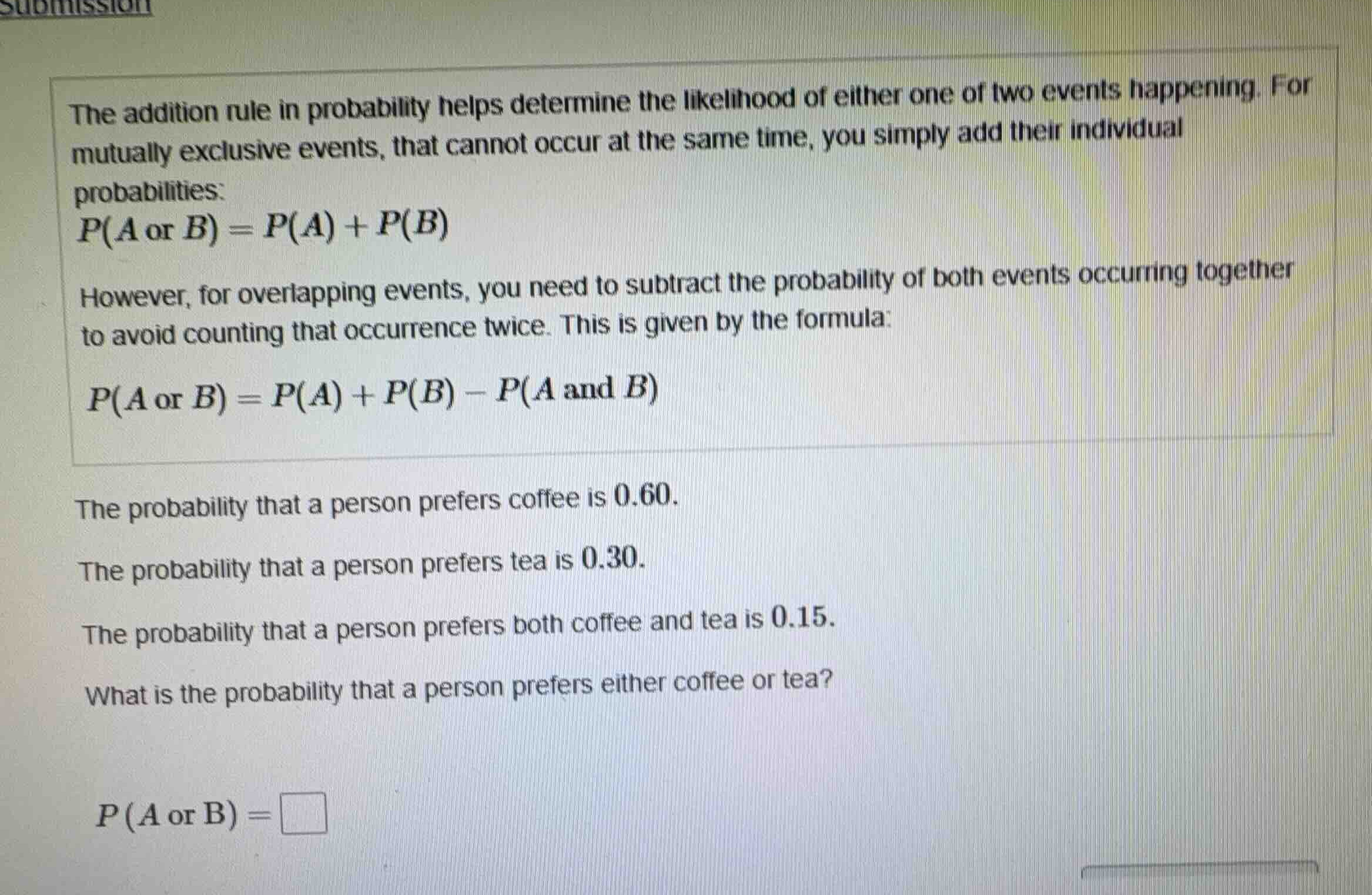
the addition rule in probability helps determine the likelihood of either one of two events happening. for mutually exclusive events, that cannot occur at the same time, you simply add their individual probabilities:
\\(p(a \text{ or } b) = p(a) + p(b)\\)
however, for overlapping events, you need to subtract the probability of both events occurring together to avoid counting that occurrence twice. this is given by the formula:
\\(p(a \text{ or } b) = p(a) + p(b) - p(a \text{ and } b)\\)
the probability that a person prefers coffee is \\(0.60\\).
the probability that a person prefers tea is \\(0.30\\).
the probability that a person prefers both coffee and tea is \\(0.15\\).
what is the probability that a person prefers either coffee or tea?
\\(p(a \text{ or } b) = \\)
Identify the given probabilities
We are given the individual and joint probabilities for two overlapping events:
- Let \(A\) be the event that a person prefers coffee: \(P(A) = 0.60\)
- Let \(B\) be the event that a person prefers tea: \(P(B) = 0.30\)
- The joint probability that a person prefers both coffee and tea is: \(P(A \text{ and } B) = 0.15\)
Select the appropriate formula
Since the events are overlapping (a person can prefer both coffee and tea, and \(P(A \text{ and } B)
eq 0\)), we must use the general addition rule for overlapping events:
Calculate the union probability
Substitute the given values into the formula:

Snap & solve any problem in the app
Get step-by-step solutions on Sovi AI
Photo-based solutions with guided steps
Explore more problems and detailed explanations
What is the probability that a person prefers either coffee or tea?
\(P(\text{A or B}) =\) <blank>0.75</blank>