QUESTION IMAGE
Question
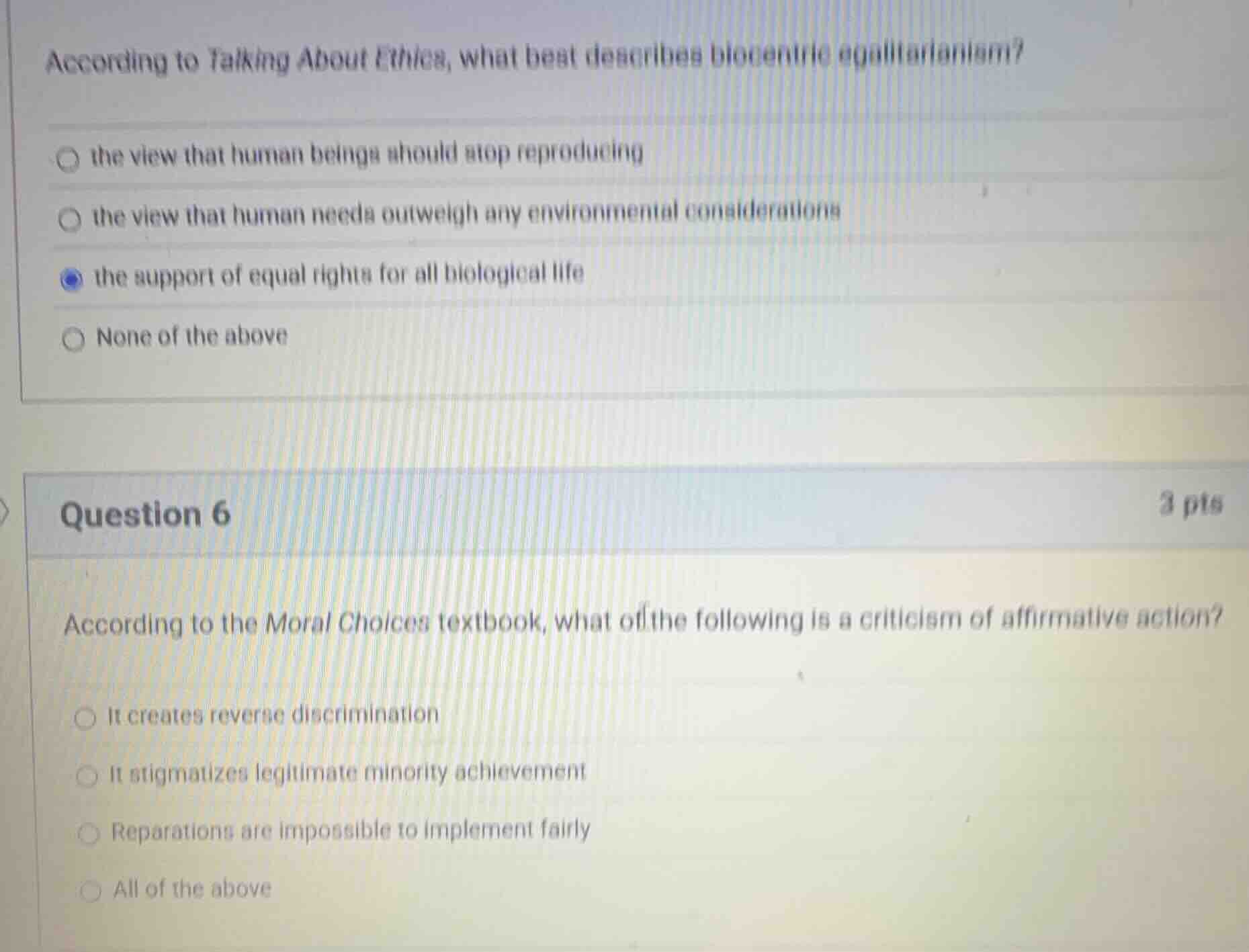
according to talking about ethics, what best describes biocentric egalitarianism?
the view that human beings should stop reproducing
the view that human needs outweigh any environmental considerations
the support of equal rights for all biological life
none of the above
question 6
according to the moral choices textbook, what of the following is a criticism of affirmative action?
it creates reverse discrimination
it stigmatizes legitimate minority achievement
reparations are impossible to implement fairly
all of the above
🆕 New Concept Discovered: Environmental Ethics and Social Justice Theories
Analyzing moral frameworks regarding nature and policy
Step 1: Analyze the first question on biocentric egalitarianism
The first question asks: "According to Talking About Ethics, what best describes biocentric egalitarianism?"
Let's break down the term:
- Biocentric (bio- = life, -centric = centered): Focusing on all living things, not just humans.
- Egalitarianism: The belief in the fundamental equality of all entities in question.
Therefore, biocentric egalitarianism is the ethical theory that all living things (biological life) have equal moral standing and inherent worth.
- Option 1 ("the view that human beings should stop reproducing") describes anti-natalism, not biocentric egalitarianism.
- Option 2 ("the view that human needs outweigh any environmental considerations") describes anthropocentrism.
- Option 3 ("the support of equal rights for all biological life") directly aligns with the definition of biocentric egalitarianism.
Thus, the selected option in the image, "the support of equal rights for all biological life", is correct.
Step 2: Analyze the second question on criticisms of affirmative action
The second question asks: "According to the Moral Choices textbook, what of the following is a criticism of affirmative action?"
Let's evaluate the common ethical and social criticisms of affirmative action discussed in standard ethics textbooks like Moral Choices:
- "It creates reverse discrimination": This is a major argument raised by critics who contend that using race or gender as a factor in admissions or hiring can unfairly disadvantage qualified individuals who do not belong to the preferred groups.
- "It stigmatizes legitimate minority achievement": This argument suggests that affirmative action can lead to the perception that successful minority individuals achieved their positions due to preferential treatment rather than their own merit and hard work.
- "Reparations are impossible to implement fairly": This is a practical and ethical objection regarding how to fairly calculate and distribute compensatory justice for historical wrongs.
Since all three points are widely recognized and discussed as standard criticisms of affirmative action in the Moral Choices curriculum, they are all correct.

Snap & solve any problem in the app
Get step-by-step solutions on Sovi AI
Photo-based solutions with guided steps
Explore more problems and detailed explanations
- First Question: The support of equal rights for all biological life
- Second Question (Question 6): All of the above