QUESTION IMAGE
Question
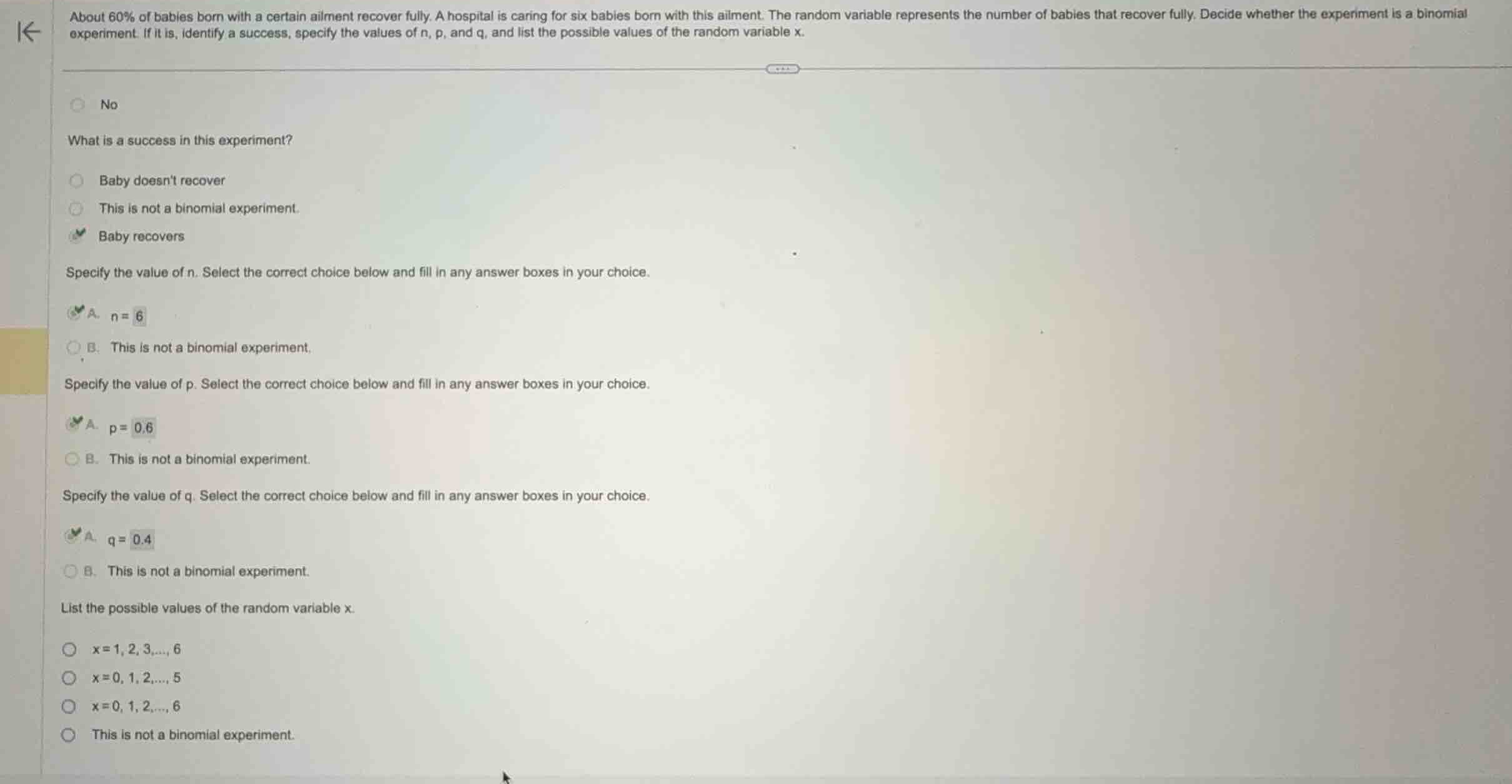
about 60% of babies born with a certain ailment recover fully. a hospital is caring for six babies born with this ailment. the random variable represents the number of babies that recover fully. decide whether the experiment is a binomial experiment. if it is, identify a success, specify the values of n, p, and q, and list the possible values of the random variable x.
no
what is a success in this experiment?
baby doesnt recover
this is not a binomial experiment.
baby recovers
specify the value of n. select the correct choice below and fill in any answer boxes in your choice.
a. n = 6
b. this is not a binomial experiment.
specify the value of p. select the correct choice below and fill in any answer boxes in your choice.
a. p = 0.6
b. this is not a binomial experiment.
specify the value of q. select the correct choice below and fill in any answer boxes in your choice.
a. q = 0.4
b. this is not a binomial experiment.
list the possible values of the random variable x.
x = 1, 2, 3,..., 6
x = 0, 1, 2,..., 5
x = 0, 1, 2,..., 6
this is not a binomial experiment.
Verify binomial experiment criteria
Identify parameters and success definition
Determine random variable values

Snap & solve any problem in the app
Get step-by-step solutions on Sovi AI
Photo-based solutions with guided steps
Explore more problems and detailed explanations
Question 1
- Yes (Correct answer)
- No
Question 2
- Baby doesn't recover
- This is not a binomial experiment.
- Baby recovers (Correct answer)
Question 3
- A. \(n = 6\) (Correct answer)
- B. This is not a binomial experiment.
Question 4
- A. \(p = 0.6\) (Correct answer)
- B. This is not a binomial experiment.
Question 5
- A. \(q = 0.4\) (Correct answer)
- B. This is not a binomial experiment.
Question 6
- \(x = 1, 2, 3, \dots, 6\)
- \(x = 0, 1, 2, \dots, 5\)
- \(x = 0, 1, 2, \dots, 6\) (Correct answer)
- This is not a binomial experiment.