QUESTION IMAGE
Question
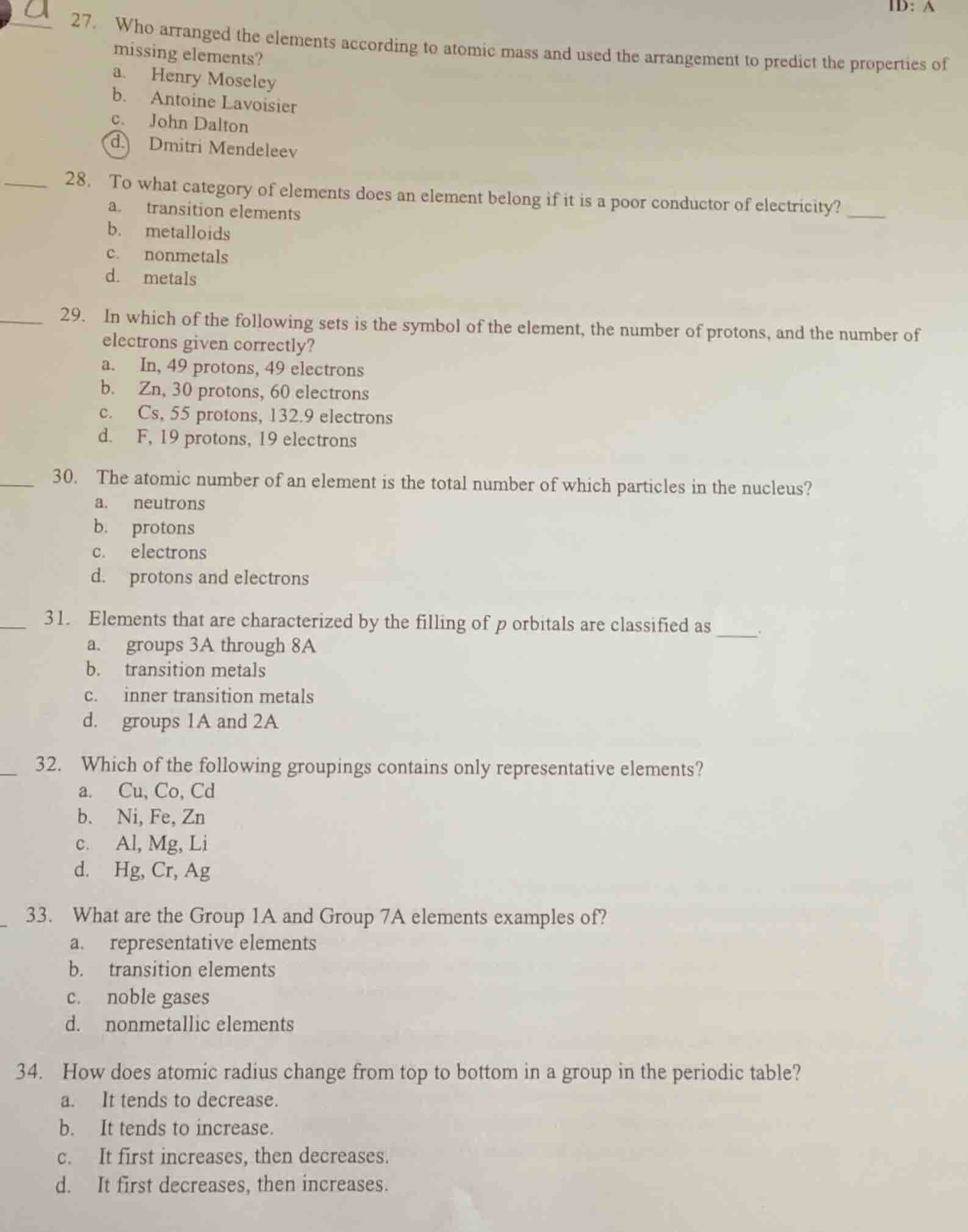
- who arranged the elements according to atomic mass and used the arrangement to predict the properties of missing elements?
a. henry moseley
b. antoine lavoisier
c. john dalton
d. dmitri mendeleev
- to what category of elements does an element belong if it is a poor conductor of electricity?
a. transition elements
b. metalloids
c. nonmetals
d. metals
- in which of the following sets is the symbol of the element, the number of protons, and the number of electrons given correctly?
a. in, 49 protons, 49 electrons
b. zn, 30 protons, 60 electrons
c. cs, 55 protons, 132.9 electrons
d. f, 19 protons, 19 electrons
- the atomic number of an element is the total number of which particles in the nucleus?
a. neutrons
b. protons
c. electrons
d. protons and electrons
- elements that are characterized by the filling of p orbitals are classified as
a. groups 3a through 8a
b. transition metals
c. inner transition metals
d. groups 1a and 2a
- which of the following groupings contains only representative elements?
a. cu, co, cd
b. ni, fe, zn
c. al, mg, li
d. hg, cr, ag
- what are the group 1a and group 7a elements examples of?
a. representative elements
b. transition elements
c. noble gases
d. nonmetallic elements
- how does atomic radius change from top to bottom in a group in the periodic table?
a. it tends to decrease.
b. it tends to increase.
c. it first increases, then decreases.
d. it first decreases, then increases.
<pre_analysis>
{
"quality": "clear",
"question_count": 8,
"skills_matched": [
"direct_cot",
"multiple_choice_formatter",
"explain_then_answer",
"tutor",
"mastery_adaptive_brevity"
],
"needs_drawing": false,
"concepts_used": [
"Periodic Table Trends",
"Periodic Table Vocabulary"
],
"new_concepts": [
"Representative Elements",
"Atomic Structure Basics",
"Electron Configuration Blocks"
],
"current_concepts": [
"Periodic Table Trends",
"Periodic Table Vocabulary",
"Representative Elements",
"Atomic Structure Basics",
"Electron Configuration Blocks"
]
}
</pre_analysis>
<reasoning>
Identify Mendeleev's contribution
Using the Periodic Table Vocabulary knowledge point
Dmitri Mendeleev arranged elements by atomic mass and predicted properties of undiscovered elements.
Classify poor electrical conductors
Using the Periodic Table Vocabulary knowledge point
Nonmetals are characterized by being poor conductors of electricity and heat.
Verify atomic symbols and subatomic particles
Using the Periodic Table Vocabulary knowledge point
Indium (\(\text{In}\)) has atomic number 49, meaning a neutral atom has 49 protons and 49 electrons.
Define atomic number
Using the Periodic Table Vocabulary knowledge point
The atomic number is defined as the total number of protons in an atom's nucleus.
Determine p-orbital block groups
Using the Periodic Table Vocabulary knowledge point
The filling of \(p\) orbitals corresponds to the main-group elements in groups 3A through 8A.
Identify representative elements
Representative elements (Group A elements) belong to the \(s\) and \(p\) blocks. Aluminum (\(\text{Al}\)), magnesium (\(\text{Mg}\)), and lithium (\(\text{Li}\)) are all representative elements.
Classify Group 1A and 7A elements
Group 1A (alkali metals) and Group 7A (halogens) are examples of representative elements.
Analyze atomic radius trend
Using the Periodic Table Trends knowledge point
Atomic radius increases from top to bottom down a group due to additional electron shells.
</reasoning>
<answer>
Question 27
<mcq-option>a. Henry Moseley</mcq-option>
<mcq-option>b. Antoine Lavoisier</mcq-option>
<mcq-option>c. John Dalton</mcq-option>
<mcq-correct>d. Dmitri Mendeleev</mcq-correct>
Question 28
<mcq-option>a. transition elements</mcq-option>
<mcq-option>b. metalloids</mcq-correct>
<mcq-correct>c. nonmetals</mcq-correct>
<mcq-option>d. metals</mcq-option>
Question 29
<mcq-correct>a. In, 49 protons, 49 electrons</mcq-correct>
<mcq-option>b. Zn, 30 protons, 60 electrons</mcq-option>
<mcq-option>c. Cs, 55 protons, 132.9 electrons</mcq-option>
<mcq-option>d. F, 19 protons, 19 electrons</mcq-option>
Question 30
<mcq-option>a. neutrons</mcq-option>
<mcq-correct>b. protons</mcq-correct>
<mcq-option>c. electrons</mcq-option>
<mcq-option>d. protons and electrons</mcq-option>
Question 31
<mcq-correct>a. groups 3A through 8A</mcq-correct>
<mcq-option>b. transition metals</mcq-option>
<mcq-option>c. inner transition metals</mcq-option>
<mcq-option>d. groups 1A and 2A</mcq-option>
Question 32
<mcq-option>a. Cu, Co, Cd</mcq-option>
<mcq-option>b. Ni, Fe, Zn</mcq-option>
<mcq-correct>c. Al, Mg, Li</mcq-correct>
<mcq-option>d. Hg, Cr, Ag</mcq-option>
Question 33
<mcq-correct>a. representative elements</mcq-correct>
<mcq-option>b. transition elements</mcq-option>
<mcq-option>c. noble gases</mcq-option>
<mcq-option>d. nonmetallic elements</mcq-option>
Question 34
<mcq-option>a. It tends to decrease.</mcq-option>
<mcq-corr…
Snap & solve any problem in the app
Get step-by-step solutions on Sovi AI
Photo-based solutions with guided steps
Explore more problems and detailed explanations
<pre_analysis>
{
"quality": "clear",
"question_count": 8,
"skills_matched": [
"direct_cot",
"multiple_choice_formatter",
"explain_then_answer",
"tutor",
"mastery_adaptive_brevity"
],
"needs_drawing": false,
"concepts_used": [
"Periodic Table Trends",
"Periodic Table Vocabulary"
],
"new_concepts": [
"Representative Elements",
"Atomic Structure Basics",
"Electron Configuration Blocks"
],
"current_concepts": [
"Periodic Table Trends",
"Periodic Table Vocabulary",
"Representative Elements",
"Atomic Structure Basics",
"Electron Configuration Blocks"
]
}
</pre_analysis>
<reasoning>
Identify Mendeleev's contribution
Using the Periodic Table Vocabulary knowledge point
Dmitri Mendeleev arranged elements by atomic mass and predicted properties of undiscovered elements.
Classify poor electrical conductors
Using the Periodic Table Vocabulary knowledge point
Nonmetals are characterized by being poor conductors of electricity and heat.
Verify atomic symbols and subatomic particles
Using the Periodic Table Vocabulary knowledge point
Indium (\(\text{In}\)) has atomic number 49, meaning a neutral atom has 49 protons and 49 electrons.
Define atomic number
Using the Periodic Table Vocabulary knowledge point
The atomic number is defined as the total number of protons in an atom's nucleus.
Determine p-orbital block groups
Using the Periodic Table Vocabulary knowledge point
The filling of \(p\) orbitals corresponds to the main-group elements in groups 3A through 8A.
Identify representative elements
Representative elements (Group A elements) belong to the \(s\) and \(p\) blocks. Aluminum (\(\text{Al}\)), magnesium (\(\text{Mg}\)), and lithium (\(\text{Li}\)) are all representative elements.
Classify Group 1A and 7A elements
Group 1A (alkali metals) and Group 7A (halogens) are examples of representative elements.
Analyze atomic radius trend
Using the Periodic Table Trends knowledge point
Atomic radius increases from top to bottom down a group due to additional electron shells.
</reasoning>
<answer>
Question 27
<mcq-option>a. Henry Moseley</mcq-option>
<mcq-option>b. Antoine Lavoisier</mcq-option>
<mcq-option>c. John Dalton</mcq-option>
<mcq-correct>d. Dmitri Mendeleev</mcq-correct>
Question 28
<mcq-option>a. transition elements</mcq-option>
<mcq-option>b. metalloids</mcq-correct>
<mcq-correct>c. nonmetals</mcq-correct>
<mcq-option>d. metals</mcq-option>
Question 29
<mcq-correct>a. In, 49 protons, 49 electrons</mcq-correct>
<mcq-option>b. Zn, 30 protons, 60 electrons</mcq-option>
<mcq-option>c. Cs, 55 protons, 132.9 electrons</mcq-option>
<mcq-option>d. F, 19 protons, 19 electrons</mcq-option>
Question 30
<mcq-option>a. neutrons</mcq-option>
<mcq-correct>b. protons</mcq-correct>
<mcq-option>c. electrons</mcq-option>
<mcq-option>d. protons and electrons</mcq-option>
Question 31
<mcq-correct>a. groups 3A through 8A</mcq-correct>
<mcq-option>b. transition metals</mcq-option>
<mcq-option>c. inner transition metals</mcq-option>
<mcq-option>d. groups 1A and 2A</mcq-option>
Question 32
<mcq-option>a. Cu, Co, Cd</mcq-option>
<mcq-option>b. Ni, Fe, Zn</mcq-option>
<mcq-correct>c. Al, Mg, Li</mcq-correct>
<mcq-option>d. Hg, Cr, Ag</mcq-option>
Question 33
<mcq-correct>a. representative elements</mcq-correct>
<mcq-option>b. transition elements</mcq-option>
<mcq-option>c. noble gases</mcq-option>
<mcq-option>d. nonmetallic elements</mcq-option>
Question 34
<mcq-option>a. It tends to decrease.</mcq-option>
<mcq-correct>b. It tends to increase.</mcq-correct>
<mcq-option>c. It first increases, then decreases.</mcq-option>
<mcq-option>d. It first decreases, then increases.</mcq-option>
</answer>
<post_analysis>
{
"subject": "Natural Science",
"question_type": "Multiple Choice",
"knowledge_point": [
"Natural Science",
"Chemistry",
"Periodic Table Trends"
]
}
</post_analysis>