QUESTION IMAGE
Question
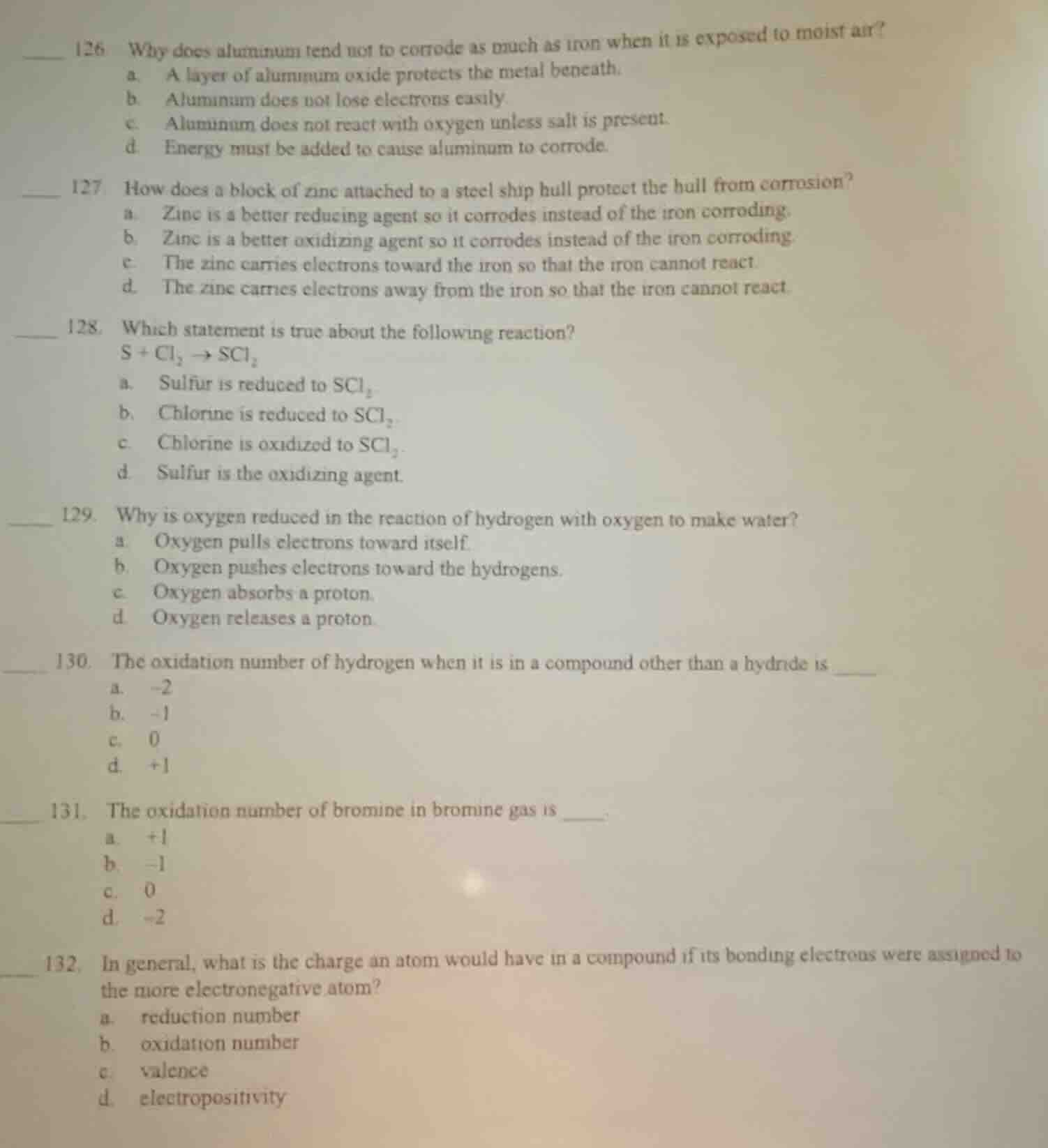
- why does aluminum tend not to corrode as much as iron when it is exposed to moist air?
a. a layer of aluminum oxide protects the metal beneath.
b. aluminum does not lose electrons easily.
c. aluminum does not react with oxygen unless salt is present.
d. energy must be added to cause aluminum to corrode.
- how does a block of zinc attached to a steel ship hull protect the hull from corrosion?
a. zinc is a better reducing agent so it corrodes instead of the iron corroding.
b. zinc is a better oxidizing agent so it corrodes instead of the iron corroding.
c. the zinc carries electrons toward the iron so that the iron cannot react.
d. the zinc carries electrons away from the iron so that the iron cannot react.
- which statement is true about the following reaction?
\\(\text{s} + \text{cl}_2 \
ightarrow \text{scl}_2\\)
a. sulfur is reduced to \\(\text{scl}_2\\).
b. chlorine is reduced to \\(\text{scl}_2\\).
c. chlorine is oxidized to \\(\text{scl}_2\\).
d. sulfur is the oxidizing agent.
- why is oxygen reduced in the reaction of hydrogen with oxygen to make water?
a. oxygen pulls electrons toward itself.
b. oxygen pushes electrons toward the hydrogens.
c. oxygen absorbs a proton.
d. oxygen releases a proton.
- the oxidation number of hydrogen when it is in a compound other than a hydride is ______.
a. -2
b. -1
c. 0
d. +1
- the oxidation number of bromine in bromine gas is ______.
a. +1
b. -1
c. 0
d. -2
- in general, what is the charge an atom would have in a compound if its bonding electrons were assigned to the more electronegative atom?
a. reduction number
b. oxidation number
c. valence
d. electropositivity
Analyze aluminum corrosion prevention
Using the Electronegativity Trends knowledge point
Aluminum reacts rapidly with atmospheric oxygen to form a thin, tough, and highly adherent layer of aluminum oxide \(\text{Al}_2\text{O}_3\) on its surface. This process, known as passivation, seals the underlying metal from further contact with oxygen and moisture, preventing deep corrosion. Iron, on the other hand, forms a porous, flaky rust layer that easily peels off, exposing fresh metal to continuous corrosion. Thus, option (a) is correct.
Analyze sacrificial protection by zinc
Using the Redox Rules knowledge point
Zinc has a lower reduction potential (higher oxidation potential) than iron, meaning it is more easily oxidized. When attached to a steel (iron) ship hull, zinc acts as a sacrificial anode. It is oxidized (corrodes) preferentially, supplying electrons to the iron hull to keep it reduced and protected. Therefore, zinc is a better reducing agent and corrodes instead of the iron, making option (a) correct.
Determine redox changes in sulfur-chlorine reaction
Using the Oxidation Numbers and Redox Rules knowledge points
In the reaction \(\text{S} + \text{Cl}_2
ightarrow \text{SCl}_2\), the reactants are in their elemental states with oxidation numbers of \(0\). In \(\text{SCl}_2\), chlorine is more electronegative than sulfur, so chlorine is assigned an oxidation state of \(-1\), and sulfur is \(+2\). Since chlorine's oxidation number decreases from \(0\) to \(-1\), chlorine is reduced. Sulfur's oxidation number increases from \(0\) to \(+2\), so sulfur is oxidized and acts as the reducing agent. Thus, option (b) is correct.
Explain oxygen reduction in water formation
Using the Electronegativity Trends and Redox Rules knowledge points
Oxygen is highly electronegative, second only to fluorine. In the reaction between hydrogen and oxygen to form water (\(2\text{H}_2 + \text{O}_2
ightarrow 2\text{H}_2\text{O}\)), oxygen strongly attracts the shared bonding electrons toward itself. This gain of electron density (or shift of electrons toward oxygen) constitutes reduction. Therefore, oxygen is reduced because it pulls electrons toward itself, making option (a) correct.
Determine oxidation states of hydrogen, bromine, and general definition
Using the Oxidation Numbers knowledge point
- For Question 130: According to standard rules, hydrogen has an oxidation state of \(+1\) in compounds with nonmetals (other than metal hydrides where it is \(-1\)). Thus, option (d) is correct.
- For Question 131: The oxidation number of any element in its pure, uncombined elemental form (such as diatomic bromine gas, \(\text{Br}_2\)) is always \(0\). Thus, option (c) is correct.
- For Question 132: By definition, the oxidation number (or oxidation state) represents the hypothetical charge an atom would carry if all shared bonding electrons were assigned completely to the more electronegative atom. Thus, option (b) is correct.

Snap & solve any problem in the app
Get step-by-step solutions on Sovi AI
Photo-based solutions with guided steps
Explore more problems and detailed explanations
Question 126
- a. A layer of aluminum oxide protects the metal beneath. (Correct answer)
- b. Aluminum does not lose electrons easily.
- c. Aluminum does not react with oxygen unless salt is present.
- d. Energy must be added to cause aluminum to corrode.
Question 127
- a. Zinc is a better reducing agent so it corrodes instead of the iron corroding. (Correct answer)
- b. Zinc is a better oxidizing agent so it corrodes instead of the iron corroding.
- c. The zinc carries electrons toward the iron so that the iron cannot react.
- d. The zinc carries electrons away from the iron so that the iron cannot react.
Question 128
- a. Sulfur is reduced to \(\text{SCl}_2\).
- b. Chlorine is reduced to \(\text{SCl}_2\). (Correct answer)
- c. Chlorine is oxidized to \(\text{SCl}_2\).
- d. Sulfur is the oxidizing agent.
Question 129
- a. Oxygen pulls electrons toward itself. (Correct answer)
- b. Oxygen pushes electrons toward the hydrogens.
- c. Oxygen absorbs a proton.
- d. Oxygen releases a proton.
Question 130
- a. \(-2\)
- b. \(-1\)
- c. \(0\)
- d. \(+1\) (Correct answer)
Question 131
- a. \(+1\)
- b. \(-1\)
- c. \(0\) (Correct answer)
- d. \(-2\)
Question 132
- a. reduction number
- b. oxidation number (Correct answer)
- c. valence
- d. electropositivity