Sovi.AI - AI Math Tutor

Scan to solve math questions

QUESTION IMAGE

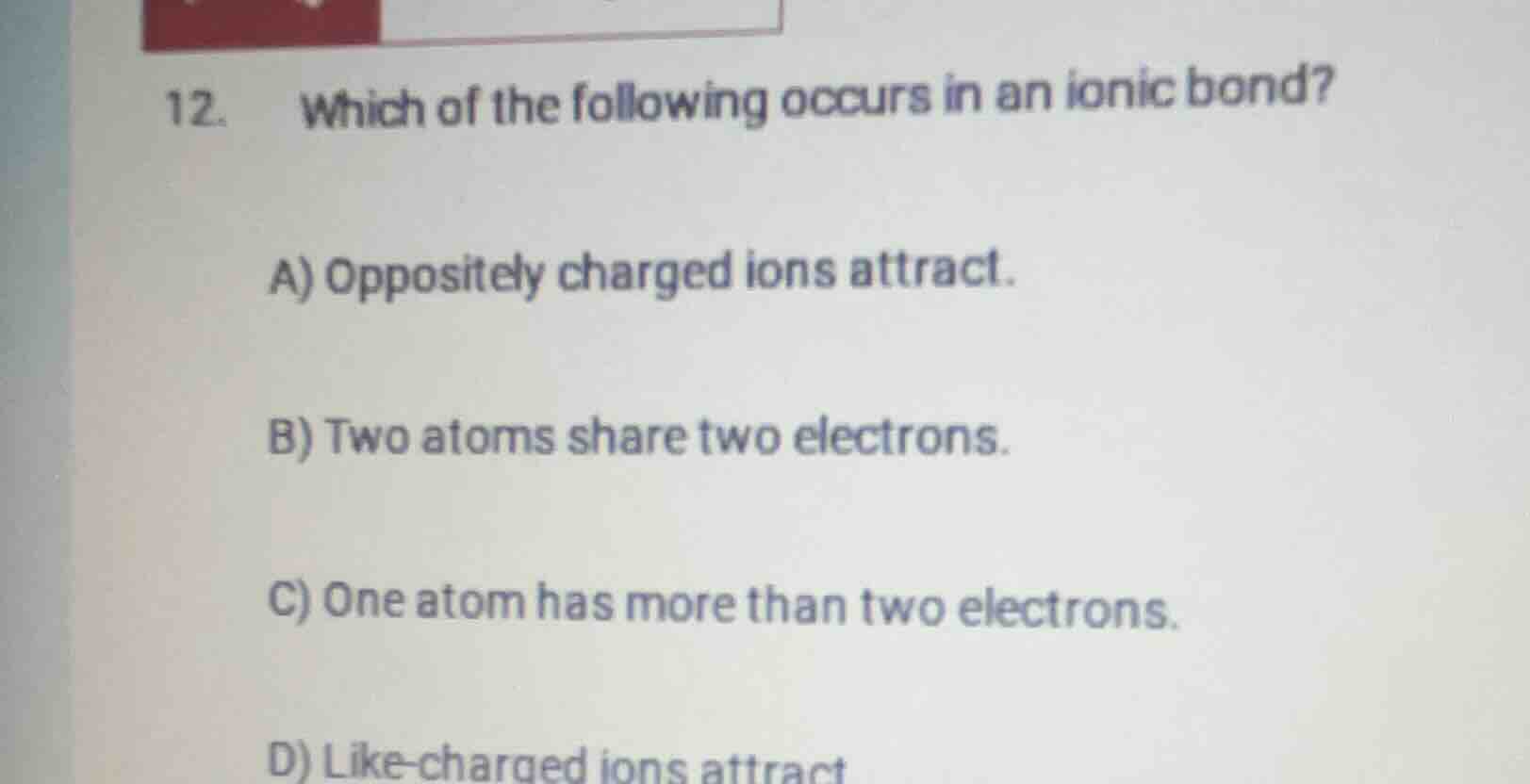
12. which of the following occurs in an ionic bond? a) oppositely charg…

Question

  1. which of the following occurs in an ionic bond?

a) oppositely charged ions attract.

b) two atoms share two electrons.

c) one atom has more than two electrons.

d) like-charged ions attract.

Explanation:

Response

<pre_analysis>
{
"quality": "clear",
"question_count": 1,
"skills_matched": [
"direct_cot",
"multiple_choice_formatter",
"explain_then_answer",
"quick"
],
"needs_drawing": false,
"concepts_used": [],
"new_concepts": [
"Ionic Bonding",
"Electrostatic Attraction"
],
"current_concepts": [
"Ionic Bonding",
"Chemical Bonds"
]
}
</pre_analysis>

<reasoning>

Define ionic bonding

An ionic bond is formed through the electrostatic attraction between oppositely charged ions (cations and anions) resulting from the transfer of electrons.

Evaluate the given options

  • A) Oppositely charged ions attract: This is the fundamental definition of electrostatic attraction in ionic bonding.
  • B) Two atoms share two electrons: This describes a single covalent bond.
  • C) One atom has more than two electrons: This is a general atomic property, not a defining feature of ionic bonding.
  • D) Like-charged ions attract: Like charges repel, they do not attract.

Select the correct option

Option A is correct.
</reasoning>

<answer>
<mcq-correct>A) Oppositely charged ions attract.</mcq-correct>
<mcq-option>B) Two atoms share two electrons.</mcq-option>
<mcq-option>C) One atom has more than two electrons.</mcq-option>
<mcq-option>D) Like-charged ions attract.</mcq-option>
</answer>

<post_analysis>
{
"subject": "Natural Science",
"question_type": "Multiple Choice",
"knowledge_point": [
"Natural Science",
"Chemistry",
"Ionic Bonding"
]
}
</post_analysis>

Answer:

<pre_analysis>
{
"quality": "clear",
"question_count": 1,
"skills_matched": [
"direct_cot",
"multiple_choice_formatter",
"explain_then_answer",
"quick"
],
"needs_drawing": false,
"concepts_used": [],
"new_concepts": [
"Ionic Bonding",
"Electrostatic Attraction"
],
"current_concepts": [
"Ionic Bonding",
"Chemical Bonds"
]
}
</pre_analysis>

<reasoning>

Define ionic bonding

An ionic bond is formed through the electrostatic attraction between oppositely charged ions (cations and anions) resulting from the transfer of electrons.

Evaluate the given options

  • A) Oppositely charged ions attract: This is the fundamental definition of electrostatic attraction in ionic bonding.
  • B) Two atoms share two electrons: This describes a single covalent bond.
  • C) One atom has more than two electrons: This is a general atomic property, not a defining feature of ionic bonding.
  • D) Like-charged ions attract: Like charges repel, they do not attract.

Select the correct option

Option A is correct.
</reasoning>

<answer>
<mcq-correct>A) Oppositely charged ions attract.</mcq-correct>
<mcq-option>B) Two atoms share two electrons.</mcq-option>
<mcq-option>C) One atom has more than two electrons.</mcq-option>
<mcq-option>D) Like-charged ions attract.</mcq-option>
</answer>

<post_analysis>
{
"subject": "Natural Science",
"question_type": "Multiple Choice",
"knowledge_point": [
"Natural Science",
"Chemistry",
"Ionic Bonding"
]
}
</post_analysis>