QUESTION IMAGE
Question
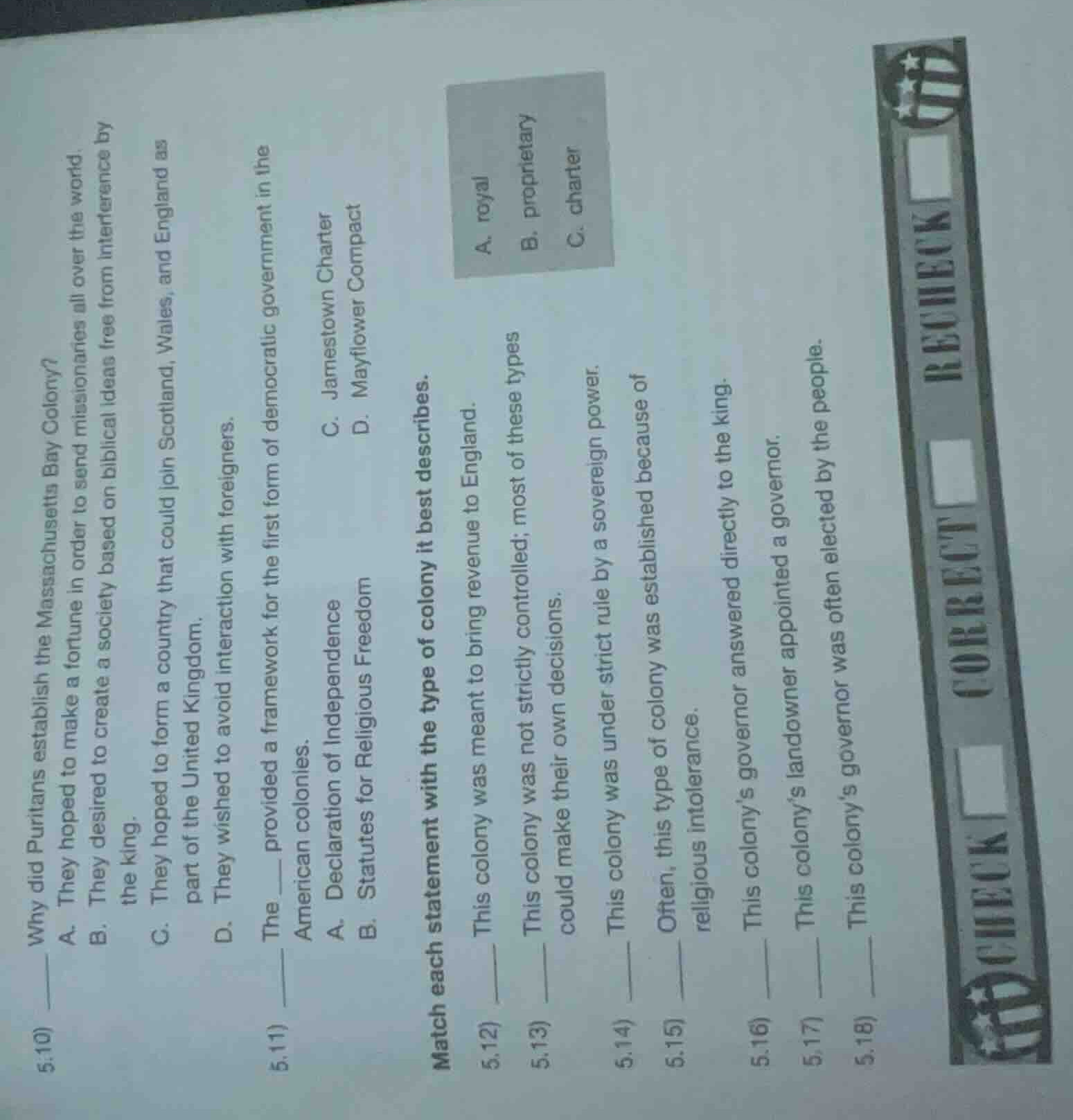
5.10) why did puritans establish the massachusetts bay colony?
a. they hoped to make a fortune in order to send missionaries all over the world.
b. they desired to create a society based on biblical ideas free from interference by the king.
c. they hoped to form a country that could join scotland, wales, and england as part of the united kingdom.
d. they wished to avoid interaction with foreigners.
5.11) the ______ provided a framework for the first form of democratic government in the american colonies.
a. declaration of independence
b. statutes for religious freedom
c. jamestown charter
d. mayflower compact
match each statement with the type of colony it best describes.
a. royal
b. proprietary
c. charter
5.12) ______ this colony was meant to bring revenue to england.
5.13) ______ this colony was not strictly controlled; most of these types could make their own decisions.
5.14) ______ this colony was under strict rule by a sovereign power.
5.15) ______ often, this type of colony was established because of religious intolerance.
5.16) ______ this colonys governor answered directly to the king.
5.17) ______ this colonys landowner appointed a governor.
5.18) ______ this colonys governor was often elected by the people.
Analyze Puritan motivations for Massachusetts Bay Colony
The Puritans sought to escape religious persecution in England and establish a society modeled strictly on their biblical interpretations, free from royal and Anglican interference. This aligns with option B.
Identify the early democratic framework
The Mayflower Compact, signed in 1620, established a self-governing agreement and provided the first framework for democratic government in the American colonies. This aligns with option D.
Match colonial descriptions to types of colonies
- 5.12: Joint-stock or charter colonies were often commercial enterprises meant to bring revenue. Thus, charter (C) fits.
- 5.13: Charter colonies (C) enjoyed the most self-governance and were not strictly controlled.
- 5.14: Royal colonies (A) were under direct, strict rule by the king (sovereign power).
- 5.15: Massachusetts Bay, a charter colony (C), was established by Puritans fleeing religious intolerance.
- 5.16: In a royal colony (A), the governor was appointed by and answered directly to the king.
- 5.17: In a proprietary colony (B), the territory was granted to a landowner (proprietor) who appointed the governor.
- 5.18: In charter colonies (C), governors were often elected by the colonists/people.

Snap & solve any problem in the app
Get step-by-step solutions on Sovi AI
Photo-based solutions with guided steps
Explore more problems and detailed explanations
Question 5.10
- (A) They hoped to make a fortune in order to send missionaries all over the world.
- (B) They desired to create a society based on biblical ideas free from interference by the king. (Correct answer)
- (C) They hoped to form a country that could join Scotland, Wales, and England as part of the United Kingdom.
- (D) They wished to avoid interaction with foreigners.
Question 5.11
- (A) Declaration of Independence
- (B) Statutes for Religious Freedom
- (C) Jamestown Charter
- (D) Mayflower Compact (Correct answer)
Question 5.12
This colony was meant to bring revenue to England.
<blank>C. charter</blank>
Question 5.13
This colony was not strictly controlled; most of these types could make their own decisions.
<blank>C. charter</blank>
Question 5.14
This colony was under strict rule by a sovereign power.
<blank>A. royal</blank>
Question 5.15
Often, this type of colony was established because of religious intolerance.
<blank>C. charter</blank>
Question 5.16
This colony's governor answered directly to the king.
<blank>A. royal</blank>
Question 5.17
This colony's landowner appointed a governor.
<blank>B. proprietary</blank>
Question 5.18
This colony's governor was often elected by the people.
<blank>C. charter</blank>